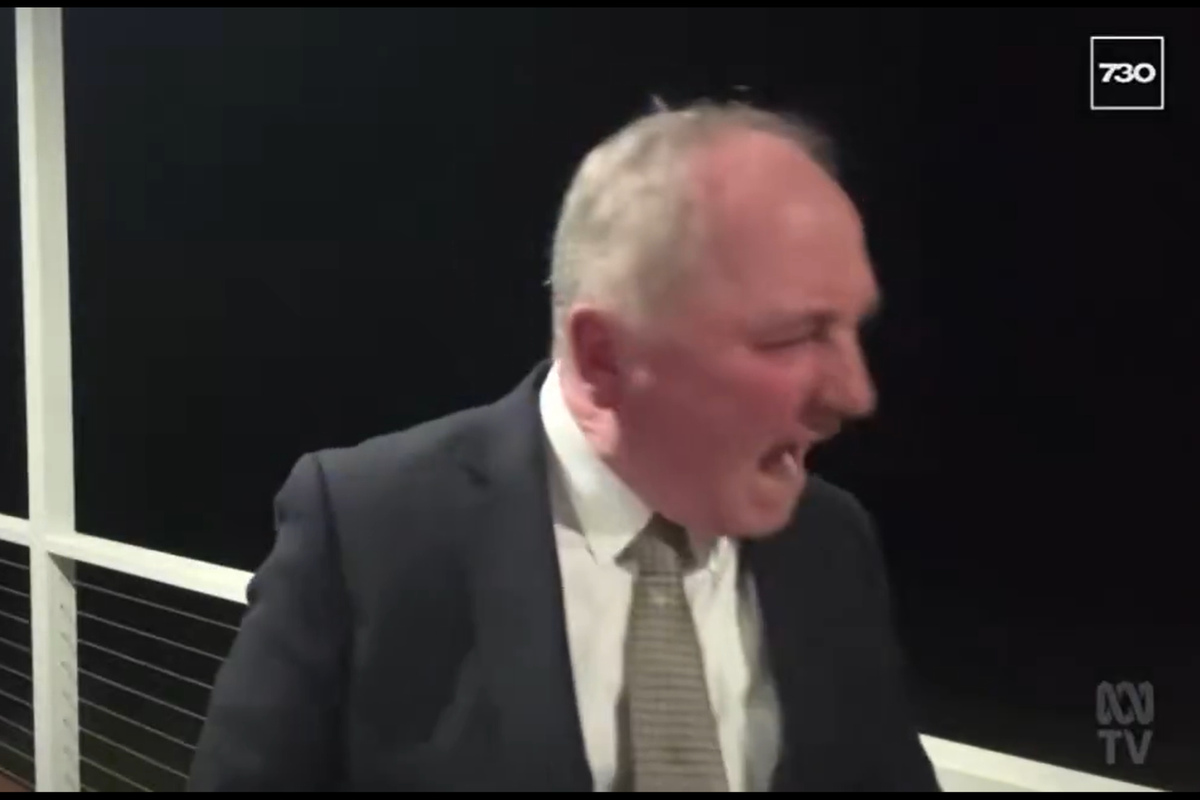
High-stakes media appearances present an asymmetric risk profile for public figures. While a successful interview yields marginal reputation gains, a single acute loss of composure creates compounded, multi-platform brand damage. When former Australian Deputy Prime Minister Barnaby Joyce interrupted a live broadcast on the ABC's 7.30 to aggressively command a dog to "sit down," the incident served as a textbook case study in narrative deflection collapse, dynamic escalation, and institutional crisis management.
An analytical breakdown of the interaction reveals how physical environment, emotional friction under questioning, and psychological displacement converge to destroy message discipline during live media cycles.
The Operational Mechanics of the Outburst
The incident occurred during a remote cross-country interview where the subject was positioned on an open, uncontrolled exterior setting (a deck at a private residence near Tamworth). Selecting an unmanaged environment introduces exogenous operational hazards—ranging from ambient noise to animal interference—that elevate a speaker's cognitive load.
[Exogenous Distraction] ──► [Elevated Cognitive Load] ──► [Displacement Event (Dog)]
                                       │
[Aggressive Host Interrogation] ───────┴─────────────────► [Aggressive Host Deflection]
Under host Sarah Ferguson’s cross-examination regarding One Nation's political platform and far-right alliances, the speaker faced high verbal pressure. The sequence unfolded across three distinct structural phases:
- Cognitive Overload and Task Switching Failure: When pressed on ideological inconsistencies, the subject’s gaze shifted off-camera. Lacking an immediate counter-argument to the host's framing, the brain attempted to process the off-camera movement of a domestic animal, triggering a sudden breach of vocal control ("SIT DOWN!").
- Failed Post-Hoc Normalization: Immediately following the outburst, the subject attempted laughter to reframe the command as a lighthearted environmental correction ("Sorry, it's the dog"). This strategy failed because the acoustic severity of the command did not match the minor nature of the distraction.
- Secondary Displacement and Escalation: When the host instructed the subject to ignore the animal and answer the core question, the subject executed a hostility shift, redirecting defensive anger from the off-camera stimulus toward the interviewer ("Don't be rude. Otherwise, this interview will come to a grinding halt, Sarah").
The Asymmetric Impact of Domestic Animal Dynamics
In modern political communication, audience perception operates on social empathy frameworks. The psychological reaction to a public figure's behavior varies depending on the target of their hostility:
| Interlocutor / Target | Expected Public Tolerances | Perceived Intent | Damage Multiplier |
|---|---|---|---|
| Journalist / Host | Moderate to High | Adversarial Debate | 1.0x (Standard Political Friction) |
| Political Opponent | High | Campaign Friction | 0.8x (Expected Behavior) |
| Unseen Domestic Animal | Near Zero | Unchecked Dominance / Anger Control Loss | 4.5x (Reputational Crisis) |
The escalation violated basic parasocial rules. Confronting a tough journalist aligns with an aggressive politician's brand narrative, but directing harsh commands at a domestic pet signals a lack of emotional self-regulation. The host's concluding remark—that "the dog was no problem"—crystallized the audience's perception that the issue lay entirely within the speaker's temperament, not the environment.
Strategic Flaws in Live Remote Broadcast Execution
Remote live broadcasts require strict environmental controls to eliminate variables that could undermine message delivery. The failure in this instance stemmed from four operational errors:
- Uncontrolled Broadcast Footprint: Broadcasting from an open exterior deck allows non-human variables to enter the frame or audio feed. Professional media strategies dictate isolated indoor environments with zero ambient movement.
- Physical Deflection Failure: When an off-camera disturbance occurs, seasoned media operators maintain eye contact with the camera lens, visually ignoring the distraction while verbally requesting a short pause if necessary. Looking off-camera to directly engage a minor distraction breaks broadcast continuity and exposes visual distress.
- Threat-Based Escalation: Threatening to terminate an interview ("this interview will come to a grinding halt") hands immediate psychological control to the host. It confirms that the line of questioning has breached the interviewee's strategic defense, validating the interviewer's stance.
- Fixation on the Distraction: Returning to the minor interruption multiple times during subsequent questions signals persistent cognitive disruption.
To minimize reputation risks during high-intensity media campaigns, political strategists must enforce strict studio-environment isolation protocols for remote interviews. Operational guidelines require placing all domestic animals in secured indoor quarters prior to going live, establishing a zero-tolerance policy against off-camera eye diversion, and training spokespeople to treat environmental distractions as non-existent background noise rather than engaging them directly.