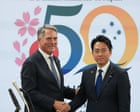
Every desk in Canberra and Tokyo is currently drowning in hand-wringing over a piece of fruit.
If you read the mainstream press coverage about Japan’s defense minister touching down to meet Richard Marles, you would think bilateral security hinges on diplomatic etiquette regarding agricultural quarantine infractions. The media calls it the melon-gate controversy. They obsess over customs declarations, protocol breaches, and whether a stray piece of luggage has permanently ruptured trust between the Japan Self-Defense Forces and the Australian Department of Defence. Recently making news in this space: Whispers on the Gulf and the Ghost Pilots of Doha.
It is kindergarten geopolitics.
While commentators hyperventilate over a bureaucratic slip-up involving a snack, the actual machinery of regional deterrence is shifting at breakneck speed. I have spent the last decade sitting in backroom defense roundtables across the region. I have watched defense budgets balloon while procurement officers trip over their own red tape. The obsession with a customs incident is a convenient smoke screen for institutional failure. It lets bureaucrats pretend that geopolitical alignment is about polite paperwork rather than hard capability. Additional insights on this are detailed by TIME.
Forget the tabloid headlines. The real story is that Australia and Japan are hastily stitching together a quasi-alliance because the United States security umbrella is looking increasingly frayed, and neither Canberra nor Tokyo has the industrial base to survive a prolonged friction scenario alone.
The Myth of Bilateral Harmony
The standard narrative paints the Australia-Japan security partnership as a natural, frictionless evolution of shared democratic values. That is pure fiction.
Let us look at the structural reality. Japan's post-war pacifist constraints are not just legal hurdles; they are deeply ingrained industrial bottlenecks. When Tokyo dispatches its defense leadership to talk interoperability with Canberra, they are not comparing notes on regional stability out of sheer goodwill. They are desperately trying to figure out how to maintain maritime supply chains when their primary security guarantor is increasingly distracted by domestic political paralysis and polarization.
The lazy consensus in international relations circles says that joint exercises like Exercise Bushmaster or reciprocal access agreements solve everything. They do not. Joint exercises are expensive photo opportunities unless they plug the terrifying gaps in munitions stockpiles and joint maintenance pipelines.
I watched a major defense contractor burn fifty million dollars trying to integrate Japanese naval architecture with Australian logistical support chains two years ago. The problem was not cultural misunderstanding or customs forms. The problem was that the bureaucratic architectures of both nations were built for the Cold War, not for contested logistics in the South China Sea.
Why the Regional Power Balance is Misunderstood
People ask why defense ministers are wasting political capital on high-profile visits when structural supply chain vulnerabilities remain unaddressed. The premise of the question is already flawed. They are not wasting capital; they are performing diplomacy because actual hard-power integration is too politically toxic to discuss openly.
Let us define terms. Interoperability is not shaking hands on an airfield tarmac. Interoperability means a Japanese submarine can dock at HMAS Stirling in Western Australia, pull into a dry dock, and receive immediate, standardized maintenance using identical parts and cleared technicians without a six-month waiver process. We are nowhere near that reality.
Instead, we get ministerial summits overshadowed by petty controversies about what someone packed in their carry-on. It is a distraction engineered to comfort a public that is entirely unprepared for the economic shockwaves of actual regional deterrence.
If you want to understand where defense spending is actually heading, ignore the joint communiques about shared values and open Indo-Pacific spaces. Look at steel production, rare earth processing agreements, and heavy manufacturing output. Japan manufactures exquisite, highly bespoke military hardware that takes years to build. Australia digs things out of the ground and ships them raw to nations that actually process them.
That is not a complementary defense partnership. That is a raw-material supplier desperately trying to buy insurance from a high-tech manufacturer that is legally barred from exporting offensive punch.
The Uncomfortable Truth About AUKUS and the Quad
We need to talk about the elephant in the room. The Quad and AUKUS are overlapping alphabets of anxiety.
Australia signed up for AUKUS because political leaders panicked about losing naval dominance in the northern approaches. But look at the math. Submarines that will not arrive until the late 2030s do nothing to solve the immediate deterrence deficit in 2026. Meanwhile, Japan is quietly pivoting its entire national security strategy under the National Security Strategy revisions, doubling its defense budget to two percent of GDP, and acquiring counter-strike capabilities that would have been unthinkable a decade ago.
Tokyo does not need Canberra's tactical advice. Tokyo needs Australia's real estate, energy security, and strategic depth. And Canberra needs Tokyo's technological prowess and industrial manufacturing weight to avoid becoming an isolated southern fortress.
Yet, the media focuses on a melon.
Why? Because systemic failure is terrifying, but a bureaucratic scandal is easy to digest. It gives everyone a villain, a punchline, and a quick resolution before the evening news ends.
What Actually Needs to Happen
If policymakers want to stop playing theater and start building real deterrence, they need to abandon three comforting illusions:
First, stop pretending that diplomatic friction is caused by cultural gaffes. Friction is caused by misaligned strategic priorities. Australia views the Indo-Pacific primarily through the lens of resource security and Southeast Asian stability. Japan views it through the existential lens of maritime encirclement and energy choke points in the East China Sea. Those are different planets.
Second, purge the defense procurement process of bureaucratic gatekeeping. When Japanese and Australian defense officials meet, they should be cutting red tape on dual-use technology sharing, not negotiating trade protocols for agricultural products.
Third, accept that the American security guarantee is an eroding asset. Planning your national survival around the assumption that the US Seventh Fleet will permanently underwrite regional security without political conditionality is operational negligence.
The melon-gate distraction is a symptom of a deeper malaise. It is the sound of institutions playing smallball while the geopolitical architecture burns around them. Stop reading the transcripts of press conferences. Watch the dockyards, the supply chains, and the quiet movement of heavy industry. That is where the future of the region is actually being decided.
Let the bureaucrats worry about the fruit. The rest of us need to wake up.


