Western media loves a good Cold War echo chamber.
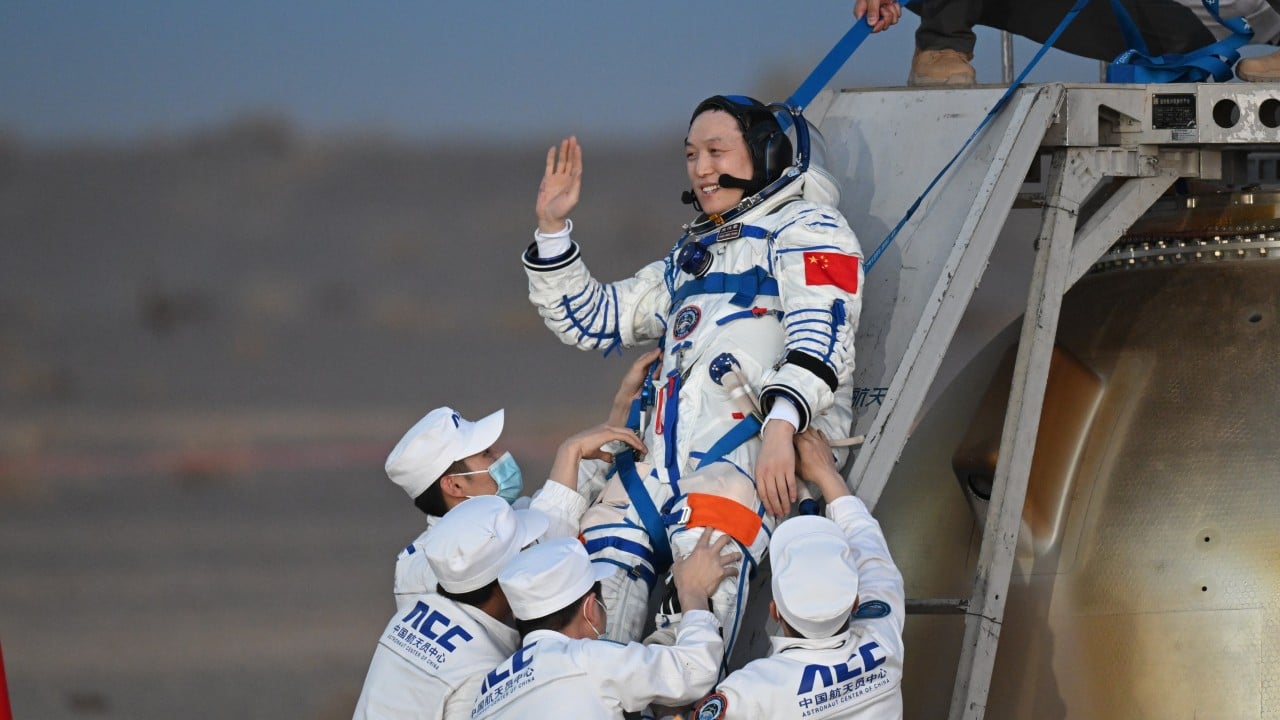
When the latest Chinese crewed spacecraft touches down safely in the Dongfeng landing site in Inner Mongolia, the headlines practically write themselves. They obsess over the geography. They scream about how Beijing is dropping its space heroes into a "former top-secret Soviet-era nuclear missile test site." They frame it as a calculated, aggressive flexing of military might—a deliberate, sinister message sent straight to Washington.
It is a great narrative. It is also completely economically and logistically illiterate.
As someone who has spent two decades tracking orbital mechanics, launch infrastructure, and the brutal realities of aerospace supply chains, watching these mainstream defense analysts lose their minds over a patch of dirt is exhausting. They are hunting for geopolitical ghosts in a story that is actually about cold, hard, unsexy math.
China isn't landing astronauts in the Gobi Desert to scare the Pentagon. They are doing it because the physics of orbital return trajectories demand it, and because reusing old military infrastructure is the cheapest way to run a space program.
The media is asking the wrong question. They are asking, "What dark military signal is Beijing sending?"
The real question we should be asking is: "Why is the West still surprised that a state-run space program behaves exactly like a state-run space program?"
The Geography Myth and the Tyranny of Orbit
Let’s dismantle the "secret nuclear site" hysteria immediately.
To the uninitiated, landing a capsule near the Jiuquan Satellite Launch Center—specifically the Dongfeng landing site—looks like a provocative choice. This area was indeed tied to China's early ballistic missile program. But international space analysts who treat this like a fresh revelation are ignoring how geography dictates orbital mechanics.
When a spacecraft returns from a low Earth orbit with an inclination of around 41.5 degrees—which is where the Tiangong space station lives—your options for a safe ground track touchdown are severely limited. You need thousands of square kilometers of flat, unpopulated, predictable terrain that aligns with the spacecraft's descending orbital path.
Look at the options:
- The Ocean: Splashing down requires a massive, incredibly expensive standing navy with constant helicopter and medical coverage spread across vast swaths of the Pacific. It ruins capsules with saltwater corrosion.
- Densely Populated Plains: Trying to land a multi-ton capsule hanging under a parachute near major agricultural or urban hubs in eastern China is a recipe for a civilian mass-casualty event.
- The Gobi Desert: It is flat. It is empty. It is under absolute government control.
Every major spacefaring nation does exactly this. The United States landed the Space Shuttle at Edwards Air Force Base in the Mojave Desert, a sprawling military flight test center. The Soviet Union, and now Russia, has dropped every single Soyuz cosmonaut into the desolate steppes of Kazakhstan, near the Baikonur Cosmodrome—a region littered with the debris of early Soviet ICBM tests.
Calling Dongfeng a "nuclear missile site" instead of "the closest flat, empty desert to the primary tracking and telemetry stations" is sensationalism masquerading as defense analysis. It’s the equivalent of panicking because NASA lands an aircraft at a base that once housed nuclear bombers during the Cuban Missile Crisis. It isn't a threat; it's a parking lot.
The Efficiency Trap: Why Bureaucracies Reuse Dust
Mainstream reporting assumes every move by a competitor is part of a grand, hyper-optimized master plan. It assumes that choosing Dongfeng over the older Siziwang Banner landing site was a strategic geopolitical pivot.
The reality? It’s budget management and logistics.
I have seen organizations waste tens of millions of dollars trying to build pristine, brand-new facilities just to appease a public relations department that wanted a clean narrative. Clever managers don't do that. They look at existing, depreciated assets and find a way to squeeze more life out of them.
+-------------------------+-------------------------+-------------------------+
| Feature                 | Siziwang Banner (Old)   | Dongfeng (Current)      |
+-------------------------+-------------------------+-------------------------+
| Proximity to Launch Hub | Farther away            | Immediate adjacency     |
| Existing Radar/Tracking | Required mobile setups  | Deeply integrated       |
| Logistics Overhead      | High transport costs    | Low, utilizes Jiuquan   |
| Terrain Predictability  | Varied agriculture/mud  | Consistent desert floor |
+-------------------------+-------------------------+-------------------------+
Dongfeng is directly adjacent to the Jiuquan Satellite Launch Center. By shifting the primary landing zone here, China's space agency cut out the logistical nightmare of transporting search-and-rescue teams, medical helicopters, heavy recovery vehicles, and tracking arrays hundreds of miles across provinces. They consolidated their entire recovery apparatus under the umbrella of an existing, fully staffed military-industrial hub.
Is there a downside to this approach? Absolutely. It means your recovery teams are operating in a brutal environment with extreme temperature swings and blinding dust storms that can ground recovery helicopters in minutes. If a capsule off-shoots its target during re-entry, searching the desert floor during a Gobi sandstorm is a nightmare. But from a cost-per-seat perspective, the consolidation makes total sense. It is corporate belt-tightening on a national scale.
Dismantling the Prevalent Consensus
If you look at online forums and defense blogs, the questions being asked reflect a profound misunderstanding of space operations. Let's address the most common misconceptions head-on.
"Does landing in an old nuclear test site mean the astronauts are exposed to radiation?"
This is a classic example of a flawed premise. The Dongfeng landing site is part of the broader Jiuquan region, which was involved in missile testing, but it is not a radioactive crater. China’s actual atmospheric and underground nuclear detonations were carried out at Lop Nur, hundreds of miles to the west. The astronauts face far more radiation risk from their six-month stay in low Earth orbit—exposed to galactic cosmic rays and solar particles—than they ever will from sitting on the dirt in Inner Mongolia for two hours waiting for the hatch to open.
"Isn't the integration of civilian space operations and military sites proof of an aggressive space program?"
This question assumes that a pure, entirely civilian space program has ever existed. It hasn't. Not in the East, and certainly not in the West.
NASA’s early astronauts were exclusively military test pilots. The agency relied entirely on Redstone and Atlas missiles—built to carry nuclear warheads—to get Americans into orbit. Today, Western military infrastructure still tracks civilian space debris, provides GPS timing signals, and launches payloads from Cape Canaveral Space Force Station. The line between civilian exploration and national defense infrastructure is a legal fiction. China simply doesn't bother maintaining the illusion.
The Real Threat is Not the Dirt, It’s the Cadence
By focusing on the spooky history of the landing site, Western analysts are blinding themselves to the metric that actually matters: operational cadence.
While commentators write long-form essays about the symbolism of the Gobi Desert, China is quietly executed a flawless, assembly-line rotation of crewed missions. They launch three astronauts, swap them out on the Tiangong station, land the previous three, and prep the next rocket within a highly predictable, repeatable schedule.
That level of operational consistency requires a lack of drama. It requires using the same landing site, the same tracking dishes, the same recovery vehicles, and the same procedures over and over again. The fact that the landing was boring, routine, and took place in a barren desert they have controlled for sixty years should terrify competitors far more than a flashy, expensive new asset ever could.
Stop looking for hidden messages in the sand. The Chinese space program isn't trying to send a message with where they land. They are trying to build a cheap, reliable, repeating orbital pipeline. And as long as the West treats basic orbital logistics as a terrifying psychological operation, it will keep missing the real race.


