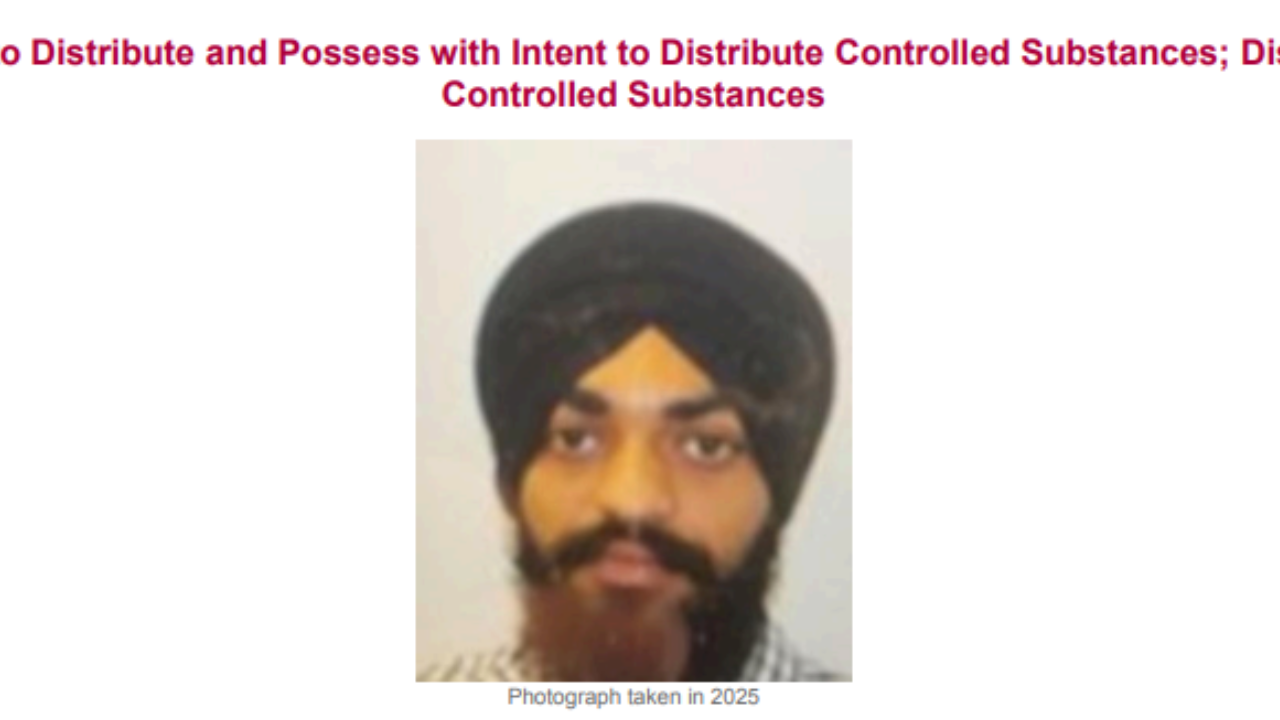
Transnational criminal enterprises operate under decentralized architectures that mirror modern supply chain management, transforming localized illicit groups into globally distributed syndicates. The recent federal indictment and inclusion of Indian national Gurpreet Singh on the Federal Bureau of Investigation most wanted list, tied to the Jaggu Bhagwanpuria Organized Crime Group, illustrates the operational evolution of gangs originating in Punjab into North American markets. Rather than viewing this development as an isolated law enforcement event, it requires a structural examination of how regional crime syndicates scale cross-border logistics, merge drug distribution networks with illicit arms trading, and exploit jurisdictional seams to maximize profitability.
The Operational Blueprint of Transnational Gang Networks
Traditional enforcement models historically categorized criminal organizations as hierarchical, localized cartels. Modern syndicates like the Bhagwanpuria network function instead as modular franchises. The architecture relies on three distinct operational layers: domestic command nodes, diaspora logistics facilitators, and street-level distribution cells. For a different view, see: this related article.
The domestic command nodes maintain roots in regions like Punjab, retaining authority through digital communication channels while managing local extortion, protection rackets, and localized capital extraction. The middle tier consists of diaspora facilitators embedded within commercial hubs in countries like the United States, Canada, and various European jurisdictions. This tier does not typically handle raw contraband; rather, it coordinates financial layering, procurement, and asset movement. The final layer comprises localized distribution cells responsible for last-mile delivery, cash collection, and localized enforcement.
When federal prosecutors issue warrants under Racketeer Influenced and Corrupt Organizations statutes or conspiracy statutes—as seen in the Central District of California—they are targeting the structural glue holding these three layers together. The inclusion of charges involving both controlled substances and unlicensed firearms reveals a classic diversification strategy. Cartels do not rely on a single revenue vector. Instead, they bundle complementary illicit goods to maximize the throughput of their established logistics channels. Related reporting on the subject has been published by BBC News.
The Logistics Vector and Border Arbitrage
The movement of illicit narcotics and firearms across international boundaries depends on arbitrage—exploiting the friction points between different national security apparatuses. Law enforcement agencies face distinct legal and territorial constraints, while criminal syndicates operate with frictionless mobility.
[Origin: Punjab Region]
       │
       ▼ (Digital Command & Financial Layering)
[Transit Hubs: North American Ports / Commercial Freight]
       │
       ▼ (Last-Mile Distribution)
[Target Market: Central District of California & Elsewhere]
To understand how a regional outfit scales into California and other Western jurisdictions, one must examine the economics of contraband transport. Commercial shipping lanes, containerized freight, and diaspora-linked transportation networks offer high-volume camouflage. When syndicates integrate illegal arms trading with drug distribution, they leverage the same couriers, secure drop locations, and encrypted communication protocols for multiple revenue streams. This dual-track model reduces overhead costs and increases the resilience of the network. If enforcement agencies disrupt one commodity flow, the infrastructure remains intact via the alternative vector.
The Financial Architecture of Globalized Extortion and Racketeering
Revenue generation in transnational networks requires efficient capital laundering mechanisms. Extortion proceeds collected in local jurisdictions are rarely held in cash; they are rapidly converted through informal value transfer systems, cryptocurrency networks, or trade-based money laundering schemes.
The integration of racketeering conspiracy charges indicates that these networks function as pseudo-corporate entities. They enforce internal discipline, manage territorial monopolies, and reinvest capital into expanding operational reach. The cost function for law enforcement involves dismantling not merely the individual actors named in federal warrants, but the underlying liquidity networks that allow fugitive members to sustain operations across multiple continents.
Systemic Vulnerabilities in Cross-Border Containment
Efforts to suppress these networks encounter structural bottlenecks. Information asymmetry between local law enforcement in South Asia and federal agencies in North America often creates latency in intelligence sharing. While agencies adapt by establishing joint task forces and cross-border operations, the decentralized nature of modular crime syndicates allows them to reconstitute leadership faster than judicial systems can secure extraditions or convictions.
The progression of investigations from local police reports to federal indictments demonstrates a shifting threshold where regional criminality transitions into a matter of national security. As intelligence apparatuses refine their tracking of transnational financial flows and communication nodes, the operational runway for distributed criminal syndicates narrows, forcing them to rely on deeper integration within legitimate economic structures to survive.
Operation Hardball Global Crime Crackdown
This video provides additional context on the international scope of the law enforcement crackdown targeting transnational criminal networks connected to Punjab-based syndicates.