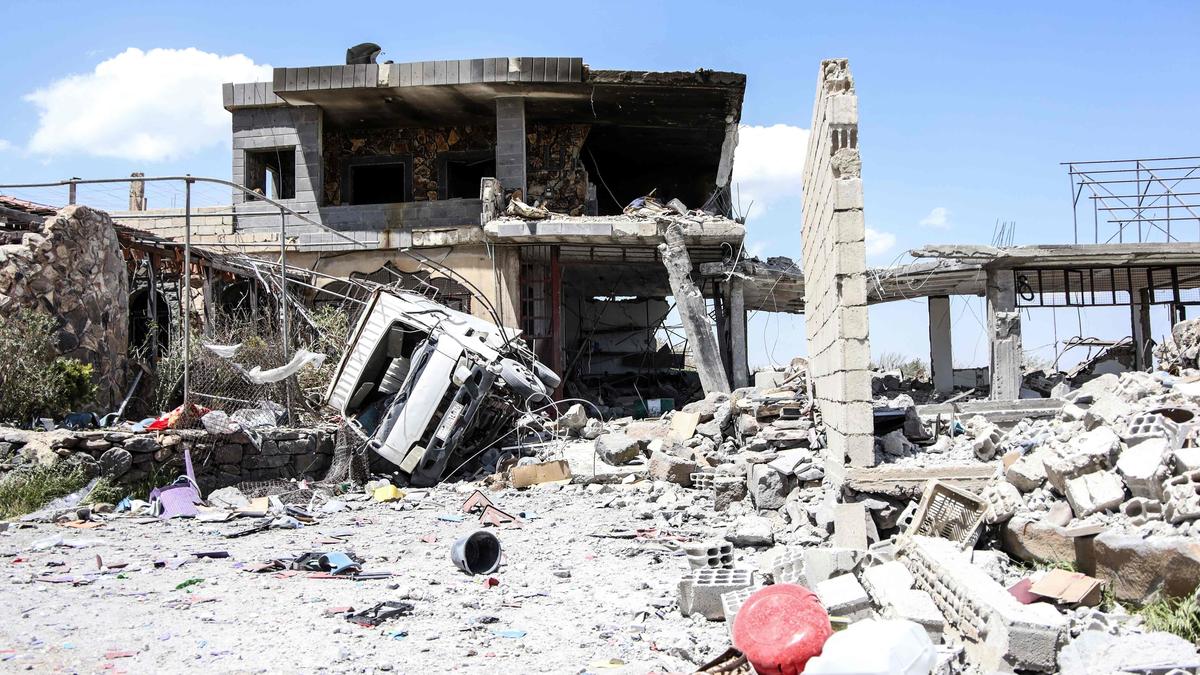
The destruction of civilian infrastructure in a conflict zone is rarely an isolated act of aggression; it is a calculated execution of a strategic objective. Amnesty International’s recent demand for a war crimes investigation into the demolition of homes in southern Syria by Israeli forces highlights a collision between operational security logic and the rigid boundaries of the Fourth Geneva Convention. To analyze the validity of these allegations, one must deconstruct the military necessity of "buffer zone" creation against the legal threshold of "wanton destruction."
The Strategic Architecture of the Buffer Zone
Military operations that involve the leveling of residential areas are typically driven by the Denial of Cover principle. In the context of southern Syria, the Israeli Defense Forces (IDF) operate under a defensive doctrine aimed at neutralizing the "Grey Zone"—the space between formal military lines and civilian habitations where non-state actors can integrate into the topography.
The logic of systematic demolition follows a three-stage sequence:
- Visibility Optimization: Removing vertical structures to establish clear lines of sight (LOS) for automated and manned surveillance systems.
- Infiltration Hardening: Eliminating subterranean access points (tunnels) and storage sites that are often co-located with residential basements.
- Transit Interdiction: Destroying road networks and peripheral structures to funnel movement into controllable corridors.
This operational framework creates a paradox. While the military views these actions as preventative measures to stop cross-border incursions, International Humanitarian Law (IHL) views them through the lens of Proportionality and Necessity. Under Article 53 of the Fourth Geneva Convention, any destruction by the Occupying Power of real or personal property is prohibited, "except where such destruction is rendered absolutely necessary by military operations."
The Legal Threshold of Absolute Necessity
The term "absolutely necessary" is the pivot point upon which a war crimes investigation turns. From a data-driven perspective, the analyst must distinguish between two types of structural removal:
Kinetic Necessity
Destruction occurring during active engagement to neutralize a direct threat. If a sniper is firing from a specific window, the destruction of that structure is generally recognized as a tactical necessity.
Strategic Engineering
Large-scale, pre-meditated demolition of entire blocks to facilitate future security. This is where the legal risk intensifies. If the threat is hypothetical or preventative rather than imminent, the "absolute" qualifier in Article 53 is rarely met.
Amnesty’s report posits that the scale of the destruction in southern Syrian villages suggests a policy of Permanent Topographical Alteration. When demolition moves from targeting specific combatant-occupied buildings to clearing entire residential perimeters, it shifts from tactical defense to prohibited collective punishment or the illegal creation of a "no-go" zone.
Quantifying Displacement and Resource Depletion
The impact of home destruction extends beyond the immediate loss of shelter; it triggers a Systemic Failure Cascade in the local economy and social fabric.
- Asset Liquidation: For rural Syrian populations, home ownership represents the primary store of generational wealth. Demolition is a 100% loss of capital that cannot be recovered in a war-torn economy.
- Infrastructure Interdependency: Housing is rarely isolated. The destruction of a home typically compromises shared water cisterns, electrical grids, and sewage systems, rendering the entire region uninhabitable for those whose homes remain standing.
- The Displacement Multiplier: Every home destroyed forces a family into the internal displacement cycle. This increases the burden on international aid agencies and creates "displacement sinks"—overcrowded areas that become flashpoints for disease and secondary conflict.
The cost function of these demolitions is not measured in bricks and mortar, but in the permanent removal of the civilian population from the border region. This leads to the "Carthaginian Solution" to security: creating a desert and calling it peace.
The Role of Satellite Imagery as Forensic Evidence
In modern conflict analysis, the "Fog of War" is increasingly pierced by high-resolution geospatial intelligence (GEOINT). Analysts use a technique called Change Detection Mapping to quantify destruction.
- Temporal Stacking: Comparing images from T-minus (pre-operation) to T-plus (post-operation).
- Blast Pattern Analysis: Distinguishing between damage caused by airstrikes (downward kinetic force) and controlled demolitions (internalized explosive charges).
- Systematicity Index: Calculating the geometric precision of the destruction. If the debris patterns are uniform and follow a grid, it indicates a deliberate engineering project rather than the chaotic results of a firefight.
Amnesty’s reliance on these data points shifts the conversation from anecdotal "eye-witness" accounts to empirical proof of intent. If 80% of a village is leveled following the cessation of active combat, the argument for "active military necessity" collapses.
Command Responsibility and the Chain of Intent
For an investigation to move from a human rights report to a legal prosecution, it must establish Mens Rea (guilty mind) at the command level. The destruction of homes on a mass scale requires logistics: heavy machinery (D9 bulldozers), engineering corps, and significant quantities of explosives.
This level of resource allocation implies a deliberate policy decision rather than a field-level error. The inquiry must determine if the orders given by the IDF Northern Command prioritized the creation of a sterile zone over the protection of civilian property. Under the Rome Statute, "extensive destruction and appropriation of property, not justified by military necessity and carried out unlawfully and wantonly," constitutes a grave breach of the Geneva Conventions.
The Geopolitical Fallout of Topographical Warfare
The use of demolition as a security tool carries significant second-order effects on regional stability.
- Normalization of scorched-earth tactics: If one actor successfully uses mass demolition to secure a border without international repercussion, it sets a precedent for other regional conflicts (e.g., the Turkish-Syrian border or the Saudi-Yemeni border).
- Radicalization Feedback Loops: The total loss of property and heritage is a primary driver of insurgent recruitment. By destroying the "Grey Zone" to improve visibility, the military may be inadvertently fueling the very asymmetrical threats it seeks to neutralize.
- Erosion of International Norms: The consistent bypassing of IHL by Western-aligned states weakens the ability of the international community to hold other actors accountable for similar violations.
Structural Recommendations for Accountability
The path forward requires a transition from rhetorical condemnation to institutionalized transparency.
- Independent Forensic Audit: Neutral third-party observers (such as the UN Mine Action Service) should be granted access to conduct post-demolition assessments to determine the presence of military infrastructure (tunnels, weapon caches) that would justify the destruction.
- The Documentation of Specificity: Military actors must be required to provide a specific justification for each structure destroyed, rather than applying a "blanket security" rationale to an entire geographic area.
- Restitution Frameworks: In cases where destruction is found to be "non-absolute," a mechanism for state-level reparations must be established to compensate civilian owners, thereby creating a financial deterrent to unnecessary demolition.
The strategic play here is not merely to "call for an investigation," but to force a re-evaluation of the Cost-Benefit Analysis (CBA) within military headquarters. When the legal and reputational costs of systematic demolition outweigh the marginal gain in visibility, the operational doctrine will shift. Until the "absolute necessity" clause is strictly enforced through diplomatic and legal sanctions, the landscape of southern Syria will continue to be reshaped by the cold logic of engineering rather than the humanitarian requirements of international law.
Military planners must recognize that while a flattened village provides a clear field of fire, it also leaves a permanent scar on the legal and moral standing of the state—a vulnerability that no amount of concrete or explosives can shield.