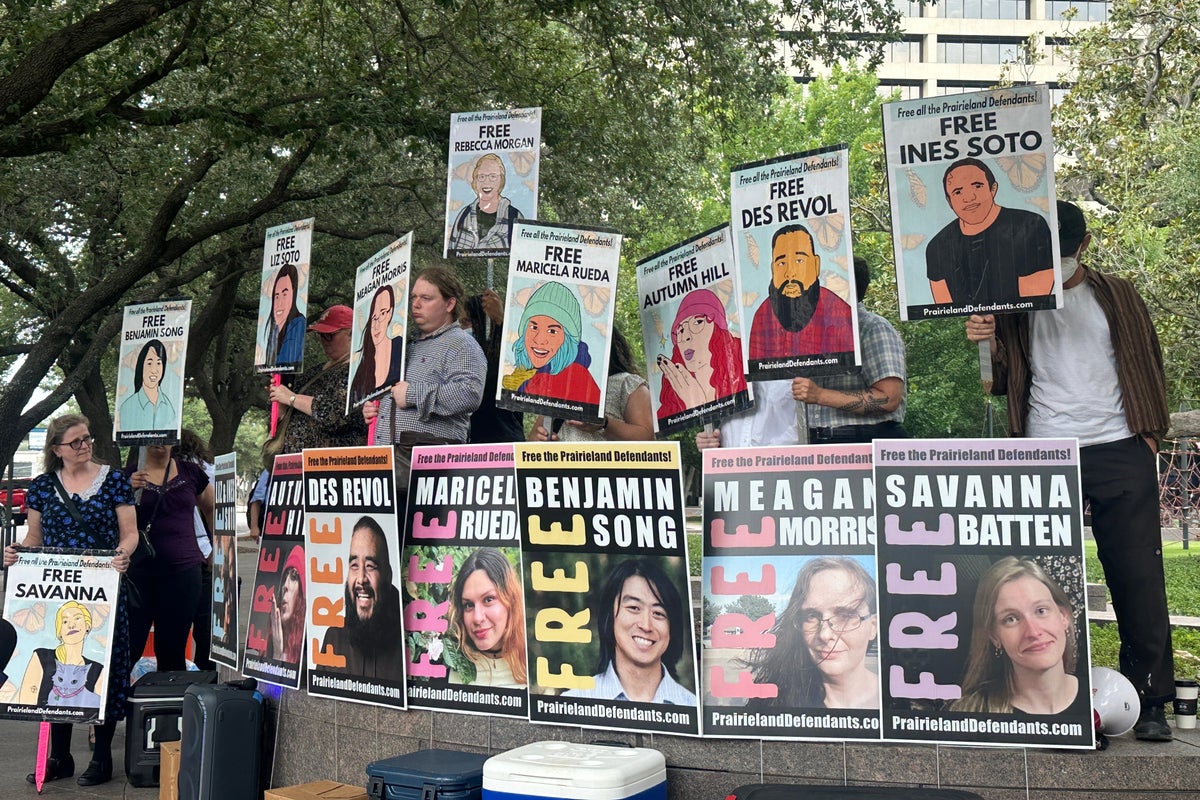
The application of maximum statutory penalties in federal cases involving politically motivated violence functions as a deliberate instrument of state deterrence. When the Department of Justice prosecutes ideologically driven asymmetric actors—such as individuals associated with decentralized movements like Antifa—the judicial objective extends beyond retribution for the immediate criminal act. The imposition of a 100-year sentence for an assault on an Immigration and Customs Enforcement (ICE) facility establishes a quantifiable benchmark in federal law enforcement strategy, signaling a shift from localized riot management to the systematic deployment of national security sentencing enhancements.
To comprehend the strategic logic behind these multi-decade sentences, one must dissect the mechanics of federal sentencing guidelines, the compounding nature of firearm specifications, and the behavioral economics of deterrence within decentralized networks.
The Architecture of Statutory Compounding
Federal sentencing outcomes are governed by a mathematical aggregation of offense levels, criminal history categories, and statutory mandatory minimums. In cases involving attacks on federal officers or facilities, the prosecution relies on specific legal multipliers to escalate a standard assault charge into a century-long term of incarceration.
The primary mechanism for achieving a 1500-month or 1200-month sentence without parole rests on three structural pillars:
- The Official Victim Enhancement: Under the United States Sentencing Guidelines (USSG) §3A1.2, if the victim of an offense is a current or former government officer or employee, and the offense was motivated by the victim's official status, the base offense level increases automatically. This structural multiplier reframes a violent act from a localized assault into an assault on the state apparatus itself.
- Terrorism Enhancements (USSG §3A1.4): If the offense involves, or is intended to promote, a federal crime of terrorism, the defendant’s criminal history category is automatically elevated to Category VI—the highest possible tier—regardless of whether the individual has a prior criminal record. The base offense level is simultaneously adjusted upward by a minimum of 12 levels. This single adjustment structurally alters the sentencing trajectory, shifting the baseline from months to decades.
- Consecutive Mandatory Minimums (18 U.S.C. § 924(c)): The most potent tool for compounding a sentence is the deployment of firearm charges during a crime of violence. Each distinct count of discharging a firearm during a violent crime carries a mandatory minimum sentence that must run consecutively, rather than concurrently, to any other sentence imposed. If a defendant discharges a firearm multiple times across separate counts within the same indictment, the statutory minimums stack exponentially.
[Base Assault Charge]
         │
         ▼
[+ Official Victim Enhancement (USSG §3A1.2)]
         │
         ▼
[+ Terrorism Enhancement (USSG §3A1.4) -> Auto Category VI]
         │
         ▼
[+ Stacking 18 U.S.C. § 924(c) Consecutive Firearm Counts]
         │
         ▼
[Result: Century-Scale Incarceration]
This mathematical compounding explains how a non-fatal shooting incident can legally generate a sentence that effectively mirrors a multiple-homicide conviction. The judge does not arbitrarily invent a 100-year figure; rather, the judicial system executes a formulaic calculation driven by strategic prosecutorial charging decisions.
Decentralized Networks and the Deterrence Cost Function
Conventional deterrence theory presumes a rational actor model where an individual calculates the probability of apprehension and the severity of punishment against the perceived utility of the criminal act. In ideological movements, this cost function is distorted by group dynamics, perceived moral mandates, and the anonymity of decentralized structures.
The Department of Justice utilizes severe sentencing to shock the cost-benefit analysis of these decentralized networks. Within an unorganized or leaderless movement, standard law enforcement interventions—such as arresting low-level rioters on misdemeanor charges—fail to alter collective behavior. The low cost of participation preserves the operational capacity of the group.
By applying a 100-year sentence to a high-profile actor within these movements, the state alters the risk profile for every participant in the network. The cost function of engaging in kinetic attacks against federal infrastructure shifts from a minor risk of short-term detention to an absolute certainty of permanent removal from society.
The strategy relies on asymmetric signaling. The state does not need to capture every member of a decentralized network; it only needs to demonstrate that the cost of capture is total. This creates a psychological bottleneck for the movement, forcing peripheral participants to re-evaluate their alignment with tactics that carry catastrophic personal liabilities.
Operational Limitations of the Maximum Sentence Strategy
While the imposition of a century-long sentence serves as a powerful communicative device to the public and potential bad actors, the strategy possesses clear operational boundaries that prevent it from being a total solution to domestic political unrest.
The first limitation is the radicalization loop. For a deeply committed ideological core, extreme state sentences do not deter; instead, they validate the narrative of state tyranny. The incarcerated individual is transformed into a martyr, providing the movement with a symbolic rallying point that can be used for recruitment and fundraising. The severe sentence may suppress mass participation while simultaneously hardening the resolve of the radical fringe.
The second limitation is prosecutorial resource allocation. Achieving a flawless conviction that survives the appellate scrutiny of a 100-year sentence requires immense investigative and legal capital. Federal agencies must deploy extensive forensic, digital, and counter-terrorism resources to link an individual unambiguously to a specific violent act within a chaotic crowd or riot setting. The Department of Justice cannot scale this level of prosecution to every individual involved in civil unrest. The strategy is inherently limited to selective, high-visibility targets.
The final constraint involves the institutional friction within the judiciary itself. Not all federal judges adhere to the doctrine of exemplary sentencing. The tension between judicial independence and executive prosecutorial priorities means that sentencing outcomes remain highly variable depending on the venue and the specific judge assigned to the case. This variance introduces an element of unpredictability that dilutes the uniformity required for absolute deterrence.
Strategic Outlook
The precedent established by this case indicates a permanent transition toward the securitization of domestic ideological violence. Future prosecutorial strategies will likely mimic this blueprint, utilizing civil disorder statutes, federal facility protection laws, and firearm compounding clauses to neutralize domestic actors.
Law enforcement agencies will prioritize the collection of digital evidence—such as encrypted communications, geolocation data, and high-definition surveillance footage—specifically to build cases that satisfy the high thresholds required for terrorism enhancements. The focus of federal intervention has moved decisively beyond containment; it is now optimized for long-term incapacitation.


