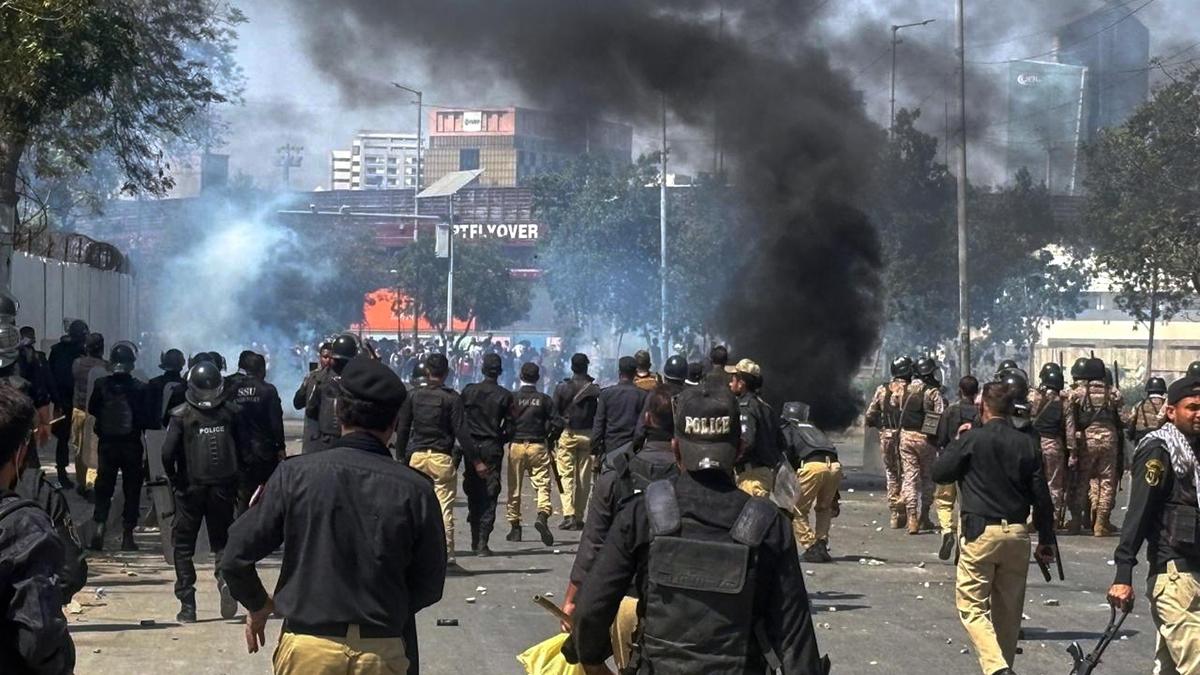
The death of nine individuals during an attempted storming of the U.S. Consulate in Pakistan represents a catastrophic breakdown in the tiered defense systems designed to manage civil unrest. While media reports focus on the immediate violence, a structural analysis reveals that these fatalities are the predictable output of a "Kinetic Convergence"—the point where high-velocity crowd dynamics meet rigid, lethal-force thresholds. To understand why this event unfolded with such lethality, one must dissect the failure of non-lethal deterrents, the geography of the "Kill Zone," and the psychological pressure of a diplomatic breach.
The Triad of Perimeter Defense Failure
A diplomatic facility relies on three concentric rings of security. Each ring is designed to bleed momentum from an attacking force. In this instance, the simultaneous collapse of all three layers necessitated the transition from crowd control to active engagement.
- The Information Layer: This is the outermost ring, consisting of local law enforcement intelligence and early warning systems. The fact that protesters reached the consulate gates in sufficient volume to attempt a breach indicates a total failure in pre-emptive dispersal. When the crowd density exceeds $4$ persons per square meter, the ability of police to extract agitators vanishes.
- The Physical Stand-off: The "Buffer Zone" between the public street and the hardened consulate structure is meant to provide reaction time. In the Pakistan event, the mass of the crowd negated this distance. Once the perimeter fence is touched, the security posture shifts from "Defensive" to "Reactive."
- The Lethal Threshold: The final barrier is the legal and tactical boundary where the use of firearms becomes the only remaining tool to prevent a breach of sovereign territory. Nine deaths suggest that the crowd crossed this invisible line, forcing security personnel to apply the "Final Protective Fire" logic.
The Physics of Crowd Compression and Breach Mechanics
The attempt to storm a consulate is not merely a political act; it is a physical event governed by fluid dynamics. A crowd of several thousand exerts thousands of pounds of pressure on a single point of entry.
The Fulcrum of Violence
Breach attempts usually fail until a "force multiplier" is introduced. This could be a vehicle ramming a gate or a coordinated push. In the Karachi or Lahore contexts, protesters often use improvised tools to create an opening. The moment a gate yields, the physics of the situation changes. Security forces are no longer managing a crowd; they are defending a bottleneck.
The "Bottleneck Effect" creates a high-density target environment. When lethal force is applied at a narrow entry point, the casualty rate is exponentially higher than it would be in an open square. The nine fatalities are likely the result of this localized density, where missed shots or ricochets find targets in the packed mass behind the initial line of attackers.
Proximal Causality vs. Root Agitation
The logic of the protest is often disconnected from the logic of the defense. While the protesters act on ideological grievances—often centered on perceived slights to religious or national sovereignty—the security personnel operate on a binary logic: Breach vs. No Breach.
- The Incentive Structure of the Protest: For organizers, a "martyrdom" event or a high-casualty incident can be more strategically useful than a successful peaceful demonstration. This creates a moral hazard where leaders push the front line toward lethal thresholds, knowing the consequences will be borne by the individuals in the "Kill Zone."
- The Command Vacuum: In many Pakistani civil disturbances, the local police (First Responders) and the paramilitary or private security (Inner Guard) operate under different Rules of Engagement (ROE). If the First Responders retreat due to lack of equipment or political will, the Inner Guard is forced to skip the "Graduated Response" steps and move straight to lethal force to prevent a total compound overrun.
The Geopolitical Cost Function of Diplomatic Violence
The loss of life in these incidents creates a feedback loop of instability. Each death acts as a data point for future recruitment, but the strategic damage extends further:
- Erosion of Sovereign Immunity: Every successful or near-successful breach diminishes the perceived power of the host nation to protect foreign assets. This leads to the "Fortress Embassy" model, which reduces diplomatic efficacy by isolating officials from the local population.
- Economic Risk Premium: Violent unrest directed at diplomatic targets triggers immediate spikes in sovereign risk ratings. This increases the cost of borrowing and halts foreign direct investment, as the instability signals that the rule of law is subservient to street-level mobilization.
- The Pivot of Responsibility: The U.S. government holds the host nation responsible for the security of its diplomats under the Vienna Convention. When nine people die, the narrative shifts from the protesters' grievances to a bilateral dispute over security failures. The host government is placed in an impossible position: they must suppress their own citizens to maintain an alliance, or allow the alliance to fracture to appease the street.
Tactical Deficiencies in Non-Lethal Deployment
A critical observation in this event is the apparent absence of effective mid-range deterrents. If the transition from shouting to shooting was immediate, it indicates a lack of:
- Active Denial Systems: Modern crowd control utilizes directed energy or acoustic devices that make it physically impossible to remain in an area without causing permanent injury.
- Persistent Irritants: Standard tear gas (CS) often fails in open-air environments or against crowds that have developed basic countermeasures (masks, vinegar-soaked rags).
- Structural Redundancy: Consulates in high-risk zones often lack the "Delayed Entry" features—like secondary interior gates or automated barriers—that would allow security to retreat without firing.
The nine deaths are a symptom of a "Gap in the Escalation Ladder." When a security force has only two speeds—stand there or fire—the outcome is binary and bloody.
Strategic Realignment of Perimeter Security
The incident proves that traditional fencing and human guards are insufficient against mass-scale ideologically driven breaches. To prevent a recurrence, the defensive architecture must move toward "Passive Neutralization." This involves designing diplomatic spaces where the physical environment itself makes a breach physically impossible through architectural geometry rather than human guards.
The focus must shift from defending the gate to eliminating the gate. This involves recessed entrances, high-speed automated bollards, and "Long-Range Acoustic Hailing" to communicate the consequences of crossing the lethal threshold before it happens.
In the immediate aftermath, the tactical priority is the identification of the agitators who directed the crowd toward the breach. By analyzing video footage, security services can map the "Directors" versus the "Participants." Neutralizing the organizational nodes of these protests is the only way to lower the casualty rate in future encounters.
The strategic play here is not "more guards," but "better friction." If a crowd cannot gain the momentum required to pressure a gate, the lethal threshold is never reached, and the diplomatic mission remains both secure and politically viable.