The weekend missile exchanges between United States forces and Iranian-backed elements represent a calculated equilibrium of kinetic force, rather than an uncontainable slide into total regional warfare. While general news reporting frames these events through the lens of sudden escalation, a structural analysis reveals a highly predictable, tit-for-tat operational matrix governed by specific strategic constraints. The fundamental tension driving this conflict is the mismatch between political rhetoric and the underlying cost functions of both state actors. Neither Washington nor Tehran seeks a theater-wide conventional war, yet both are trapped in a signaling cycle where inaction incurs a higher domestic and geopolitical cost than calibrated kinetic engagement.
To understand the trajectory of this confrontation, the theater must be disaggregated into its component tactical drivers, logistical realities, and asymmetric doctrines.
The Tri-Border Friction Framework
The recent engagements are concentrated within specific geographic choke points and logistical corridors, primarily spanning the Iraq-Syria border and the lower Red Sea maritime transit lanes. This geography creates a structural vulnerability that can be broken down into three distinct operational pillars.
- The Logistical Land Bridge: The overland route running from western Iran, through Iraq, and into eastern Syria serves as the primary supply vector for advanced conventional munitions. US kinetic strikes targeted these specific node locations to disrupt the velocity of supply, rather than to permanently hold territory.
- The Asymmetric Maritime Proxy: In the southern maritime corridor, the deployment of anti-ship cruise missiles and unmanned aerial vehicles leverages low-cost manufacturing against high-cost naval defense systems. This creates an economic asymmetry where the cost of intercepting a threat routinely exceeds the cost of production by a factor of ten.
- The Forward Operational Basing Matrix: US installations in the region, established during counter-terrorism campaigns, operate under a revised defensive posture. They no longer function primarily as offensive launchpads but as static, high-value targets that test the efficacy of integrated air and missile defense systems.
The immediate cause-and-effect relationship missed by standard reportage is the synchronization of these geographic vectors. A strike in the Levant is rarely an isolated tactical event; it is directly correlated with pressure points applied in the maritime domain, demonstrating a unified command-and-control apparatus on the Iranian side, countered by a distributed, theater-wide defensive posture by US Central Command.
The Cost Function of Kinetic Signaling
Every missile launched carries a dual burden: the physical cost of the ordnance and the geopolitical cost of the resulting escalation. The current engagement model relies on a strict calculus of deterrence capability versus risk tolerance.
The Iranian Cost Function
Iran’s strategic doctrine relies on forward defense and strategic depth. By utilizing local proxies to execute missile and drone strikes, Tehran achieves plausible deniability while shifting the physical destruction away from its sovereign territory. The primary variable in Iran's cost function is the preservation of its core domestic infrastructure and nuclear assets. Therefore, its proxy strikes are calibrated to remain just below the threshold that would trigger a direct, conventional strike on the Iranian homeland.
When US forces retaliate against proxy infrastructure in Syria or Iraq, the material cost to Iran is negligible; the assets destroyed are easily replaceable surplus munitions. The real cost to Tehran is the potential degradation of its proxy networks' operational morale and regional prestige. Consequently, Iran must respond to US strikes to maintain the credibility of its regional deterrent, creating a self-perpetuating feedback loop.
The United States Cost Function
The United States operates under a different set of constraints, primarily dictated by global force posture and domestic political accountability. The deployment of carrier strike groups and advanced air defense assets to the Middle East diverts critical resources away from the Indo-Pacific theater—the primary focus of long-term US defense strategy.
The economic cost of maintaining a high-readiness posture, coupled with the consumption rate of sophisticated interceptors like the SM-2 and SM-6, introduces a material bottleneck. The US cost function increases exponentially if a proxy strike results in significant American casualties, as domestic political pressure would then mandate a disproportionate response, shattering the current calibration and forcing a direct confrontation with Iranian sovereign targets.
Logistical Reality vs. Strategic Rhetoric
The public declarations from both Washington and Tehran emphasize absolute resolve and the willingness to take all necessary measures to protect national interests. However, an examination of the actual ordnance expended and the target selection reveals a far more conservative operational reality.
During the weekend exchanges, the choice of targets by US forces focused on uncrewed storage facilities, command-and-control nodes, and active launch sites. This target selection aims to degrade capability temporarily while minimizing human casualties. By striking unmanned nodes, the US offers Iran an off-ramp, allowing Tehran to absorb the tactical loss without being forced by internal political pressure to execute a massive, multi-front retaliation.
Conversely, the missile and drone volleys launched by Iranian-aligned groups targeted fortified US positions equipped with robust Counter-Rocket, Artillery, and Mortar (C-RAM) systems and Patriot missile batteries. The utilization of low-velocity loitering munitions suggests an intent to test response times and deplete defensive stocks rather than a serious attempt to inflict catastrophic structural damage. The tactical objective is saturation, not destruction. By forcing US systems to expend millions of dollars in defensive ordnance to defeat thousands of dollars in offensive assets, the proxies achieve a strategic victory through economic attrition.
The Friction of Material Attrition
The structural vulnerability in this equilibrium lies in the material limits of missile defense. Integrated air defense systems are not infallible; they are subject to probability metrics and mechanical failure rates.
[Offensive Swarm: Low-Cost UAVs/Missiles]
       │
       ▼
[Integrated Air Defense Layer (Patriot/C-RAM)] ──► Interception Attrition Rate (90-95%)
       │
       ▼ (5-10% Leakage)
[Kinetic Impact on Base Infrastructure] ──► Casualties / Structural Damage
       │
       ▼
[Mandatory Asymmetric Escalation Pathway]
This structural bottleneck means that even if the political leadership of both nations wishes to maintain the current calibrated level of violence, a single tactical anomaly—a missile bypassing a defense shield due to a sensor glitch and striking a barracks—instantly alters the strategic matrix. The current stability is highly fragile because it depends on the precise execution of defensive systems operating under saturated conditions.
Furthermore, the supply chain for advanced precision-guided munitions and surface-to-air interceptors cannot be rapidly scaled. A prolonged war of attrition using cruise missiles and short-range ballistic missiles depletes deep-theater magazines faster than Western industrial bases can replenish them. This material reality acts as a hard ceiling on how long the United States can sustain a purely reactive, defensive posture without shifting to a preemptive strategy designed to eliminate the threat at its source.
Tactical Reality of the Weekend Exchanges
The specific engagement metrics from the latest weekend actions confirm this pattern of controlled friction. The utilization of short-range ballistic missiles (SRBMs) by proxy forces indicates a desire to reduce the reaction time available to US automated defense networks. Unlike slower-moving cruise missiles or loitering munitions, SRBMs possess a high-velocity terminal phase that requires immediate engagement by Patriot PAC-3 hit-to-kill interceptors.
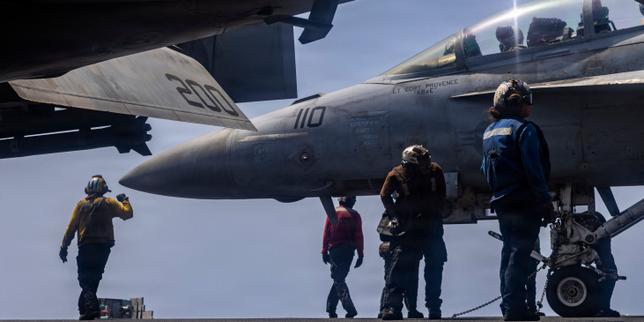
The US response utilized precision standoff munitions delivered by carrier-based aircraft and land-based bombers. This operational choice maximizes force protection, ensuring that US personnel are not exposed to anti-aircraft systems while delivering localized, high-impact kinetic payloads. The structural outcome of these specific exchanges was a temporary degradation of the proxy launch infrastructure, balanced by a demonstrative assertion of Iranian regional reach. No territory shifted control; no strategic balance was fundamentally altered.
Strategic Forecast and Escalation Pathways
Barring a catastrophic intelligence or defensive failure that results in mass casualties, the conflict will likely maintain its current structural contours. The primary systemic risk is not a deliberate decision by either power to launch a total war, but rather the cumulative effect of continuous kinetic friction.
The immediate operational priority for defense planners must shift from reactive interception to systemic interdiction. To disrupt the self-perpetuating cycle of the tri-border friction framework without triggering theater-wide escalation, the strategic focus must target the logistics velocity of the land bridge and maritime supply vectors. This requires a sustained electronic warfare and cyber interdiction campaign designed to degrade the precision guidance assembly kits before they arrive at forward launch positions. By lowering the accuracy and reliability of proxy offensive systems at the manufacturing and transit stages, the economic and material strain on US defensive infrastructure is minimized, preserving long-term force posture without expanding the geographic footprint of the kinetic conflict.