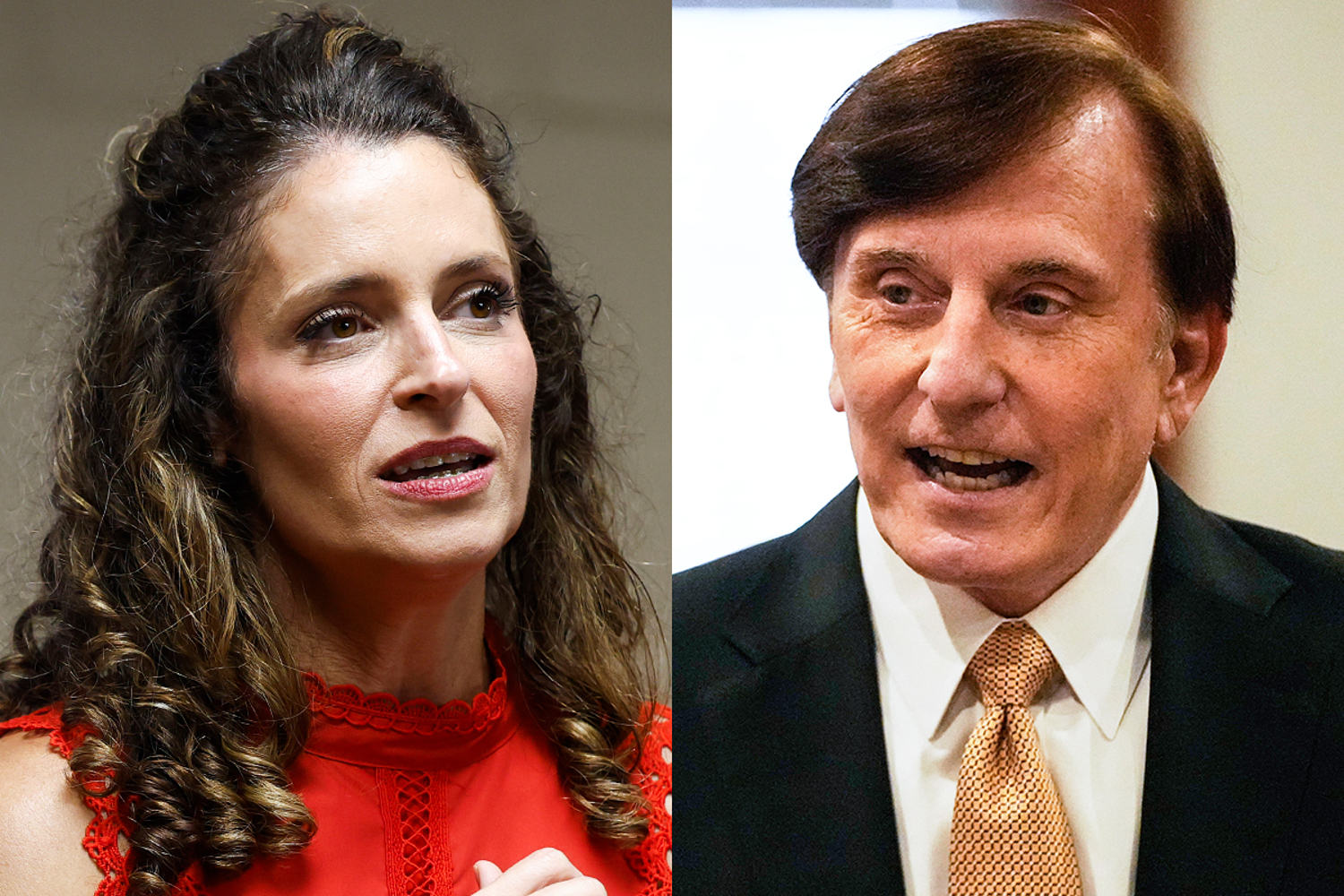
The removal of an incumbent United States Senator during a closed primary party execution represents an engineered systemic realignment rather than a standard electoral shift. The defeat of incumbent Senator Bill Cassidy in the May 16 primary ballot laid bare the underlying mechanical dynamics of internal party filtering. By processing candidate selection through a sequential primary and runoff mechanism, the electorate establishes a laboratory for testing the structural elasticity of presidential endorsements. The current contest between Representative Julia Letlow and State Treasurer John Fleming serves as an exact metric of how ideological loyalty interacts with local political machinery when the primary objective—purging a non-aligned incumbent—has already been achieved.
Understanding this race requires moving past the conventional commentary of horse-race politics and examining the structured institutional incentives, financial asymmetries, and voter behavioral matrices that govern a low-turnout runoff. If you enjoyed this article, you might want to read: this related article.
The Dual-Track Primary Filter and the Incumbency Deficit
The classical model of political science assumes that incumbency offers an insulating barrier composed of institutional name recognition, legislative achievements, and built-in fundraising networks. In the contemporary intra-party framework, this insulation fails when an incumbent violates core alignment parameters. Cassidy’s structural deficit originated from his vote to convict during the 2021 impeachment proceedings, a decision that created a permanent ideological premium within the state's primary electorate.
This premium operates through a two-stage filter: For another perspective on this story, check out the latest coverage from NBC News.
- The Elimination Stage: The first primary function serves to fragment the moderate and institutional coalition while consolidating the ideological core. In a multi-candidate field, Letlow captured 44.5% of the vote, Fleming secured 28.1%, and Cassidy finished third at 25.1%. The mathematical reality of this distribution indicates that 72.6% of the participating Republican electorate actively selected an alternative to the incumbent.
- The Consolidation Stage: The runoff removes the negative focal point—the incumbent—shifting the electoral calculus from a retrospective referendum on institutional defiance to an prospective evaluation of ideological authenticity.
The elimination of Cassidy alters the voter utility function. In the primary phase, Letlow operated as the primary vehicle for enforcement, backed by an endorsement issued before her formal entry into the race. In the runoff phase, the remaining electorate must differentiate between two candidates who both claim alignment with the national party leadership, testing the diminishing marginal utility of an endorsement when its explicit target has been eliminated.
The Efficiency Curve of Endorsement Capital
An endorsement does not function as a monolithic block of transmissible votes; instead, it operates as a multiplier on existing structural variables. The allocation of this capital follows specific operational pathways that differ between Letlow and Fleming.
Candidate Resource Allocation Matrix:

Letlow Assets:
- Direct Presidential Endorsement
- $4 Million Super PAC Independent Expenditures
- Gubernatorial and House Leadership Alignment

Fleming Assets:
- Historical House Freedom Caucus Credentials
- Executive Branch Experience (First Trump Administration)
- $1 Million Direct Campaign Advertising Outlays
The distribution of the primary vote highlights a distinct geographical and demographic bifurcation in how this endorsement capital is absorbed. Letlow’s primary strength anchored itself in rural parishes across northeastern Louisiana and along the Mississippi border, where she secured outright majorities. This pattern demonstrates the high efficiency of national endorsements in lower-density media markets, where institutional signals face minimal competing noise.
Conversely, Fleming established a localized stronghold in northwestern Louisiana, leading in nine rural parishes. His ability to capture these areas despite Letlow’s explicit backing indicates a localized resistance point where personal brand equity and past regional representation override national executive dictates. Fleming’s positioning as a founder of the House Freedom Caucus allows him to run an alternative ideological play: framing himself as an authentic ideological actor whose alignment predates the current institutional structure.
The structural limitation of Fleming’s strategy lies in the institutional firewall built around Letlow by state actors. The endorsement of Governor Jeff Landry and House Majority Leader Steve Scalise creates a dual-layer signaling framework. For high-information voters in high-density areas, these endorsements convert Letlow from a purely ideological insurgent into an institutional consensus choice, neutralizing Fleming’s attempts to outflank her from the right.
The Turnout Asymmetry Model in Low-Velocity Elections
Runoff elections are defined by a systemic drop in absolute voter participation, changing the composition of the active electorate. Historical baselines in Louisiana show that moving from a high-stakes primary to a localized runoff can cause voter turnout to drop significantly—frequently falling from above 40% down to under 15% of registered voters.
This contraction accelerates the influence of high-propensity, highly ideological voters while reducing the impact of casual or moderate participants.
May 16 Primary Turnout baseline: ~832,000 Total Ballots
- Registered Democrats: ~347,000
- Registered Republicans: ~336,000
- Turnout Rate: 28%
Because the rules governing this runoff restrict participation along strict partisan lines, independent and unaffiliated voters who sat out the primary are restricted from entering a new primary ecosystem. This structural barrier creates a closed loop. The critical variable becomes the migration pattern of the 25.1% of voters who supported Cassidy in the first round.
Mary Patricia Wray, a regional political strategist, notes that higher-information voters in major metropolitan centers like East Baton Rouge, Jefferson, and Orleans parishes—where Cassidy performed strongest—tend to view Letlow as the more institutional option. This creates an electoral paradox: the candidate backed by national insurgent capital becomes the beneficiary of moderate, establishment preservation votes in the final phase.
Cassidy’s voters face a choice between an institutional conservative with deep federal legislative backing (Letlow) and a hardline ideological purist who rejects compromises on issues like carbon capture and federal subsidies (Fleming). Because Letlow holds a 16-point head-start from the primary, Fleming must convert a supermajority of Cassidy’s displaced voters while maintaining his own base in the northwest—a mathematical scenario that encounters steep resistance given his ideological positioning.
Tactical Friction: Technological Disinformation and Policy Divergence
As the race narrowed into a binary choice, the tactical execution shifted from broad ideological branding to targeted structural friction. This friction manifested in two primary domains: technological manipulation and localized economic policy.
The introduction of an artificial intelligence-generated video by external networks, which Fleming amplified on social platforms, represents a shift in intra-party campaign mechanics. The video attempted to exploit a vulnerability in Letlow’s profile—her past rhetorical support for diversity, equity, and inclusion (DEI) frameworks during a 2020 university presidential interview.
By using synthetic media to heighten this vulnerability, the opposition attempted to disrupt her ideological alignment signal. Letlow’s counter-strategy relied on a rapid pivot to personal grievance and emotional insulation, focusing on the video's references to her deceased husband to invalidate the medium itself rather than engaging with the underlying policy critique.
On substantive policy, a distinct fracture emerged regarding industrial infrastructure. Fleming anchored his late-stage campaign on opposition to carbon capture and sequestration projects, a major economic development initiative backed by the state's industrial sector and supported by the traditional business wing of the Republican party.
Fleming framed these projects as an infringement on private property rights and an extension of wasteful federal subsidy regimes, directly appealing to populist distrust of corporate-state partnerships. This strategy aims to split the conservative coalition by separating the populist base from the corporate donors who fund the state party apparatus. Letlow avoided this policy trap by focusing her platform on national social conservative priorities, such as restricting transgender participation in scholastic sports, a positioning strategy designed to maximize consensus across all factions of the primary electorate.
The final deployment of political capital in this runoff points toward a clear structural outcome. The combination of Letlow’s 16-point primary advantage, her $4 million independent expenditure advantage managed via supportive super PACs, and her dual positioning as both the endorsed loyalist and the institutional consensus choice leaves Fleming with an unsustainable path to a majority. Fleming’s path requires an unprecedented level of turnout asymmetry in the northwest quadrant of the state alongside a complete collapse of Letlow’s rural base—an outcome contradicted by early voting returns showing steady participation across the northeastern parishes.
The structural blueprint established by this election demonstrates that a national executive endorsement is most potent when it acts as an initial filter to break an incumbent, but its success in subsequent runoff phases depends on local institutional actors consolidating the remaining factions. Letlow's organization has successfully executed this consolidation, positioning her to secure the nomination and establishing a repeatable template for intra-party leadership transitions in deeply unipolar states.