An analysis of urban infiltration failures reveals that structural barriers present a far higher risk of operational failure than human intervention. The incident in Salinas, California, where a burglary suspect became immobilized within a commercial wall structure, serves as a case study in the miscalculation of structural tolerances and acoustic transmission. While conventional narratives attribute the apprehension to chance surveillance during a law enforcement break, a mechanical and situational analysis shows that the outcome was predetermined by the physics of confined spaces and the spatial layout of the structure.
Infiltration operations that rely on unconventional entry points frequently fail because they treat architectural voids as navigable pathways rather than rigid, unforgiving enclosures. To understand how an entry attempt degenerates into a life-threatening entrapment requiring a multi-agency rescue, we must analyze the structural mechanics of standard commercial walls, the acoustic profile of confined spaces, and the operational variables of localized law enforcement positioning.
The Structural Mechanics of Columnar Entrapment
Commercial real estate construction relies heavily on standard framing dimensions that create predictable internal voids. The vulnerability of an intruder in this scenario is governed by a fundamental mismatch between human anatomy and architectural engineering tolerances.
Vertical Tapering and Friction Locks
Most commercial interior and exterior walls utilize standard wood or light-gauge steel framing. Studs are typically spaced 16 inches or 24 inches on center. When a structure includes hollow decorative pillars, utility chases, or double-walled partitions, the internal clearance often narrows significantly due to structural bracing, plumbing, or electrical conduit.
The physical mechanism of entrapment operates on three specific variables:
- The Wedge Effect: As a body descends vertically into a narrowing shaft, gravity forces the wider structural points of the anatomy—specifically the shoulders and pelvis—into a wedge-shaped constriction.
- Frictional Resistance: Standard drywall (gypsum board) or rough-cut timber possesses a high coefficient of friction against clothing fabric. Once downward momentum ceases, the static friction required to move upward exceeds the mechanical advantage a human body can generate without leverage.
- Compressive Asphyxia Risk: In a vertical entrapment, every exhalation allows the surrounding structure or shifting debris to settle tighter against the thoracic cavity. This restricts inhalation volume, rapidly accelerating fatigue and diminishing the individual's capacity to extricate themselves or signal for help.
The suspect in the Salinas incident entered a void that offered no internal purchase or structural variance to allow for lateral movement or reversal of direction. Once the hips or shoulders bypassed a critical clearance threshold, the structural void functioned effectively as a mechanical one-way valve.
Acoustic Transmission in Sealed Voids
The traditional reportage of this incident emphasizes the luck of the responding officers hearing cries for help during a coffee break. A rigorous acoustic analysis reveals that the audibility of the suspect was not a matter of pure chance, but rather a function of structural resonance and ambient noise dampening.
The Megaphone Effect of Architectural Conduits
A sealed wall cavity behaves like an acoustic waveguide. Sound waves generated inside a gypsum or concrete enclosure cannot easily dissipate laterally; instead, they are channeled along the length of the void until they encounter an exit point, such as a vent, a gap in the roofing joists, or an unsealed baseboard.
This creates a localized amplification effect. A vocalization that would be muffled if generated behind a flat wall becomes directional and highly concentrated when traveling through a continuous vertical shaft.
Ambient Noise Thresholds and Human Auditory Detection
The timing of the discovery coincided with a period of low operational noise in the immediate vicinity. For an acoustic signal to breach the threshold of human attention, it must exceed the ambient background noise (the noise floor) by a specific decibel margin.
$$\text{Signal-to-Noise Ratio (SNR)} = P_{\text{signal}} - P_{\text{noise}}$$
During a stationary break period, the localized noise floor drops significantly compared to periods of active transit or operational deployment. Law enforcement personnel, trained in situational awareness, are optimized to detect anomalies that deviate from the baseline acoustic environment. The structural waveguide delivered the acoustic signal directly to an area where the ambient noise floor was low enough to yield a positive signal-to-noise ratio, rendering detection highly probable despite the physical barrier of the wall.
Operational Dynamics of the Rescue Intervention
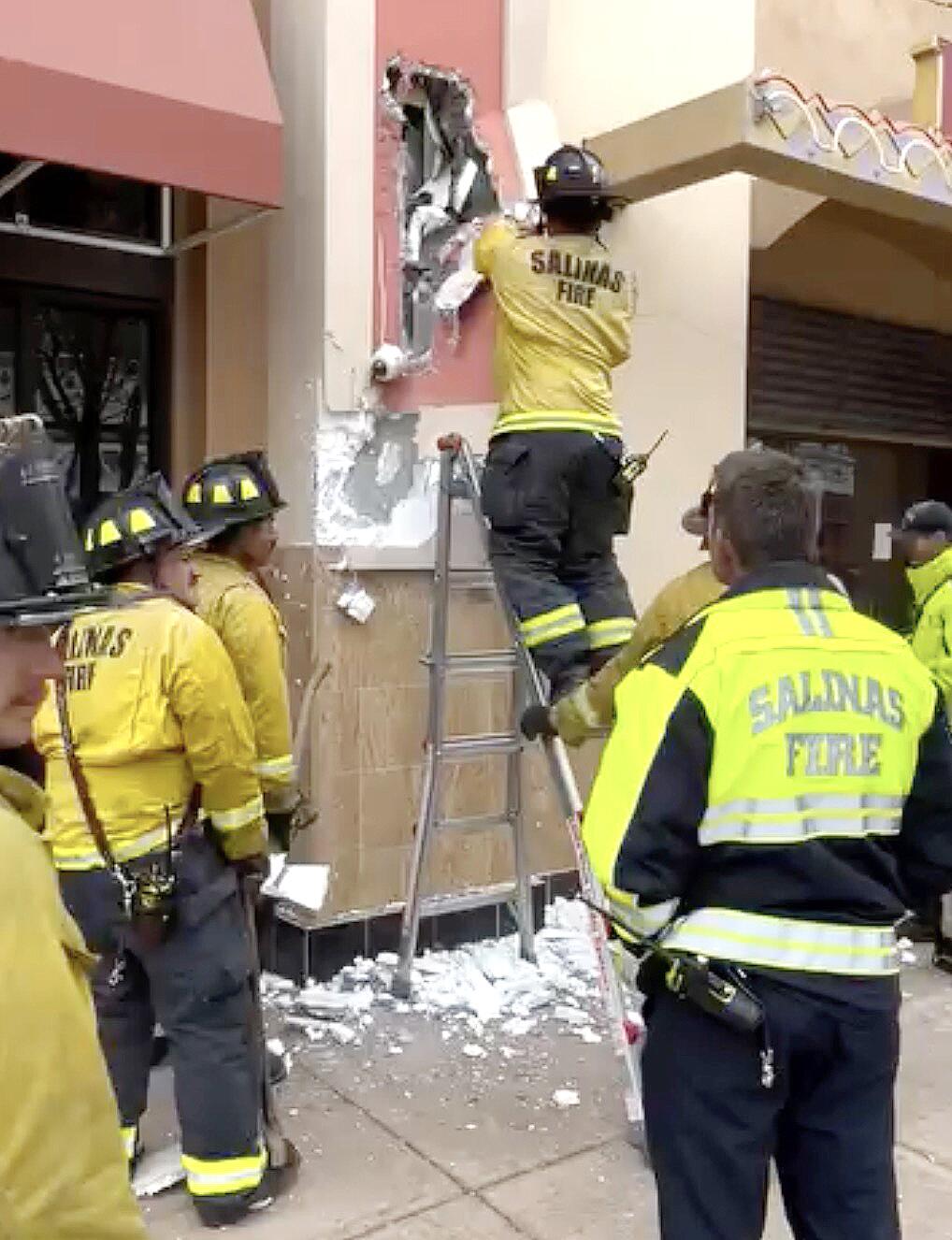
Once the transition from a standard criminal investigation to a technical rescue operation occurs, the operational framework shifts from tactical containment to specialized engineering mitigation. The Salinas Police Department, upon identifying the source of the acoustic anomaly, had to coordinate with local fire department technical rescue units to execute a controlled extrication.
Risk Assessment and Structural Integrity
Breaching a commercial wall requires a precise understanding of load-bearing configurations. Randomly cutting into a wall assembly introduces the risk of structural collapse or utility compromise. The extrication process follows a strict protocol:
- Localization: Utilizing thermal imaging or acoustic triangulation to pinpoint the exact elevation and lateral position of the trapped individual within the wall cavity.
- Atmospheric Monitoring: Ensuring that the air quality within the void remains sufficient to sustain life during the breach, particularly if power tools generate heat or dust.
- Controlled Breaching: Employing reciprocating saws, rotary hammers, or hand tools to create a relief opening. This opening must be positioned below or adjacent to the primary point of friction to prevent gravity from worsening the entrapment during the cut.
The complexity of this operation explains why the suspect was not immediately pulled from the structure. Technical rescue requires a systematic reduction of structural pressure, ensuring that the act of cutting the wall does not cause the internal components to shift and crush the occupant.
Strategic Realities of Urban Security and Structural Design
The Salinas incident highlights a systemic vulnerability in commercial facility design: the existence of unmonitored, accessible architectural voids. For property owners and security managers, the lessons extend beyond traditional physical access controls like locks and cameras.
The primary vulnerability lies in the external access points to these vertical voids—such as roof hatches, HVAC intake plenums, and decorative architectural facades. When these entry points are left unsecured, they present a deceptive path of travel that terminates in mechanical immobility. Security optimization requires closing these structural gaps or installing internal barriers, such as heavy-gauge expanded metal mesh, within any void that exceeds a 10-inch cross-sectional clearance.
Future architectural designs must balance aesthetic structural elements with physical security realities. If a decorative pillar or false wall cannot be eliminated, it must be engineered without access vectors, or completely filled with low-density insulating foam to neutralize its utility as a point of concealment or entry. The structural failure of the Salinas infiltration demonstrates that the physical laws of architectural spaces remain the final, absolute barrier to unauthorized entry.