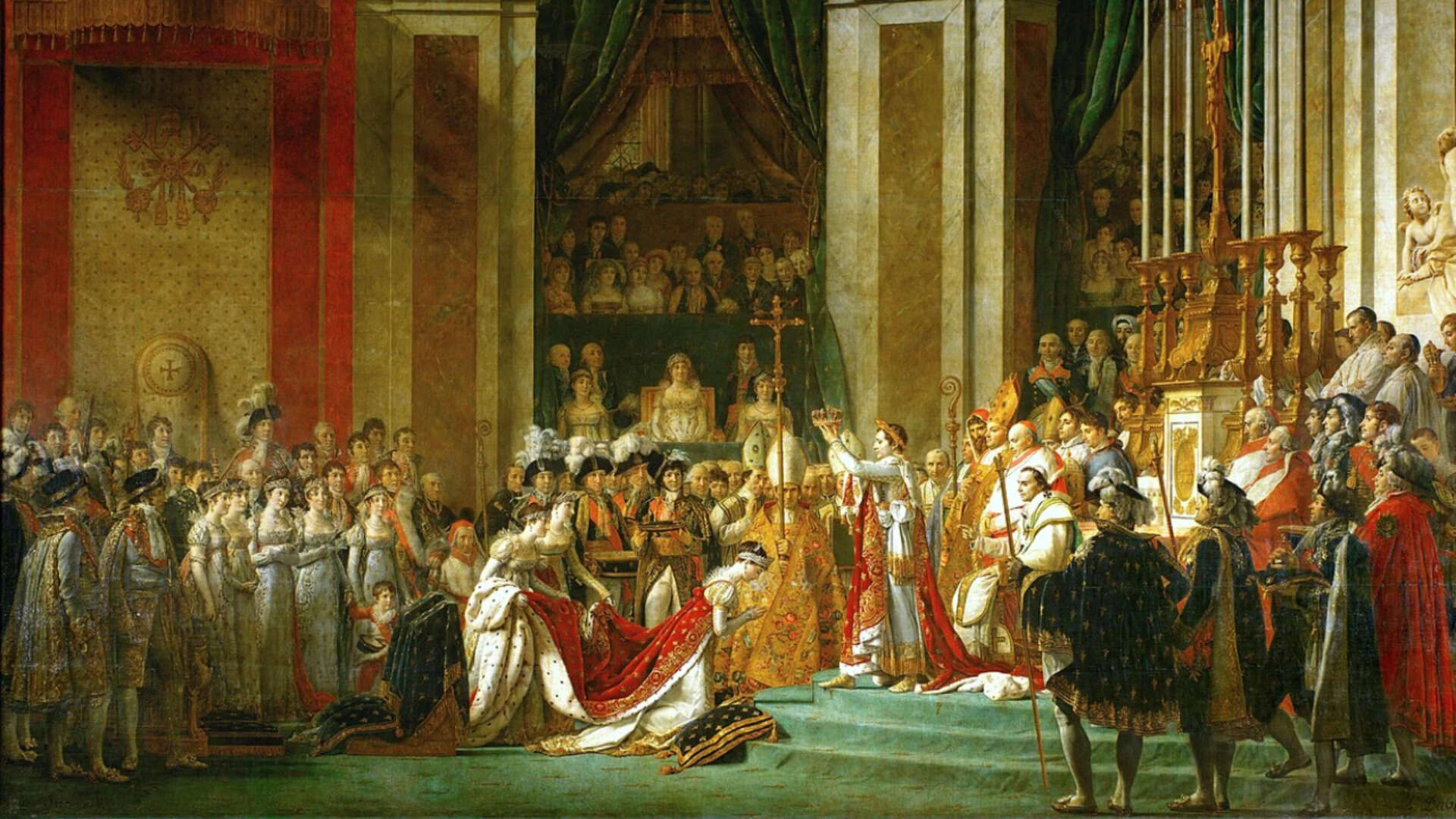
Napoleon Bonaparte’s famous declaration that "the throne is only a piece of wood covered with velvet" but "I am the state" serves as a foundational text for analyzing the transition from institutional authority to personalistic leadership. This statement, delivered to the Senate in 1814 as his empire crumbled, is not merely historical rhetoric. It represents a precise distinction between two distinct forms of power: legal-rational authority, which is bound to physical symbols and codified offices, and charismatic authority, which resides entirely within the individual.
When an organization or nation relies on the "throne"—the physical structure, the title, the organizational chart—it operates under a structural vulnerability. The moment the individual occupying that seat fails to project the personal competence, strategic vision, or sheer force of will required to sustain it, the symbol loses its utility. For executives, founders, and political strategists, understanding this division is critical. True power is never inherited through an office; it is generated through the alignment of strategic execution, systemic control, and perceived legitimacy. If you found value in this piece, you might want to read: this related article.
The Weberian Framework of Authority
Max Weber’s tripartite classification of authority provides the analytical scaffolding required to deconstruct Bonaparte’s assertion. To understand why a physical throne fails to secure power in times of crisis, we must map how these forms of authority interact and decay.
                  ┌────────────────────────┐
                  │   Traditional Power    │
                  │ (Custom, Bloodline, H2O)│
                  └───────────┬────────────┘
                              │
               ┌──────────────┴──────────────┐
               ▼                             ▼
┌────────────────────────┐     ┌────────────────────────┐
│ Legal-Rational Power   │     │   Charismatic Power    │
│ (The "Throne" / Office)│     │  (The Persona / "I")   │
└────────────────────────┘     └────────────────────────┘
Traditional Authority
This power bases its legitimacy on sanctified custom and long-standing practice. The monarchical systems of Europe pre-1789 operated almost exclusively on this axis. The throne was not merely wood; it was an artifact of divine right. For another angle on this event, refer to the latest update from MarketWatch.
Legal-Rational Authority
Legitimacy here is anchored in offices, laws, and bureaucratic procedures. The authority belongs to the role, not the individual. When an executive steps down, the power remains with the title, seamlessly transferring to the successor. Bonaparte's Senate represented this framework, attempting to assert control over France based on constitutional decrees.
Charismatic Authority
This dynamic relies on the extraordinary, often revolutionary qualities of a single leader. The followers' devotion is directed toward the person, not the institution. Napoleon’s rise was a pure manifestation of charismatic authority, forged through military genius at Lodi, Marengo, and Austerlitz.
The structural tension in Napoleon’s quote arises because he stripped away both traditional and legal-rational illusions. By reducing the throne to "wood and velvet," he exposed the fragility of institutional frameworks when divorced from the underlying raw power needed to enforce them.
The Strategic Asymmetry of Personal vs. Institutional Power
Institutions build structures to survive human mortality and incompetence. They create standard operating procedures, clear hierarchies, and symbolic markers of office to ensure continuity. However, this creates a profound strategic bottleneck. When an institution relies entirely on its formal structures, it becomes rigid, slow to adapt, and vulnerable to external disruptions.
Conversely, personalistic or charismatic power is highly agile but intrinsically unstable. It operates on a continuous feedback loop of performance and validation.
| Dimension | Institutional Power (The Throne) | Personalistic Power (The Individual) |
|---|---|---|
| Source of Legitimacy | Codified rules, titles, physical symbols | Direct execution, perceived competence, crisis resolution |
| Speed of Adaptation | Slow; bounded by bureaucratic inertia | Rapid; driven by unilateral decision-making |
| Fragility Risk | Vulnerable to structural disruption and loss of faith | Vulnerable to personal failure, succession crises, and physical mortality |
| Scalability | High; easily replicated across geographies | Low; deeply tied to the cognitive bandwidth of the leader |
The failure of the French Empire in 1814 illustrates the limits of trying to merge these two paradigms. Napoleon attempted to institutionalize his charismatic authority by crowning himself Emperor and creating a new nobility. He sought to turn his personal brilliance into a permanent "throne." Yet, the moment his military execution faltered, the institutional apparatus he built realized that the throne itself possessed no independent power. The Senate voted for his deposition because they recognized the structural reality: without Napoleon’s personal victories, the legal-rational framework had no enforcement mechanism.
The Cost Function of Maintaining Symbolic Authority
Relying on symbolic or institutional authority carries a high operational cost. When a leader's power is derived solely from their position rather than their capability, the organization must expend immense resources to maintain the illusion of legitimacy.
The Cost of Compliance Enforcement
In the absence of voluntary followings driven by charismatic alignment, institutions must use coercive or transactional mechanisms to ensure compliance. This requires extensive monitoring systems, complex incentive structures, and layers of middle management. This bureaucratic overhead slows operational velocity.
The Innovation Deficit
Symbolic authority prioritizes systemic preservation over adaptation. Because the legitimacy of the "throne" is tied to the existing order, any deviation from established protocols threatens the authority itself. Consequently, organizations relying heavily on formal titles systematically reject disruptive innovations that might undermine the value of those titles.
The Succession Bottleneck
When an organization fails to cultivate charismatic capability in its ranks, relying instead on formal promotions, a leadership vacuum occurs during transitions. The successor inherits the "piece of wood," but lacks the execution capability to wield the actual power, leading to immediate operational degradation.
Deconstructing the "I Am the State" Paradigm
When Napoleon bypassed the Senate's authority by claiming "I am the state," he identified the ultimate convergence of execution and governance. In a highly volatile environment, the individual who can synthesize information, make rapid decisions, and command absolute loyalty effectively supersedes the formal system.
This dynamic plays out repeatedly in modern corporate environments. When a founder-led company transitions to professional management, the board of directors often mistakes the institutional metrics (revenues, assets, headcounts) for the source of the company's competitive advantage. They believe the "throne" (the CEO office) will function regardless of who occupies it.
However, the real value driver is often the founder’s idiosyncratic ability to navigate ambiguity, motivate key talent, and make high-stakes bets. When that individual is replaced by a manager relying purely on legal-rational authority, the organization frequently enters a period of stagnation. The new executive commands obedience through their title, but they cannot command the creative risk-taking or deep loyalty required to survive industry transitions.
The Limits of Charisma: The Succession Paradox
While personalistic power outclasses symbolic power in terms of speed and execution, it possesses a terminal flaw: it cannot be easily institutionalized. This is known as the routinization of charisma.
For a charismatic leader to build an enduring legacy, they must eventually transfer their personal authority into legal-rational structures. This process requires a deliberate reduction in personal control. The leader must willingly empower the "throne"—the institution—at the expense of their own personal agency.
[Phase 1: Pure Charisma] ──> [Phase 2: Operationalization] ──> [Phase 3: Systematization]
(Leader-Centric, High Agility)   (Delegation to Key Lieutenants)     (Institutionalized Codification)
Napoleon failed this transition. He could not tolerate the independent operation of the institutions he created. His ministries, his code of laws, and his marshals were constantly bypassed by his personal intervention. Because he insisted on being the sole engine of the state, the state collapsed the moment he was physically removed from the theater of operations.
To avoid this failure mode, modern strategic leaders must execute a deliberate three-step transition program to transfer personal authority to systemic infrastructure before market forces or personal fatigue erode their execution capacity.
1. Codify Decision Frameworks, Not Just Outcomes
The leader must document the underlying logic of their strategic choices. Instead of creating rigid rulebooks, they must establish "first-principles" playbooks that teach the organization how to think, rather than what to do. This ensures that the strategic DNA of the leader survives within the system.
2. Decentralize Tactical Execution While Retaining Strategic Alignment
Power must be distributed to high-competence nodes within the organization. This requires moving away from a hub-and-spoke model where every decision routes through the center. Lieutenants must be given genuine autonomy, backed by clear performance metrics, allowing them to build their own local execution-based authority.
3. Transition the Symbol from Person to Purpose
The organization’s mission must transcend the individual. The leader must systematically redirect the loyalty of their followers away from their personal brand and toward a shared, objective-driven mission. The "throne" must stop representing the leader’s ego and start representing the collective capacity of the enterprise to solve specific, high-value problems.
Tactical Execution: Balancing Symbol and Substance
The highest performing organizations do not choose between symbolic and personal authority; they synthesize them. They understand that while the "throne" is indeed just wood, it serves as a valuable force multiplier when occupied by an individual of genuine competence.
To achieve this synthesis, leadership teams must audit their internal distribution of power. They must identify where authority is purely nominal—held by individuals who rely on titles without possessing execution capability—and where actual influence resides. Realigning formal titles with demonstrated execution capability is the only way to prevent structural decay.
Ultimately, Bonaparte’s warning serves as a diagnostic tool for any organization. If your leadership team vanished tomorrow, would your systems continue to execute, adapt, and win based on the strength of your institutional frameworks? Or would your organization realize it was merely staring at a piece of velvet, devoid of the force required to make it mean something? Power is never static. It belongs to those who can execute in the present, not those who merely sit upon the artifacts of past victories.