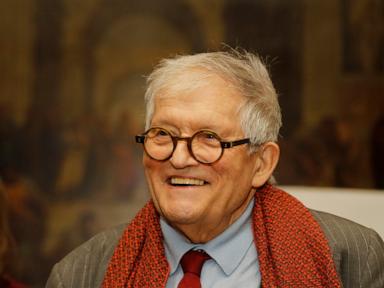
The death of David Hockney at age 88 marks the closure of one of the most financially and conceptually successful careers in contemporary art history. While standard obituary formats catalog his biography through a lens of mid-century bohemianism and British pop art lineage, an analytical deconstruction of Hockney’s career reveals a systematic disruption of two primary vectors: spatial geometry in visual representation and the market economics of living artists.
Hockney’s impact cannot be evaluated purely through aesthetic appreciation. It requires a rigorous assessment of how his work altered the valuation frameworks of twentieth-century art, how his technological adoption shifted production paradigms, and how his signature subject matter—most notably the California swimming pool corpus—served as a highly deliberate solution to a specific formal problem in painterly physics.
The Formal Problem of Fluid Dynamics and Light
The market dominance of Hockney’s 1960s and 1970s paintings depends heavily on his systematic approach to capturing unstable surfaces. The depiction of water in Western painting historically relied on standardized impressionistic codes or rigid classical glazing. Hockney treated the swimming pool not as a luxury lifestyle motif, but as a complex technical problem involving the intersection of three distinct physical properties: reflectivity, transparency, and two-dimensional flattening.
The Tri-Chromatic Spatial Framework
To solve the visual paradox of showing a surface that is simultaneously transparent and highly reflective, Hockney discarded the traditional tonal gradations used by academic realists. Instead, he developed a precise, compartmentalized methodology.
- The Graphic Matrix: Replacing the organic fluidity of water with hard-edged, interlocking linear patterns. These lines functioned as geometric vectors mapping the trajectory of light refracting through moving water.
- The Artificial Horizon: Structuring the composition around sharp architectural grid lines (such as diving boards, modernist glass walls, and concrete coping) to anchors the viewers spatial orientation, making the fluid chaos of the water appear controlled and hyper-real.
- The Matte Surface Medium: Abandoning oil paints early in this period for newly developed acrylics. Acrylic paint dried rapidly, allowing Hockney to apply distinct, unblended layers of color. This prevented the atmospheric depth common to oil painting, forcing the viewer to confront the canvas as a flat, calculated surface rather than an illusionary window.
By reducing the representation of liquid to a series of hard-edged abstract shapes, Hockney bridged the gap between mid-century abstract expressionism and figurative representation. The swimming pool paintings succeeded commercially and critically because they satisfied the period's demand for avant-garde flatness while remaining completely legible to the collector class.
The Economics of Post-War British Art and the Pop Mutation
Hockney’s emergence from the Royal College of Art in London occurred precisely during a structural shift in the global art market. Post-war austerity in the United Kingdom was collapsing, replaced by a consumer culture heavily influenced by American media imagery.
While his contemporaries either leaned into purely industrial imagery or rejected consumerism entirely through gritty kitchen-sink realism, Hockney applied a calculated hybrid strategy. He took the high-art techniques of traditional draftsmanship and applied them to banal or highly commodified subjects.
This created a specific economic leverage point. His work appealed to British institutional gatekeepers because of his undeniable technical mastery of line and printmaking, while simultaneously attracting international commercial galleries because his subject matter was aligned with the rising tide of global media consumption. The deliberate cultivation of his personal brand—characterized by bleached hair, thick-rimmed glasses, and mismatched sartorial choices—was not merely eccentric behavior; it functioned as an early form of market differentiation that linked the value of the physical artwork directly to the recognizable celebrity of its producer.
Technological Monopolization and Production Scale
A recurring bottleneck for highly successful artists is the physical limitation of production scale. A single painter working with traditional mediums can only produce a finite number of masterworks per fiscal year, creating an asset-scarcity problem that limits gross market penetration.
Hockney bypassed this systemic constraint through a multi-decade strategy of technological adoption. He systematically integrated new reproduction technologies into his studio practice, not as tools for passive duplication, but as primary mediums for original creation.
The Evolution of Hockney’s Production Vectors
[Polaroid Composite Photography (1980s)]
       │
       ▼ Reduces temporal lag; introduces cubist multi-perspective grid.
[Color Photocopiers and Fax Machines (1990s)]
       │
       ▼ Democratizes distribution; eliminates logistics overhead for exhibitions.
[Digital Tablets and Stylus Inputs (2010s)]
       │
       ▼ Removes physical dry-time bottlenecks; allows instant global distribution.
The transition to digital mediums, specifically the iPad, represented a fundamental shift in Hockney’s cost function. The marginal cost of producing an additional digital mark fell to zero. Pixels eliminated the expenses associated with physical canvas preparation, pigment sourcing, and drying time bottlenecks.
Crucially, this digital pivot did not dilute his market value. By outputting these digital files as limited-edition, large-format inkjet prints signed and numbered in highly restricted runs, Hockney maintained artificial scarcity while drastically reducing the labor hours required per square meter of finished product. The market accepted these digital outputs as authentic masterworks because they carried the same structural handwriting—the distinct vector-like line-work—developed during his analog career.
Market Dynamics: The Mechanics of Liquidity and Peak Valuation
The financial peak of Hockney’s career offers a clear case study in how scarcity, provenance, and historical canonization interact to drive asset inflation in the secondary art market. The benchmark event occurred in November 2018, when his 1972 painting, Portrait of an Artist (Pool with Two Figures), sold at Christie's for $90.3 million. At the time, this transaction established a new global record for the most expensive work by a living artist sold at auction.
       [Historical Rarity: 1970s Pool Masterworks held in permanent museum collections]
                                      │
                                      ▼
             [High Provenance: Celebrated institutional exhibition history]
                                      │
                                      ▼
      [Consensus Asset Class: Low-risk vehicle for ultra-high-net-worth capital]
                                      │
                                      ▼
[Final Auction Cleared Valuation: $90.3 Million (Zero Third-Party Irrevocable Bids)]
This valuation was driven by three distinct structural variables:
- The Culmination Vector: The canvas combined Hockney's two most valuable thematic categories: the pristine swimming pool environment and the double-portrait format.
- Institutional Validation: The painting had spent decades cycling through premier global retrospectives (including Tate Britain, the Centre Pompidou, and the Metropolitan Museum of Art). This continuous museum exposure removed all speculative risk for institutional and private buyers, converting the artwork from a volatile cultural artifact into a blue-chip financial instrument.
- Absence of Guarantees: The auction lacked a third-party irrevocable bid or a house guarantee, meaning the final price was driven entirely by unmanipulated market demand between competing ultra-high-net-worth individuals. This provided a transparent metric of his true market ceiling.
Post-Mortem Estate Dynamics and Strategic Prognosis
The death of a primary market anchor inevitably triggers an immediate realignment of asset distribution and valuation strategies. For the Hockney estate and the galleries representing his archives, the objective shifts from managing an active living artist to protecting a finite historical legacy.
The immediate consequence of his passing at 88 is the hard capping of supply. No new catalog entries can be generated. The David Hockney Foundation, which holds a vast repository of unreleased works, early drawings, and personal archives, now becomes the primary mechanism for price stabilization.
The Estate Management Protocol
To prevent market saturation and ensure long-term value appreciation, the estate must execute a precise three-part operational strategy.
- Phased Institutional Gifting: Systematically donating key historical pieces to international museums. This removes prime assets from commercial circulation permanently, thereby increasing the scarcity and value of the remaining privately held inventory.
- Rigorous Cataloguing and Authentication: Publishing definitive catalogues raisonnés covering his late-career digital outputs and landscape periods. Clarifying the exact edition sizes of the iPad drawings and photographic prints prevents counterfeit contamination and stabilizes secondary market confidence.
- Exhibition Licensing Liquidity: Utilizing block-buster touring retrospectives funded by corporate sponsorships and museum ticket revenue to generate consistent cash flow for the foundation without needing to liquidate major paintings.
The secondary market for Hockney's work will likely experience a short-term liquidity crunch as current owners withhold pieces from auction, anticipating a post-mortem price premium. The sharpest appreciation will occur not within the already saturated swimming pool sector, which is largely locked away in permanent collections, but in his mid-career photo-collages and late-career Yorkshire landscapes. These categories remain undervalued relative to their art-historical importance and present the highest growth potential for institutional and private collectors seeking exposure to the definitive British master of the post-war era.