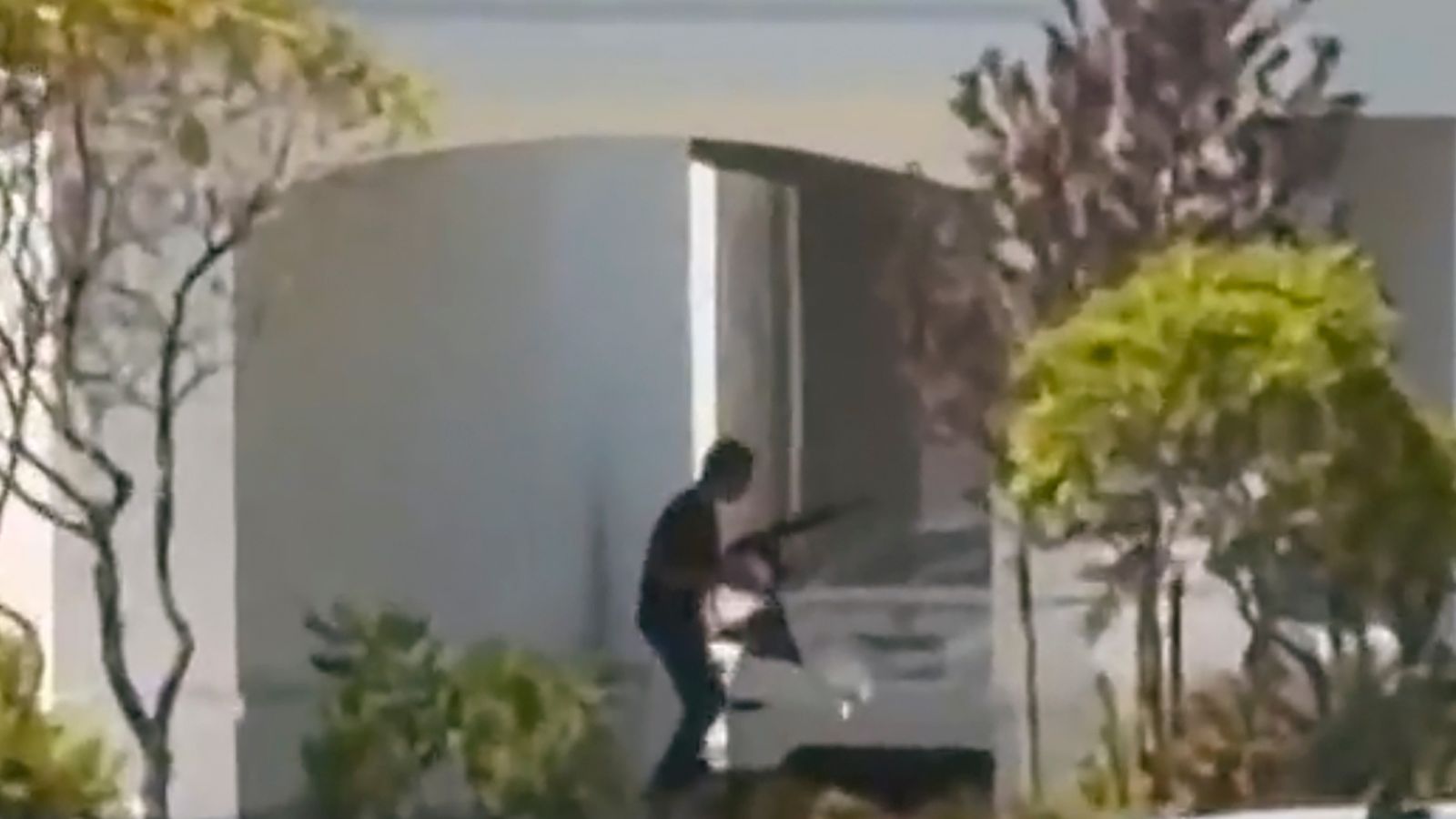
On a Saturday afternoon in Twin Falls, Idaho, an active shooter event materialized at a newly established commercial hub, resulting in three fatalities and seven injuries before terminating with the death of the suspect. The timeline, spanning from the initial report at 2:29 p.m. to the public declaration that the community threat was neutralized, tests the operational capacity of municipal emergency infrastructure. Analyzing events of this magnitude requires stripping away emotional narratives to examine the operational mechanics of first response, public communication loops, and urban spatial vulnerability.
The Spatial and Temporal Variables of Urban Vulnerability
The location choice of the incident—a high-traffic commercial corridor on Blue Lakes Boulevard North featuring a newly opened fast-food establishment—introduces specific density parameters. High-turnover retail zones possess distinct architectural and crowd-flow characteristics that dictate crisis progression:
- High pedestrian density combined with confined vehicular queueing spaces in drive-thru lanes restricts immediate physical egress.
- Proximity to major regional transit arteries, including the Perrine Bridge crossing the Snake River Canyon, creates regional choke points when municipal authorities initiate road closures.
- Rapid accumulation of hundreds of civilians in open-air parking lots transforms a localized interior space into an expansive perimeter security challenge.
When an armed individual emerges from a vehicle carrying an AR-style platform into a crowded public square, the time window for institutional intervention is measured in seconds, forcing civilian populations to execute improvised self-preservation strategies long before tactical units arrive.
The Mechanics of Civilian Intervention and Multi-Agency Response
In chaotic urban settings, the initial phase of incident mitigation frequently relies on non-institutional actors. Eyewitness accounts and digital video documentation from the Twin Falls incident reveal a decentralized response matrix:
- Armed civilian engagement disrupted the continuation of fire, altering the tactical calculus of the assailant before law enforcement units cleared the perimeter.
- Internal staff execution of emergency protocols—such as directing patrons toward kitchen exits and locking spatial zones—mitigated higher casualty concentrations inside the facility.
- Municipal and federal coordination, involving the Twin Falls Police Department, Idaho State Police, and the Federal Bureau of Investigation, established structural containment within hours.
The identification of the deceased suspect near the immediate scene resolved the acute phase of the threat, yet initiated a secondary operational phase centered on forensic investigation and casualty verification.
The Information Propagation Function and Public Safety Communication
A critical vector in modern crisis management is the control of informational entropy. Within minutes of the initial shots, social media distribution networks generated conflicting casualty figures and unverified hypotheses. Municipal public information officers faced a dual mandate: stabilizing the physical perimeter and suppressing digital misinformation.
The initial divergence between preliminary county commissioner estimates of five injured and subsequent municipal updates citing seven injured and three dead highlights the friction inherent in early-stage casualty accounting. Emergency medical systems, such as St. Luke's Magic Valley health network, implemented procedural lockdowns and visitor restrictions to protect clinical triage workflows from operational interference.
Future municipal resilience depends on standardizing real-time data feeds between regional trauma centers, municipal public information desks, and state-level emergency management apparatuses to compress the feedback loop between incident containment and public clarity.