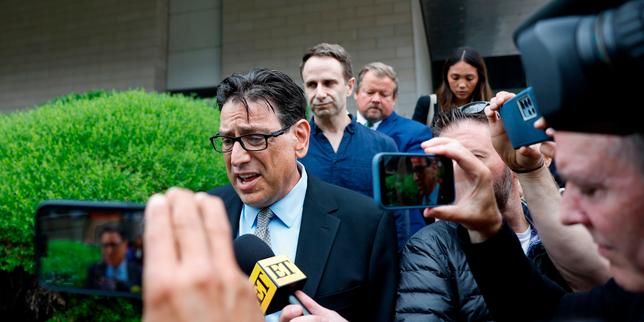
The final moments of Matthew Perry’s life were not spent in the company of friends or family, but under the influence of a surgical anesthetic administered by a live-in assistant who had no medical training. On Wednesday, the man who facilitated that fatal supply, Erik Fleming, was sentenced to two years in federal prison. While the headline focuses on the term served, the court proceedings revealed a far more disturbing reality about the ecosystem that sustains high-profile addiction in Los Angeles.
Fleming, a 56-year-old former producer turned drug counselor, admitted to acting as the bridge between the "Ketamine Queen" of North Hollywood and a desperate movie star. His sentencing marks the penultimate chapter in a federal investigation that has peeled back the layers of a sophisticated distribution network—one that utilized doctors, assistants, and mentors to exploit a man whose struggle with sobriety was the most public battle of his life.
The Cost of Access
Between September and October 2023, the operation to supply Perry with ketamine shifted from the clinical to the criminal. When the actor’s legitimate medical providers refused to increase his dosages for depression treatment, he turned to a shadow economy.
Fleming’s role was logistical. He procured the drug from Jasveen Sangha—recently sentenced to 15 years—and delivered it to Perry’s residence. These were not small-scale transactions. In the four days preceding Perry’s death, Fleming delivered 25 vials of ketamine for $6,000 in cash. He admitted in court that he marked up the price to turn a profit, treating a "friend" in crisis as a revenue stream.
The mechanics of the exchange were chillingly efficient.
- The Source: Jasveen Sangha, operating a "drug emporium" from her home.
- The Middleman: Erik Fleming, leveraging his trust as a counselor to facilitate the buy.
- The Enabler: Kenneth Iwamasa, Perry’s assistant, who performed the injections.
- The Exploiters: Doctors Salvador Plasencia and Mark Chavez, who viewed Perry as a "moron" to be milked for thousands of dollars.
A Counselor’s Betrayal
The most jarring aspect of Fleming’s involvement is his professional background. As a licensed drug addiction counselor, he was ethically and legally bound to protect individuals from the very substances he was hand-delivering. His defense argued that Fleming himself had relapsed following a personal tragedy, suggesting he was a victim of the same cycle he was supposed to break.
However, the prosecution successfully argued that his expertise made his crime more heinous. He understood the pharmacology. He knew the risks of respiratory depression and the dangers of unsupervised administration. Yet, he chose to facilitate the distribution of 50 vials of ketamine in total to a man he knew was spiraling.
Judge Sherilyn Peace Garnett’s decision to hand down a two-year sentence—lighter than the four years suggested by federal guidelines—reflects Fleming’s "extraordinary cooperation." He was the first to plead guilty and provided the roadmap that led authorities to the higher levels of the supply chain. But for the Perry family, no amount of cooperation mitigates the fact that a recovery professional became a concierge for the drug that killed their son.
The Doctor Factor
While Fleming provided the physical product, the moral erosion began with the medical community. Dr. Salvador Plasencia, sentenced to 2.5 years, and Dr. Mark Chavez, who received eight months of home detention, provided the blueprint for Perry’s downfall.
The investigation uncovered text messages where the physicians joked about the actor’s willingness to pay. This wasn’t just a failure of care; it was a targeted extraction of wealth from a vulnerable person. By the time Fleming entered the picture, the guardrails had already been dismantled by the very people wearing white coats.
The legal system often struggles with the blurred lines of "assisted" overdoses. In this case, the Department of Justice made a calculated move to treat the network as a conspiracy. By charging the middleman, the assistant, and the suppliers with distribution resulting in death, they signaled an end to the era where Hollywood enablers could hide behind the "accidental" nature of a celebrity’s passing.
The Assistant Awaiting Fate
The final piece of the puzzle remains Kenneth Iwamasa. As the individual who actually pushed the plunger, his sentencing on May 27 will likely be the most scrutinized. Iwamasa’s plea agreement detailed how he was taught to inject Perry by Dr. Plasencia, eventually administering six to eight shots a day in the actor's final week.
On the day he died, Perry reportedly told Iwamasa to "shoot me up with a big one" before getting into his hot tub. Iwamasa complied and left the house to run errands. When he returned, the "Friends" star was face down in the water.
This case exposes the terrifying isolation of extreme fame. Perry was surrounded by a staff of people whose livelihoods depended on his satisfaction, creating a feedback loop where the word "no" ceased to exist. Fleming, Sangha, and the doctors were simply the vendors in a marketplace built on that silence.
The two years Fleming will spend in prison are a fraction of the time Perry spent trying to get sober. The tragedy is not just that he died, but that the very systems meant to save him—addiction counseling and medicine—were the ones that cleared the path for his exit.