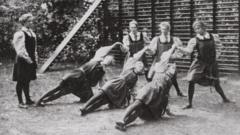
In late Victorian England, women were expected to be delicate, quiet, and physically frail. Tight corsets locked down breath, while social etiquette kept young women firmly on the sidelines of active life.
Then came Martina Bergman-Österberg. For another perspective, read: this related article.
She didn't just want women to take up space. She wanted them strong, capable, and completely independent. Long before netball became a global sport played by millions, it was a bold feminist experiment designed to reshape female bodies and break open political barriers. Bergman-Österberg set out with an explicit goal that shocked Victorian society: she wanted to build physically perfect women who could demand the right to vote and earn their own living.
Her work laid the groundwork for modern women's athletics, physical education, and netball itself. Yet her name rarely shows up in mainstream history books. Understanding how she turned exercise into a tool for female emancipation reveals a lot about the sports we play today. Further coverage on this trend has been provided by The Athletic.
Breaking the Victorian Mold of Female Frailty
Victorian doctors regularly claimed that strenuous physical activity would damage a woman's reproductive organs. Medical experts warned that running, jumping, or sweating could cause nervous breakdowns or permanent bodily harm. Middle- and upper-class women were encouraged to remain passive, sheltered inside restrictive clothing.
Martina Bergman-Österberg thought that was nonsense.
Born in Sweden in 1849, she trained at the Royal Central Gymnastics Institute in Stockholm, where she mastered Swedish gymnastics—a system created by Pehr Henrik Ling focused on precise, methodical movements designed to build balance, posture, and core strength. Sweden was far ahead of Britain in understanding physical health, and Bergman-Österberg saw exercise as a prerequisite for equality.
When she arrived in London in 1881 to take a job with the London School Board, she found a school system where girls got virtually no physical training. She changed that immediately.
Within a few years, she trained thousands of female teachers to deliver daily exercise routines to working-class schoolgirls across London. She discarded tight corsets and heavy skirts, forcing her students to wear loose tunics that allowed free movement. For many girls, this was the first time in their lives they were encouraged to jump, stretch, and breathe deeply.
The Birth of Netball inside Hampstead and Dartford
In 1885, Bergman-Österberg took her vision a step further by founding the Hampstead Physical Training College—the first institution of its kind in Britain. She later moved the college to Dartford in Kent, building a dedicated space where young women trained to become professional physical education instructors.
She didn't run a gentle finishing school. Her regimen was intense.
Students woke early, ran outdoor tracks, lifted weights, swam, and mastered anatomy and physiology. Bergman-Österberg demanded academic excellence alongside physical mastery. She wanted her graduates to be respected professionals who could command real salaries, financial independence, and social respect.
Around 1895, an American visitor brought a new indoor game called basketball to the college. The original rules involved throwing a heavy ball into peach baskets hung on walls.
When Bergman-Österberg's students tried playing it outdoors on grass, the indoor rules didn't work well. The ball bounced poorly on wet turf, and the tall, rigid indoor baskets were impractical.
Rather than abandoning the game, they adapted it. They replaced the peach baskets with open rings tied to posts and swapped the heavy basketball for a lighter ball. Because players were restricted to designated zones on the grass to prevent violent collisions, the game shifted focus toward rapid passing, spatial awareness, and tactical movement.
That modified lawn game became netball.
Bergman-Österberg saw netball as the ideal team sport for women. It required stamina, quick thinking, and tight coordination, without relying on brute force or physical contact that Victorian critics would label unladylike. By 1901, formal rules for netball were published, and the sport rapidly spread across British schools and the wider Empire.
Exercise as a Weapon for Political Suffrage
For Bergman-Österberg, physical fitness was never just about health or recreation. It was direct political activism.
She was an ardent suffragette who believed that physical strength and political power went hand in hand. In her view, if women wanted equal rights, they had to prove they possessed equal stamina, discipline, and capability. Weak bodies, she argued, made it easier for male-dominated institutions to keep women dependent.
Her graduates—often called Österberg's physical training pioneers—spread across Britain and the wider British Commonwealth. They set up physical education programs in elite girls' schools, normal colleges, and community centers. Everywhere they went, they brought a clear message: women have an inherent right to physical autonomy and health.
Her students didn't just teach gymnastics and netball; they supported the fight for women's suffrage. They marched in demonstrations, organized rallies, and financially backed suffrage organizations. By proving that women could manage physical colleges, earn higher education degrees, and maintain thriving careers, they dismantled the myth that women were naturally unfit for public life.
Why Bergman Österberg Legacy Was Overshadowed
If Bergman-Österberg contributed so much to education and women's sports, why isn't she a household name today?
Part of the reason lies in how history records sporting origins. Early netball history was often treated as an accidental variation of basketball rather than an intentional, feminist redesign. Because netball developed primarily within female-only institutions and schools, male sports writers and historians largely ignored it for decades.
Another reason stems from Bergman-Österberg's complex, uncompromising personality. She was notoriously strict, highly demanding, and held views on physical perfection that aligned with the late 19th-century focus on eugenics and racial fitness. While her primary drive was women's liberation, her rhetoric around building a stronger nation through physical training matched the nationalist tones of her era. That blend of radical feminism and Victorian social theory makes her legacy nuanced and hard to fit into simple historical boxes.
Still, her practical achievements remain striking:
- She established physical education for girls as a standard part of the British school curriculum.
- She opened up professional career pathways for women in sports science, physical training, and health education.
- She gave birth to netball, a sport now played by over 20 million people in more than 80 countries.
- She provided a concrete model for how physical autonomy supports political rights.
How to Apply Her Movement Principles Today
Bergman-Österberg's core philosophy was simple: physical capacity drives confidence and autonomy. You don't need expensive gear or complex routines to build genuine functional strength.
If you want to apply her high-discipline approach to your own training, focus on these clear steps:
- Prioritize posture and spinal alignment over raw weight loads. Master basic bodyweight movements—lunges, bodyweight squats, and shoulder mobility drills—before adding extra resistance.
- Build functional movement into daily routines. Do not treat exercise as an isolated one-hour block. Maintain daily mobility work, walk frequently, and focus on deep breathing.
- Choose team sports that demand quick decision-making and spatial awareness. Sports like netball, ultimate frisbee, or basketball build cardiovascular endurance while sharpening reflexes.
- Dress for movement, not restriction. Wear clothing that allows full range of motion without restricting breath or posture.
Martina Bergman-Österberg didn't wait for society to grant women permission to be strong. She built the institutions, trained the teachers, and created the sports that made female strength impossible to ignore.