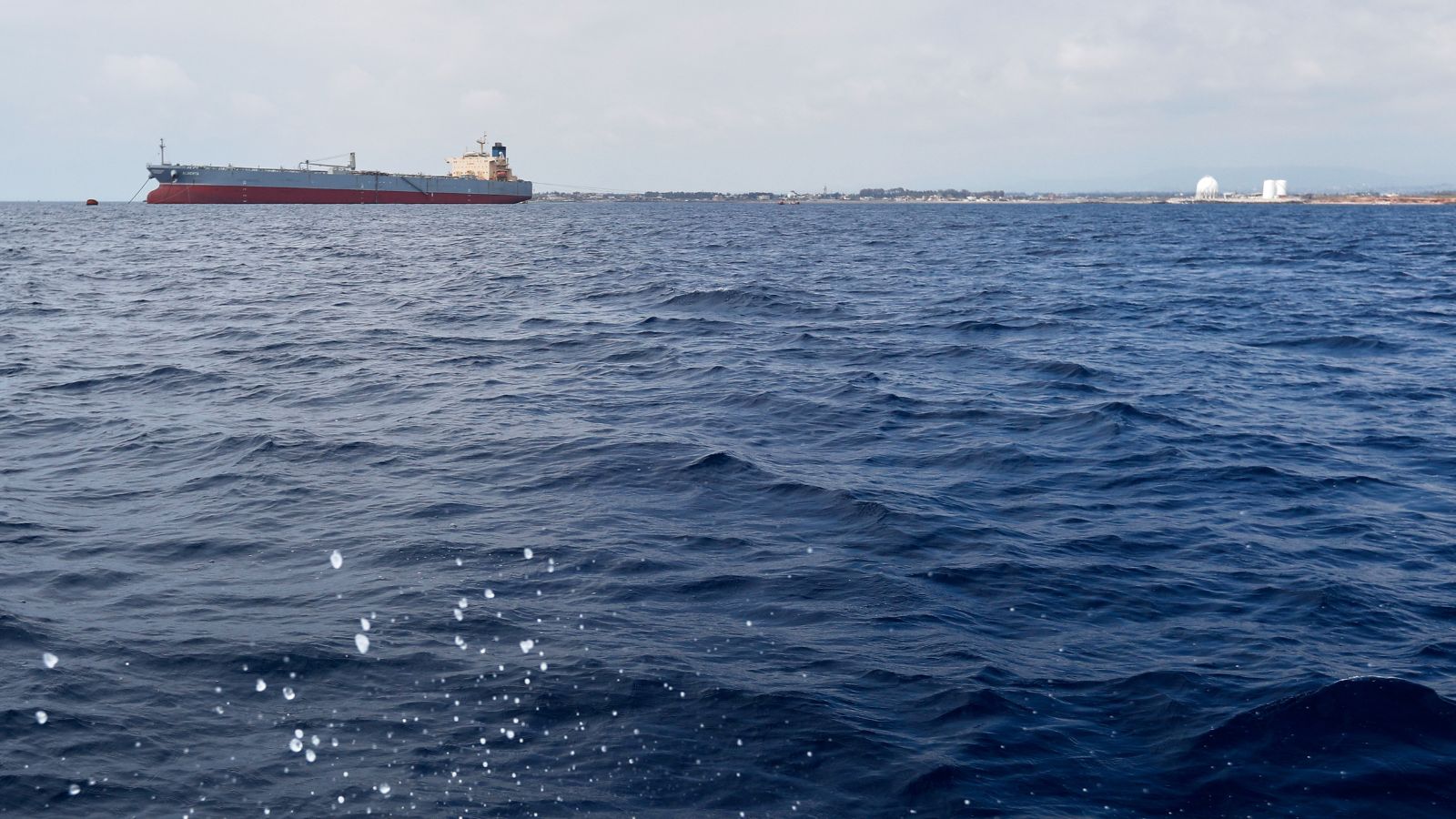
The arrival of a Very Large Crude Carrier (VLCC) at its destination despite a coordinated multilateral blockade is not an accident of luck but the result of a sophisticated, three-tier operational framework designed to exploit the physical and legal frictions of global maritime trade. When an Iranian supertanker successfully delivers a $220 million cargo, it demonstrates a mastery of "dark fleet" mechanics that render traditional enforcement protocols obsolete. The failure of the blockade rests on the inability of state actors to address the fundamental decoupling of a vessel’s physical location from its digital identity.
The Architecture of the Shadow Registry
The primary mechanism for bypassing a blockade is the exploitation of the "Flag of Convenience" (FOC) system. By cycling through registries in jurisdictions with minimal oversight, a vessel owner can effectively reset the ship’s regulatory history. This creates a recursive loop of identity obfuscation that functions through three distinct layers: Discover more on a connected subject: this related article.
- Corporate Layering: The vessel is typically owned by a Special Purpose Vehicle (SPV) based in a jurisdiction like the Marshall Islands or Panama. This SPV is then owned by a shell company in a second jurisdiction, which is managed by a third-party entity in a third. This prevents authorities from seizing assets or applying pressure to the ultimate beneficial owner (UBO).
- The Identity Pivot: During a single voyage, a tanker may change its name, its Maritime Mobile Service Identity (MMSI) number, and its flag state multiple times. These changes often occur in high-traffic corridors like the Malacca Strait or the Sohar anchorage, where the sheer volume of data noise allows a ship to "disappear" and "reappear" as a new entity.
- Technical Spoofing: Advanced AIS (Automatic Identification System) manipulation involves more than just turning off a transponder. Operators now utilize "location spoofing," where a vessel’s AIS signal is broadcast from a different geographic coordinate than its actual position. This is achieved through ground-based or satellite-link manipulation, making the tanker appear to be safely at anchor in a neutral port while it is actually conducting a Ship-to-Ship (STS) transfer in the open ocean.
The Economics of the STS Transfer
The blockade is most vulnerable at the point of the Ship-to-Ship (STS) transfer. This is the operational bottleneck where the cargo’s provenance is officially laundered. For a $220 million cargo, the risk-to-reward ratio for the involved parties justifies the high operational costs of these maneuvers.
The process functions through a "blending" strategy. A sanctioned vessel meets a non-sanctioned vessel in international waters. The oil is transferred, often under the cover of night or in poor weather conditions to evade satellite photography. Once the oil is on the second vessel, it is often re-documented as being of "Malaysian" or "Omani" origin. This "dirty-to-clean" handoff creates a break in the chain of custody that standard customs inspections are ill-equipped to bridge. Further reporting by TIME delves into comparable perspectives on this issue.
The cost function of this operation includes:
- The Risk Premium: Crew members and ship owners involved in the dark fleet command rates 200% to 300% above market averages.
- The Insurance Gap: Because these vessels cannot access the "International Group of P&I Clubs" for insurance, they rely on sovereign guarantees from the exporting nation or shadow insurance schemes. This creates a massive liability risk in the event of an oil spill, which acts as a deterrent for some coastal states but is ignored by others.
- Demurrage and Delay: The time spent loitering in "waiting zones" to coordinate a dark transfer adds significant overhead, but this is offset by the deep discount at which sanctioned oil is sold—often $10 to $20 below Brent benchmarks.
Structural Failures in Sanctions Enforcement
The US blockade fails because it treats a fluid, decentralized network as a static military target. Enforcement relies on "choke point" logic, assuming that by guarding the Strait of Hormuz or the Suez Canal, the flow can be stopped. However, the global tanker fleet is too large, and the incentives for evasion are too high.
The first limitation of current enforcement is the Legal Jurisdiction Gap. International law restricts the ability of a navy to board a foreign-flagged vessel in international waters without the consent of the flag state. If a tanker is flying the flag of a non-cooperative nation, the blockade is legally toothless unless a formal state of war exists.
The second limitation is Data Saturation. Satellite imagery and radio frequency (RF) monitoring provide a constant stream of data, but the "dark fleet" comprises hundreds of vessels. Distinguishing between a legitimate tanker experiencing a technical AIS failure and a sanctioned tanker intentionally spoofing its signal requires a level of real-time analysis that outstrips current naval intelligence capacities. This creates a bottleneck where action can only be taken after the cargo has already been offloaded or blended.
Strategic Logistics of Sanctioned Cargo
The logistics of moving $220 million in oil requires a destination that is willing to provide "sovereign cover." This is usually a refinery in a region with high energy demand and a decoupled financial system. By using local currencies or barter systems (oil-for-goods), the transaction bypasses the SWIFT banking network, removing the primary lever of US economic power.
This creates an asymmetric advantage for the exporter. The US must spend millions of dollars in carrier strike group deployments and satellite time to monitor a single vessel, while the exporter only needs to successfully land one out of every three shipments to remain profitable. The "attrition of enforcement" favors the evader.
The Emerging Tech-Driven Counter-Strategy
To effectively neutralize this logistics chain, the paradigm must shift from physical interdiction to digital and financial isolation. This requires:
- RF Fingerprinting: Every vessel has a unique radio frequency signature based on its communication equipment and engine noise. Building a global database of these "acoustic and electronic fingerprints" would allow authorities to identify a ship even if it changes its name, MMSI, and AIS signal.
- Blockchain Chain-of-Custody: Implementing a mandatory digital ledger for oil molecular signatures would prevent the "blending" of sanctioned crude. If the refinery cannot verify the origin of every barrel through a cryptographic proof, the cargo becomes unmarketable in the global financial system.
- Automated Behavioral Analysis: Moving beyond static AIS monitoring toward AI-driven behavioral modeling. A tanker that deviates from the most fuel-efficient route, lingers in known STS zones, or sits "low in the water" (indicating a full load) despite reporting an empty hold would trigger an automatic high-risk designation.
Necessary Operational Realignment
The blockade of a supertanker is not a naval problem; it is a data and insurance problem. As long as the "dark fleet" has access to flags of convenience and shadow insurance, physical blockades will remain porous. The strategic play is to target the service providers—the registries, the bunker fuel suppliers, and the small-scale insurers—rather than the ships themselves. By making the "cost of concealment" higher than the "discount on the crude," the economic incentive for the shadow registry collapses.
Effective containment requires the immediate establishment of a "White List" for maritime insurance, where any vessel not carrying verifiable, third-party audited insurance is denied entry into any major port or territorial waters. This shifts the burden of proof from the enforcer to the vessel owner, effectively flipping the operational script that currently allows the Iranian fleet to operate with impunity.
The future of maritime sanctions lies in the weaponization of port access and digital identity. Until the "digital twin" of the vessel is as regulated as the physical hull, the blockade remains a performative gesture rather than a functional barrier.