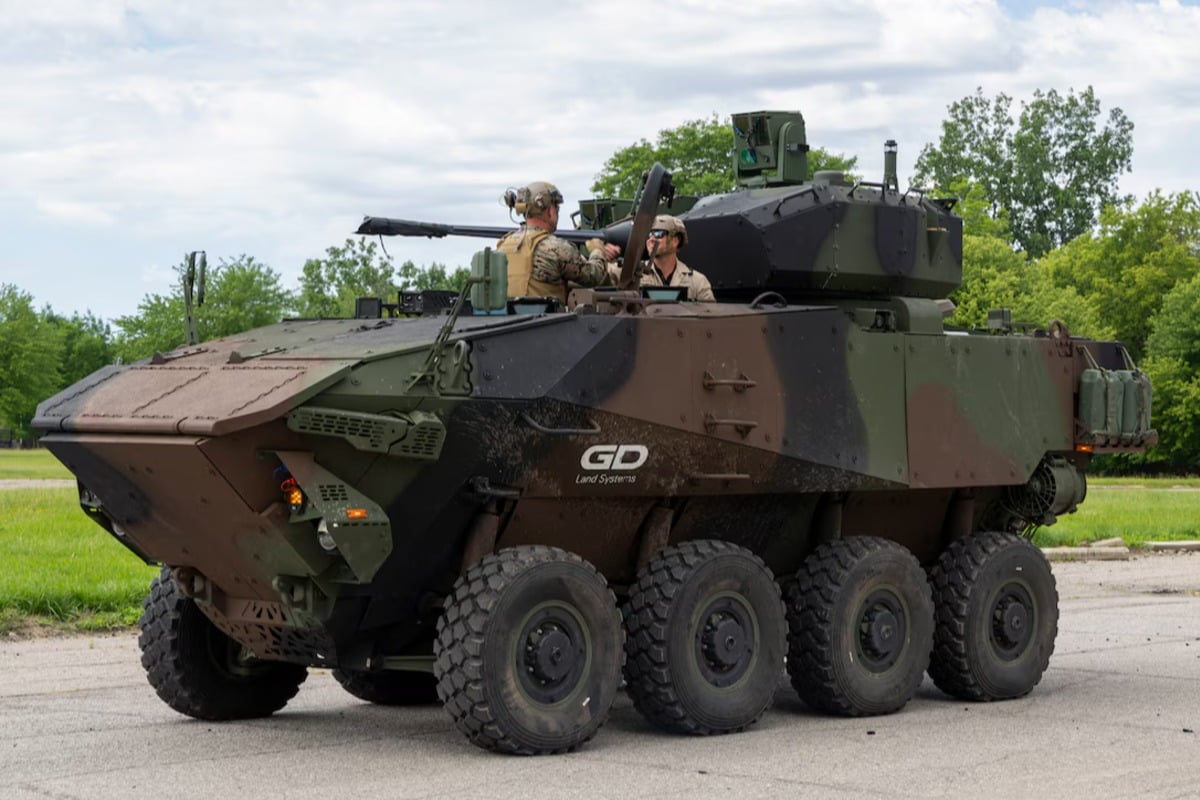
The United States Marine Corps is actively field testing prototypes for its next generation Advanced Reconnaissance Vehicle to replace the aging Light Armored Vehicle fleet that has served since the 1980s. These field trials are designed to evaluate how a modern battlefield scout handles amphibious insertions, multi-domain sensor integration, and contested logistics. However, beneath the press releases and field demonstrations lies a stark operational dilemma. The Marine Corps wants a platform that acts as a mobile command hub, launches autonomous drones, and survives heavy artillery, yet must remain light enough to ship across vast ocean expanses. Balancing these competing demands is proving far harder than military planners anticipated.
The Flaws in the Current Scouting Strategy
For four decades, the eight-wheeled Light Armored Vehicle, or LAV-25, served as the primary eyes and ears of Marine air-ground task forces. It was fast, relatively light, and equipped with a 25mm chain gun that gave infantry commanders immediate fire support. But modern anti-armor weapons, thermal optics, and long-range precision strikes have turned light armor into an extremely vulnerable asset. Also making headlines lately: Why Summons and Condemnations expose the Deep Failure of Maritime Policy.
When defense officials recognized that legacy scout cars could no longer survive in high-intensity combat, they initiated the Advanced Reconnaissance Vehicle program. The goal was simple on paper. Build a family of wheeled vehicles capable of gathering data, jamming enemy signals, and coordinating fire support without getting destroyed on arrival.
In practice, the operational concept has ballooned into an overcrowded wish list. More insights regarding the matter are detailed by The Washington Post.
Military analysts who study light armor doctrine point to a recurring historical trap. Every time a armed force tries to build a light reconnaissance vehicle, engineers stack on additional armor, heavier weapons, electronic countermeasures, and sophisticated communications suites. Weight rises rapidly. Mobility drops. The vehicle eventually becomes too heavy for rapid transport aircraft and small landing craft, defeating the initial reason for its existence.
The Marine Corps now stands directly in that trap.
The Drone Launching Hub vs Heavy Weight Armor
The core design philosophy of the new vehicle centers on offboarding lethality. Rather than relying solely on a direct-fire cannon to destroy targets, the vehicle acts as a node that controls uncrewed aerial systems and loitering munitions.
In recent field testing, crews deployed small tethered and untethered drones straight from the hull. These platforms extend the vehicle's line of sight over terrain obstacles and coastal shorelines, feeding real-time target data back to command networks.
That digital capability creates a massive power and weight burden.
Consider a hypothetical operational unit deployed on an isolated Pacific island. A single vehicle carrying high-powered radar array systems, continuous drone battery charging stations, satellite uplink terminals, and climate-controlled computing racks requires substantial internal space and continuous electrical generation. To power those sub-systems, manufacturers must install larger diesel engines or complex hybrid-electric powertrains.
Larger engines require bigger fuel tanks and heavier suspension assemblies.
Suddenly, a scout vehicle designed to slip quietly onto a beachhead weighs over thirty tons. At that mass, traditional ship-to-shore connectors struggle to move multiple vehicles simultaneously. Strategic transport aircraft can carry only one or two units per flight, clogging logistics pipelines during a crisis.
Electronic Signatures will Get Scouts Killed Fast
An even greater hazard involves electromagnetic visibility. Modern battlefields are saturated with radio frequency detectors, thermal imagers, and signal interceptors.
A vehicle emitting constant high-bandwidth signals to control swarms of drones and transmit targeting feeds becomes a giant beacon on electronic warfare maps. Adversaries do not need to visually spot the vehicle through tree canopies or urban alleys. They simply track the dense cloud of radio emissions back to its origin and launch a salvo of long-range rockets.
Engineers are testing directional antennas, low-probability-of-intercept radios, and burst transmission protocols to mitigate this danger. Yet the fundamental physics remains unyielding. You cannot run a powerful command and control node without broadcasting energy into the environment.
Field commanders are forced to choose between two risky operating modes. They can turn off their electronic sensors to stay hidden, rendering their multimillion-dollar data hub functionally blind. Alternatively, they can transmit at full power to direct strikes, knowing that every radio pulse risks revealing their position to enemy artillery batteries.
The Industrial Base Reality and Cost Overruns
Beyond tactical concerns, the acquisition process exposes severe vulnerabilities in modern defense manufacturing.
The Marine Corps has evaluated prototypes from major defense contractors including General Dynamics Land Systems and Textron Systems. Each prototype offers distinct mechanical configurations, sensor packages, and hull geometries. Yet both programs face the reality of high unit costs and supply chain constraints.
Production lines for specialized combat vehicles are narrow. Microchip shortages, specialized steel fabrication bottlenecks, and skilled labor deficits regularly delay delivery schedules. As engineering teams add new capability requirements to meet emerging battlefield threats, unit costs soar.
When a single reconnaissance vehicle costs as much as a platoon of standard troop carriers, commanders become risk-averse. They hesitate to push expensive, irreplaceable assets close to contested front lines. That caution destroys the primary function of a scout, which is to make contact with the enemy and uncover hidden threats before main forces arrive.
Rethinking the Light Armor Equation
Some military tacticians argue that building a monolithic, highly expensive scout vehicle is an obsolete approach. They advocate for a distributed network of much smaller, low-cost, uncrewed ground vehicles paired with light commercial utility trucks fitted with modular sensor kits.
Under this alternative model, losing an individual remote scout vehicle causes minimal financial or tactical damage. Infantry squads can distribute sensors across multiple simple platforms rather than concentrating all capability inside a single thirty-ton armored hull.
The Marine Corps leadership has partially acknowledged this argument by continuing to refine its overall force structure under recent organizational overhauls. They have retired heavy tanks and reduced conventional tube artillery in favor of mobile rocket launchers and flexible infantry units. Yet the desire for a heavily protected, highly capable crewed scout vehicle remains deeply embedded in tactical planning.
The ongoing field tests will demonstrate whether advanced suspension systems and automated software can overcome the physical limits of weight and electromagnetic exposure. Mechanics are currently pushing these prototypes through muddy terrain, ocean surf, and deep sand to discover mechanical failure points. Engineers are pounding sensor arrays with simulated jamming to measure signal resilience.
The testing data will force hard choices. Marine planners will either have to accept a heavier, more expensive platform that requires specialized transport, or strip away advanced features to keep the vehicle light, fast, and expendable. Trying to achieve every operational goal inside a single chassis will result in a vehicle too heavy to transport quickly and too noisy to survive when it arrives.