The fluorescent lights in a basement kitchen in Haifa hum at a frequency you only notice when the air raid sirens stop.
Silence, in a conflict zone, is never peaceful. It is a held breath.
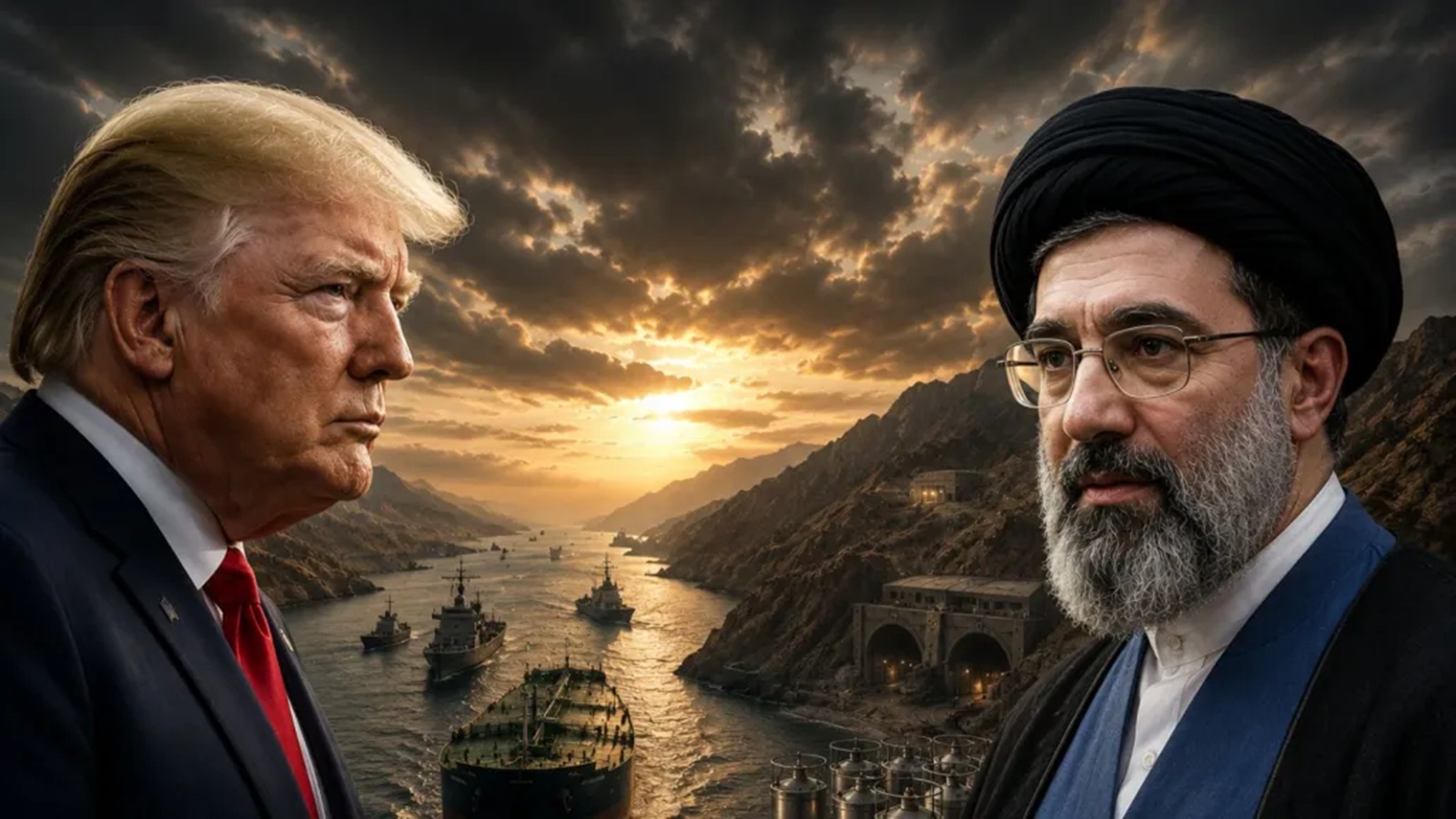
Consider a hypothetical family sitting around a laminate table in northern Israel just past midnight. Let us call the father David, an electrical engineer who spent thirty years calibrating power grids, and his daughter Maya, a university student whose suitcase has sat packed by the front door since autumn. On the small television mounted near the refrigerator, a news ticker scrolls across the bottom of the screen in stark white letters. The words are clinical, diplomatic, and stripped of all oxygen. Mojtaba Khamenei, the son of Iran’s Supreme Leader and a man long rumored to be the quiet architect behind Tehran’s most secretive security apparatuses, has issued a warning to the United States and Israel. Any further escalation, the statement reads, will trigger a response "without geographic limits."
David reaches out and turns the volume down. He does not look at Maya. He looks at the map of the world taped to the pantry door—a relic from Maya’s high school geography class, faded yellow at the edges.
For decades, wars in the Middle East came with borders drawn in thick, predictable ink. You knew where the front line was. You knew which skies belonged to the jets and which oceans belonged to the carriers. When politicians traded threats in Tehran, Tel Aviv, or Washington, ordinary people could measure their personal risk with a ruler and a compass. You checked the distance from the border. You calculated the range of a ballistic missile. You bought extra water if you lived within three hundred kilometers of a launchpad, and you slept soundly if you lived three thousand miles away in a quiet suburb outside Chicago or a coastal apartment in Marseilles.
Four words just erased the compass.
"Without geographic limits."
To a diplomat sitting in a wood-paneled briefing room in Brussels or Washington, that phrase looks like standard geopolitical bluster—the kind of maximalist rhetoric regimes deploy when they feel cornered, aging, or desperate to project strength to a domestic audience. Analysts will spend days parsing the syntax, debating whether Mojtaba Khamenei is signaling an impending succession in Tehran or merely echoing the hardline consensus of the Islamic Revolutionary Guard Corps. They will treat it as a chess move.
To David, staring at that faded map in Haifa, it is not a chess move. It is the realization that the walls of the room have just vanished.
The Architecture of an Invisible Front
To understand why those four words carry a chill that conventional military threats never quite achieve, you have to step away from the satellite imagery of missile silos and look at how modern asymmetric warfare actually breathes.
I remember standing on the tarmac of an international airport in Europe several years ago during a sudden security lockdown. No bombs had fallen. No planes had been hijacked. Yet four thousand people stood frozen beside their rolling luggage for six hours because a single encrypted message had been intercepted three continents away. You could feel the collective pulse of the terminal spike. Every unattended backpack became a suspect. Every stranger checking a watch became a threat. That is the psychological engine of unbounded conflict: you do not need to destroy a city to paralyze it. You only need to convince the people inside it that nowhere is out of bounds.
When a figure of Mojtaba Khamenei’s stature—a cleric who rarely speaks publicly, preferring the shadowy corridors of intelligence and paramilitary coordination over the podium—steps into the light to erase geographic boundaries, he is not talking about flying fighter jets over New York or marching infantry into Tel Aviv. Iran does not possess a conventional navy capable of crossing the Atlantic, nor an air force that could survive an hour against American stealth interceptors.
Tehran knows this. Washington knows this. Jerusalem knows this.
So what does "without geographic limits" actually mean in the physical world?
Think of traditional warfare like a boxing match inside a roped ring. Both fighters know the dimensions of the canvas. They know the rules of engagement, the weight classes, and the bell that ends the round. Now imagine one fighter steps through the ropes, walks out into the parking lot, and announces that the fight now includes the referees, the spectators’ cars, the electrical substation down the street, and the grocery stores where the fighters’ families shop.
That is the reality of modern proxy networks and covert operational cells. Over the last forty years, Iran has built something far more durable than a conventional army: an archipelago of influence stretching from the Levant to the Red Sea, and quiet logistical footprints reaching into South America, Europe, and beyond. Through groups like Hezbollah in Lebanon, the Houthis in Yemen, and various militias across Iraq and Syria, Tehran has mastered the art of fighting at arm’s length.
When Mojtaba Khamenei removes geographic limits, he is signaling that the retaliatory menu is no longer restricted to military bases in the Persian Gulf or border towns in the Galilee. It stretches to commercial shipping lanes in the Bab el-Mandeb Strait, where a single Houthi drone can reroute global supply chains and drive up the price of winter coats in London. It stretches to diplomatic compounds in distant capitals, cyber infrastructure governing municipal water supplies, and soft targets where the uniforms disappear entirely.
The Man Behind the Curtain
There is a reason this specific warning landed with heavier weight than the routine Friday prayer sermons broadcast from Tehran. It comes down to the messenger.
For most of his adult life, Mojtaba Khamenei has been a ghost in the machine of the Islamic Republic. Born in Mashhad in 1969, ten years before the revolution toppled the Shah, he grew up inside the crucible of clerical power. Unlike his father, Ayatollah Ali Khamenei, who spent decades at the center of public rallies and televised addresses, Mojtaba cultivated silence. He taught theology in Qom, kept a low public profile, and quietly wove himself into the nervous system of the state: the Basij paramilitary forces, the intelligence ministries, and the senior command of the Revolutionary Guards.
In Washington and Jerusalem, intelligence officials have tracked his shadow for twenty years, watching how influence flows through his office like water through underground pipes. When a man who builds his power on discretion suddenly uses explicit, global threats, it tells you two things simultaneously.
First, it signals internal consolidation. With Ali Khamenei well into his eighties, the question of who inherits the mantle of Supreme Leader hangs over every calculation in Tehran. By stepping forward as the voice of uncompromising deterrence, Mojtaba is speaking not only to external adversaries in the United States and Israel, but also to rival factions inside Iran’s own political establishment. He is demonstrating that he holds the reins of the security apparatus—and that he will not flinch.
Second, it reveals acute vulnerability. Regimes that feel invulnerable rarely threaten to burn down the entire neighborhood. Over the past two years, Tehran has watched its carefully constructed "Ring of Fire" around Israel take devastating blows. Senior commanders have been assassinated in fortified compounds. Air defense batteries have been blinded. The psychological aura of untouchability that Iran spent decades cultivating has cracked.
Fear, when cornered, becomes expansive. If you cannot win a localized duel against superior technology, you threaten to turn the entire globe into a chessboard.
The Cost Measured in Kitchens, Not Capitals
It is easy to get lost in the grand geometry of deterrence theory. Strategists love words like escalation dominance, vertical integration, and asymmetric parity. Those terms make war sound clean, like an equation solved on a glass whiteboard.
They hide the human toll.
Consider a second hypothetical scenario, this one three thousand miles west of Tehran, in a small import-export office near the port of Rotterdam. Let us introduce Marcus, a logistics coordinator whose job consists entirely of tracking container ships moving between Asia and Europe. Marcus has no opinion on clerical succession in Qom. He has never visited Washington or Jerusalem.
Yet three days after a threat "without geographic limits" triggers heightened naval alerts in the Red Sea and the Persian Gulf, Marcus watches his computer screen turn red. Marine insurance premiums for vessels transiting the Suez corridor spike overnight. Three major shipping lines announce immediate diversions around the Cape of Good Hope—adding fourteen days and a million dollars in fuel costs to every single voyage.
Within six weeks, that single sentence uttered in Tehran shows up as a twelve percent price hike on medical supplies in Madrid, delayed automotive parts in Detroit, and higher heating bills for a retired schoolteacher in Ohio.
Invisible stakes. Unseen shockwaves.
And what of the ordinary people inside Iran itself? Walk down Valiasr Street in Tehran on a crisp autumn evening, and you will not find a population clamoring for global confrontation. You will find young software engineers trying to bypass internet firewalls to freelance for European clients. You will find mothers calculating how many eggs their dwindling rials can buy after years of crushing international sanctions and runaway inflation. For millions of Iranians, the rhetoric of limitless confrontation feels like a heavy iron door slamming shut on their own future—a guarantee of deeper isolation, harsher economic suffocation, and the terrifying possibility that the skies above their own homes could soon ignite.
I admit, writing about these cascading dominoes brings a familiar, cold knot to my stomach. Anyone who claims to know with certainty where this spiral stops is either lying or selling something. Deterrence is a psychological tightrope strung over an abyss; it works flawlessly right up until the exact millisecond one side misreads the wind.
The Trap of Infinite Deterrence
History offers a grim warning to leaders who declare that their reach has no boundaries.
In the summer of 1914, the great powers of Europe entangled themselves in a web of alliances so rigid and expansive that a single gunshot in Sarajevo dragged empires from London to St. Petersburg into industrial slaughter. Each capital believed that threatening total, boundless retaliation would force the other side to back down. Instead, removing limits removed off-ramps. When every border is a front line, every minor skirmish becomes an existential crisis.
Modern intelligence agencies operate under that exact nightmare today.
If a cyberattack disrupts a regional hospital network in the American Midwest tomorrow, or an explosive device is discovered outside an embassy in South America, how does Washington respond? Is it a rogue criminal syndicate, a lone wolf inspired by online propaganda, or the opening move of Mojtaba Khamenei’s borderless campaign?
Ambiguity is the deadliest accelerant in geopolitics. When a leader vows a response without geographic limits, they inadvertently claim responsibility for every shadow that moves in the dark. Any incident anywhere in the world risks being interpreted by the United States or Israel as the crossing of a red line—demanding a counterstrike that Tehran may not even have ordered, against targets Tehran cannot defend.
Back in that basement kitchen in Haifa, David finally stands up from the laminate table. He walks over to the pantry door, reaches up, and gently peels the faded paper map off the wood. He folds it neatly along its worn creases—once, twice, three times—until the continents disappear into a small, thick square no larger than his palm, and slips it into a kitchen drawer.
Maya watches him from across the room, her hand resting on the handle of her packed suitcase.
"Where are we going?" she asks quietly.
David looks at the closed drawer, then back at his daughter, knowing that for the first time in his life, the map has no answer left to give.