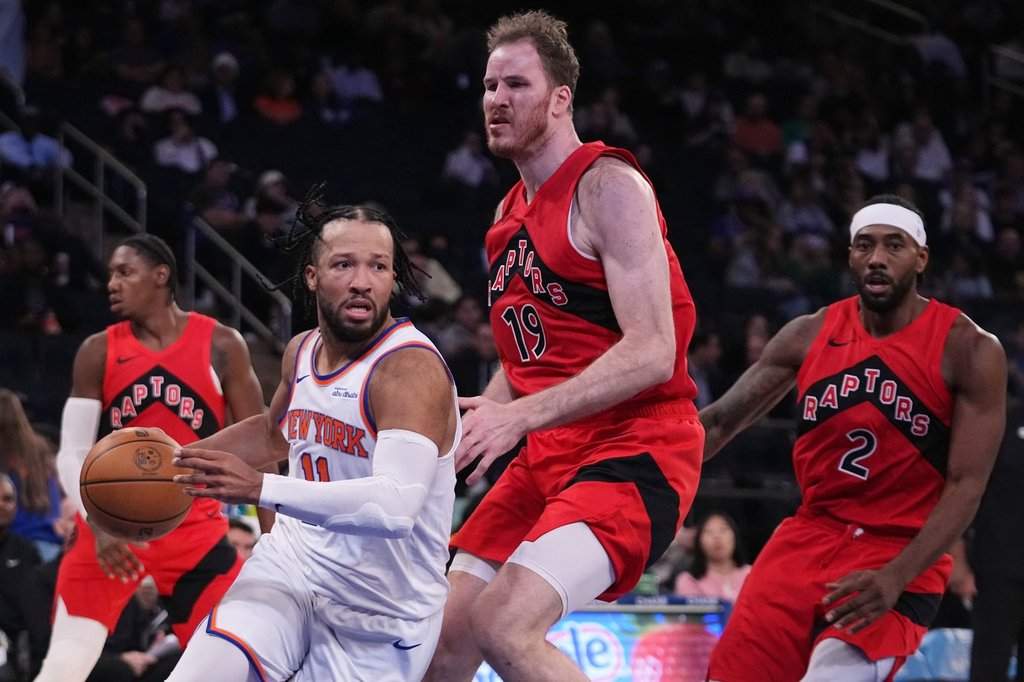
Squeak. Thud. Swish.
In an NBA preseason game between the Toronto Raptors and the New York Knicks, those are the sounds that carry furthest when the upper bowl is half-empty and the starters sit out the fourth quarter. A standard box score reduces the night to field-goal percentages, turnover tallies, and a final margin that neither franchise will carry into the standings. Yet anyone who has spent years watching teams stitch themselves together every autumn knows a loss in October is never just a loss. It is a stress test on chemistry, confidence, and rotation spots that carry real price tags long before opening night. Meanwhile, you can find similar developments here: The Hidden Cost of Asking One Man to Carry Everything.
I have sat in enough cold arena press rows and walked through enough quiet locker rooms in early October to recognize the peculiar tension of preseason basketball. Players talk calmly about "finding rhythm" and "getting legs under us," while their eyes keep drifting toward the coaching staff at the end of the bench. Every blown switch or rushed three-pointer feels small on paper and enormous in the moment if you are fighting for the last two-way contract or trying to prove your knee holds up through back-to-back nights.
The Invisible Stakes Beneath a Meaningless Box Score
Why do fans argue over a game whose outcome does not count in the standings? Because preseason basketball is where a team's habits get audited in public. During summer workouts and training camp scrimmages, players learn plays in controlled environments where whistles come quickly and coaches reset mistakes on the spot. Against an opponent like the Knicks—a franchise that traditionally prizes physicality, rebounding pressure, and half-court grit—those habits meet real friction. When the Raptors fall short in a preseason matchup, the story is rarely a single cold shooting night. It is usually a sequence of small breakdowns: a late rotation to the corner, an unboxed-out rebound, or a second unit that stalls when the primary creator sits. To understand the complete picture, we recommend the excellent report by Sky Sports.
Consider this hypothetical scenario to see how thin those margins really are. Picture a hypothetical third-year wing named Marcus, signed to a non-guaranteed camp deal after spending most of last season in the G League. He checks in with six minutes left in the third quarter against New York. He has twelve minutes to show he can guard two positions without fouling and knock down open catch-and-shoot jumpers. Two missed corner threes and one misread help assignment later, the coaching staff pulls him and never puts him back in during the fourth. On the box score, Marcus is zero-for-two with a personal foul. In his life, those twelve minutes might decide whether he unpacks his bags in Toronto or catches a flight to a minor-league gym.
That is the hidden weight of a preseason defeat. To a veteran star resting sore legs or an established coach testing five-man lineups, a loss is data. To a young guard or a two-way forward, every possession is an audition.
How Preseason Defeats Shape Rotations and Expectations
To understand what a preseason loss to New York means for Toronto, it helps to separate what happens on the floor from how coaches read it. A coach looking at film after a preseason loss asks three practical questions: Did we execute the concepts we practiced this week? Did our conditioning hold up in the third quarter? And which combinations generate clean shots without bleeding points on the other end?
If the answers are mostly yes despite a narrow defeat, a coach might walk away encouraged. A team can lose a preseason game by four or seven points while discovering that a new bench lineup moves the ball crisply or that a young big man defends pick-and-rolls with discipline. Conversely, a team can win an exhibition game sloppy and uninspired, hiding structural flaws that better defenses will punish in November.
Still, losing does change the emotional temperature around a young or retooling roster. Think of a basketball rotation like a mosaic made of glass tiles rather than a solid slab of marble. Early in the season, the glue is still wet. A couple of sharp wins help the tiles lock together; a frustrating loss where communication breaks down can leave hairline cracks that take weeks of film sessions to mend. When the Raptors come up short against the Knicks, the test isn't whether they panicked in October. It is whether they talk honestly the next morning instead of brushing off every mistake as "just preseason."
Fans often ask whether preseason results predict anything about how the regular season will unfold. Historically, preseason records correlate weakly with regular-season dominance—teams rest key players, hide certain sets, and prioritize player evaluation over late-game execution. Yet the process visible in those games often rhymes with what follows. If a team struggles to take care of the basketball, surrenders second-chance points, or relies too heavily on tough contested jumpers in October, those tendencies rarely vanish on their own when the calendar flips. They require deliberate work.
What Losing to New York Reveals About Toronto's Identity
Matchups between Toronto and New York carry a distinct edge even when nothing is technically on the line. Both cities care deeply about basketball, both fanbases notice effort immediately, and both rosters usually feature players eager to prove toughness. Even in an exhibition setting, the physical tone set by New York forces an honest mirror up to Toronto.
When the Raptors fall short in that kind of game, the most telling details show up in the quiet stretches—the middle of the second quarter or the opening four minutes of the second half. Are players talking on defense when screens get stacked? Are cutters moving with purpose when the first option is taken away? Does the bench bring energy or wait for something good to happen?
I admit that watching preseason games can feel strangely disorienting. Half the time you are trying to judge a team's ceiling while watching lineups that will never share the floor in a playoff game. It is confusing to care deeply about a contest where coaches are experimenting with odd pairings and pulling regulars early. You find yourself asking whether you are overreacting to a Tuesday night tune-up—or noticing an early warning sign everyone else is ignoring.
That tension is part of why basketball in October is so human. Nobody has earned anything yet. Every player is still carrying the hopes and doubts of the summer, and every coach is still searching for answers that only live competition can provide. A preseason loss to the Knicks does not end a season before it starts, nor does it erase months of preparation. It simply strips away illusions and shows where the work still has to be done.
The final buzzer sounds in an arena that feels half-awake, the scoreboard flashes a number that will be forgotten by spring, and a twenty-two-year-old walking toward the tunnel already replays a missed rotation in his head.


