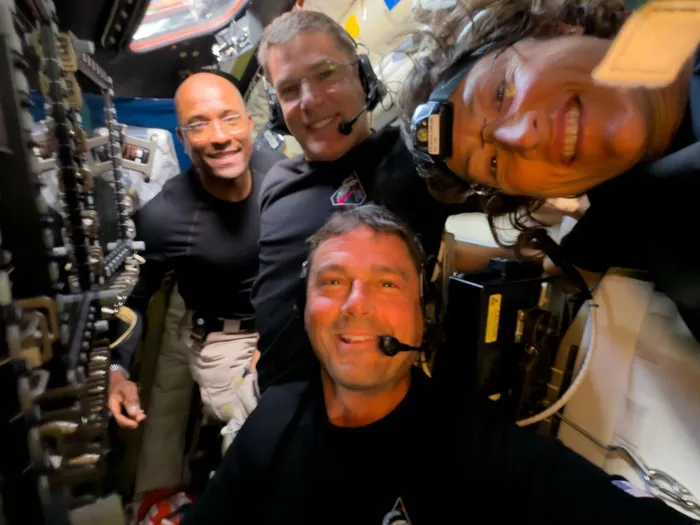
The Pacific Ocean is a terrifyingly indifferent place. It is four miles deep in the spots where the sun doesn't reach, a vast, undulating sheet of dark sapphire that could swallow a continent without ripples. On a humid Tuesday, four human beings—Reid Wiseman, Victor Glover, Christina Koch, and Jeremy Hansen—were falling toward it at twenty-five thousand miles per hour.
They were not merely falling; they were screaming through the atmosphere in a capsule called Orion, a titanium-and-carbon-fiber seed pod designed to survive the literal friction of the sky. Behind them lay a quarter-million miles of vacuum. Behind them lay the moon, a silent, grey sentinel they had just circled, becoming the first humans to see the lunar far side with their own eyes in over half a century. But as the heat shield began to glow at five thousand degrees Fahrenheit, the moon felt like an ancient dream. The only reality was the roar of ionized air and the bone-crushing weight of six Gs pressing their lungs against their spines.
Standard news reports call this a "splashdown." That word is too soft. It suggests a pebble in a pond or a diver entering a pool. This was a controlled car crash into a liquid wall. It was the violent culmination of Artemis II, a mission that didn't just aim to break records, but to prove that humanity still has the stomach for the deep dark.
The Weight of a Silence
Communication blackouts are a ghost story for engineers. As Orion hit the upper reaches of the atmosphere, the friction created a sheath of plasma around the craft. This superheated gas acts as a physical barrier to radio waves. For several minutes, the world’s most expensive, most sophisticated spacecraft becomes a silent stone.
At Mission Control in Houston, the silence isn’t empty. It’s heavy. You can see it in the way the flight controllers lean into their monitors, their headsets pushed tight against their ears as if they could somehow hear the heartbeat of the crew through the static. Every second of that silence is a calculation of risk. Is the heat shield holding? Are the parachutes ready to deploy? Or is the crew currently a streak of light over the ocean, unnoticed by anyone but the sensors?
Then, a crackle. A voice.
Victor Glover’s tone was steady, a testament to the thousands of hours of training that replace panic with procedure. The "nominal" report came through. The plasma cleared. The world breathed again. But the mission wasn't over. They were still miles above the waves, plummeting toward the water under the massive, orange-and-white blossoms of three main parachutes.
The Human Toll of Ten Days
We often talk about space travel in terms of fuel consumption, trajectory math, and life support systems. We rarely talk about the smell of a capsule after ten days in a confined space. We don't talk about the way the human inner ear rebels when gravity returns, making the simple act of sitting upright feel like spinning on a carnival tilt-a-whirl.
Christina Koch, who already held the record for the longest single spaceflight by a woman, knew what was coming. She knew that as the capsule bobbed in the Pacific swells, the stomach-churning motion of the waves would be the final test. To the public watching the grainy long-range camera feeds from the recovery ships, the sight of the capsule upright in the water was a victory. To the four people inside, it was the start of the "vomit window."
The physical transition from weightlessness to the heavy pull of Earth is a slow-motion trauma. Blood that has spent ten days pooling in the upper body suddenly rushes to the legs. The heart, which had grown slightly lazy in the absence of gravity’s constant pull, has to kick back into overdrive. Every movement requires a conscious, Herculean effort.
Consider the hypothetical sensation of wearing a suit made of lead while suffering from a permanent inner-ear infection. That is the physical reality of a returning hero. They are escorted from the hatch not because they lack strength, but because their brains are literally relearning how to tell up from down.
Why This Specific Splashdown Matters
It is easy to be cynical about the moon. We have been there before. We left footprints and golf balls and flags that have long since been bleached white by solar radiation. But Artemis II was never about repeating Apollo. It was about stress-testing the bridge to Mars.
The Orion capsule is a different beast than the Apollo Command Module. It is designed to sustain life for longer, to navigate with more autonomy, and to withstand higher re-entry speeds. By successfully bringing these four individuals back from a lunar flyby, NASA didn't just check a box. They validated a philosophy: that we are no longer visitors to the lunar neighborhood. We are becoming residents.
The recovery teams aboard the USS San Diego moved with a practiced, surgical precision. Divers jumped from helicopters. Inflatable collars were wrapped around the base of the scorched capsule to keep it stable. This dance is necessary because a capsule in the open ocean is vulnerable. If it flips—a "Stable II" position in NASA parlance—the crew is left hanging upside down in their harnesses, waiting for the uprighting bags to inflate.
On this day, the Pacific was kind. Orion stayed upright. The hatch opened, and the salt air of Earth rushed in, replacing the sterile, metallic scent of recycled oxygen.
The Invisible Stakes
While the world watched the splashdown, the real story was written in the telemetry data. Every charred millimeter of the heat shield will be analyzed. Every vibration recorded by the sensors during the descent will be mapped against computer models.
The success of Artemis II determines the fate of Artemis III—the mission that will actually put boots back on the lunar dust. If Orion had shown a single catastrophic flaw during this re-entry, the timeline for the lunar landing would have collapsed. Billions of dollars and a decade of international cooperation were riding on those parachutes opening exactly when they were supposed to.
Beyond the money, there is the psychological weight. We live in an era of digital distractions and terrestrial crises. Space often feels like a luxury we can’t afford. Yet, as the crew walked across the deck of the recovery ship, wobbly but grinning, that cynicism felt thin.
There is a fundamental human need to see the horizon and wonder what is past it. For ten days, these four people were our eyes. They looked back at the Earth from 230,000 miles away—a blue marble hanging in a void—and reminded us that everything we have ever known is contained on that fragile, beautiful sphere.
The mission didn't end when the capsule hit the water. It ended when the crew realized that the ground beneath their feet was no longer a simulation. They were home. They were heavy. They were safe.
The scorched heat shield of Orion now sits in a hangar, a silent witness to a journey that pushed the boundaries of what we can endure. It is covered in the soot of atmospheric fire, a dark, crusty armor that saved four lives. We are going back to the moon, not because it is easy, but because the fire of re-entry is the only way to prove we are still capable of the impossible.
The Pacific remains indifferent, its waves continuing to roll as they have for eons. But for a few hours, it held the center of the human story on its surface, cradling a small metal seed that had touched the stars and returned to tell us how they look.
The journey of the Artemis II crew is a reminder that the most difficult part of leaving is always the coming back. To return from the moon is to fall through a furnace and land in a wilderness, hoping that the people you left behind are waiting with a net. Today, the net held. Tomorrow, the footprints we leave will be permanent.