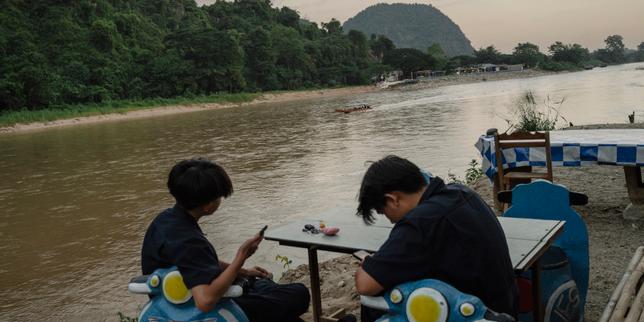
Your favorite supermarket staples might be carrying a lethal secret from the Golden Triangle. If you think the environmental chaos of Myanmar’s civil war stops at its borders, you’re dead wrong. A massive surge in unregulated rare earth and gold mining in Myanmar’s Shan State has crossed a terrifying threshold, transforming northern Thailand’s water supply into a toxic cocktail of heavy metals.
For years, local activists warned that something was deeply wrong with the water. Now, the official data confirms their worst nightmares. In recent testing, Thailand's Pollution Control Department detected dangerous levels of arsenic right in the mainstream sediment of the Mekong River for the first time. This isn't a vague future threat. It's a current, active poison flowing into the crops, fish, and bodies of millions of people.
The Toxic Cost of the Global Tech Rush
The smartphone in your hand, the electric vehicle in your garage, and the defense tech driving global military strategies all rely on rare earth elements. But the supply chain powering our clean energy future is shockingly filthy.
Since the 2021 military coup plunged Myanmar into chaos, ethnic armed organizations have turned to resource extraction to fund their operations. Satellite imagery from the Stimson Center identified over 800 unregulated mines across the Mekong River Basin. Nearly a hundred of these are rare earth mines, recognizable by their telltale blue tarpaulin leaching ponds. More than half of these operations popped up out of nowhere.
The mining process is brutal on the environment. Workers inject a liquid mix of harsh chemicals directly into mountaintops to liquefy the ore. This toxic slurry drains out into crude leaching ponds to separate the rare earth elements. When heavy seasonal rains hit Shan State, these unlined, unregulated ponds overflow. The toxic runoff washes directly into major Mekong tributaries like the Sai, Kok, and Ruak rivers.
Extracting just one single ton of rare earths can create up to 2,000 tons of toxic waste. This reckless process accelerates the release of naturally occurring arsenic and heavy metals straight into the regional water grid.
From Rivers to Dinner Plates
The pollution is no longer confined to remote border streams. It has fully entered the food chain, threatening what locals call "the world's kitchen."
Northern Thai farmers and fishers are watching their livelihoods collapse in real time. For over five decades, local fishers in Chiang Rai cast their nets without fear. Recently, they began hauling in fish covered in bizarre growths, tumors, and raw skin lesions. Environmental toxicologists note that heavy metal exposure destroys the immune systems of aquatic life, leaving them completely vulnerable to horrific infections.
The crisis hits even closer to home through regional agriculture. Consider the reality for local farmers like Thongkham Inprom. The 71-year-old harvests roughly 60 tons of rice every year from his northern Thai farm, keeping a small fraction for his family and selling the rest to commercial mills. Government tests recently revealed that both his soil and his water are highly contaminated with arsenic.
"Even if the daily intake is within the limit, it still builds up," warns health advocate Somporn. "At first, the body says, 'I can handle it and flush it out.' After a month, it starts to struggle. After six months, the kidneys can no longer clear it. That's when arsenic poisoning starts causing cancer in the skin and bladder."
Tests performed months apart show the arsenic levels in Thongkham’s own urine have already doubled the safe exposure limit. He still eats his own rice every day because he has no other choice. While local consumers are actively boycotting fresh produce from these border zones, vast quantities of contaminated rice, baby corn, and vegetables are still flowing to regional canneries and processing plants, ending up on global supermarket shelves.
The Hard Numbers Behind the Contamination
The scientific data exposes a massive governance failure. Thailand's safety guidelines state that arsenic levels under 10 milligrams per kilogram of river sediment are safe, while anything over 33 mg/kg is openly dangerous to life.
The recent official testing of the Mekong mainstream painted a grim picture:
- Peak Contamination: Sediment samples hit a staggering 296 mg/kg. That is nine times the safety threshold for environmental disaster.
- Water Toxicity: In Chiang Rai, water testing returned arsenic values at 0.03 mg/L, which is triple the safe drinking water standard set by the World Health Organization.
- Widespread Impact: The contamination covers an estimated 100,000 rai (around 39,500 acres) of critical agricultural land across northern Thailand, ruined by a toxic mix of arsenic, lead, manganese, and cadmium.
Why Blocking the Poison is Next to Impossible
You might wonder why the Thai government doesn't just call up Myanmar and demand they shut these operations down. The reality is a geopolitical mess.
The vast majority of these destructive mines are located in areas controlled by the United Wa State Army (UWSA) and the National Democratic Alliance Army. These powerful ethnic militias operate with total autonomy, completely out of reach of Myanmar’s military junta. They maintain close economic ties with Chinese buyers who snap up raw rare earth materials as fast as they can extract them.
The Thai government tried using emergency engineering fixes. They built consecutive dams and sluice gates along the Kok River, hoping to trap the contaminated sediment before it travels deep into central Thailand. But top environmental scientists call this an ignorant band-aid solution. When arsenic precipitates on a riverbed without oxygen, it transforms into an even more hazardous, bioavailable form.
Worse yet, the state's plan to dredge sections of the Kok River to restore water flow is backfiring. Environmental groups warn that churning up the riverbed will simply re-release tons of trapped heavy metals back into the water column, sending a fresh wave of poison downstream toward Cambodia and Vietnam.
Survival Steps for a Contaminated Environment
If you live in or travel through Southeast Asia, you can't afford to wait for a regional diplomatic miracle that probably won't happen. You need to take immediate, practical steps to protect your health.
Audit Your Food Sources
Stop buying unverified local rice, fish, or shellfish sourced from the Chiang Rai or Chiang Mai border districts. Check packaging labels for processed vegetables and baby corn. Choose brands that explicitly state they perform independent heavy metal screening. Arsenic concentrates heavily in the heads and bellies of fish and shrimp, so avoid eating those parts entirely.
Upgrade Your Filtration Architecture
Standard carbon faucet filters or basic gravity pitchers do absolutely nothing against dissolved heavy metals. If you rely on groundwater or local municipal water in northern Thailand, you must install a multi-stage Reverse Osmosis (RO) filtration system. Pair it with an activated alumina filter cartridge, which specifically targets dissolved arsenic.
Push for Transnational Accountability
The only way to stop the bleeding is to cut off the money. Support regional environmental legal groups like the Rivers and Rights Foundation. They are actively gathering data to pressure international electronics brands to audit their supply chains, ensuring their "green" components aren't being laundered out of unregulated war zones in Shan State.
The invisible poison flowing out of Myanmar’s lawless hills proves that global tech demands carry a heavy, localized body count. The Mekong is choking on our appetite for critical minerals, and the clock is ticking for the millions of people who call its riverbanks home.