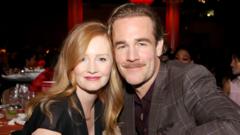
The screen glows with a familiar face, but the context has shifted entirely. We remember the jawline from a thousand posters, the earnest eyes that defined a generation’s coming-of-age television. But when Kimberly Van Der Beek hits "post" on a tribute to her late husband, James, the digital world stops spinning for a second. It isn’t just about a celebrity passing. It is about the specific, agonizing geometry of a chair that will never be sat in again.
Grief is a messy, uncoordinated thing. It doesn’t follow the script of a three-act play. It doesn’t respect the boundaries of a social media caption. Kimberly’s recent words—or rather, her admission that words are fundamentally broken tools for this task—strike a chord because they strip away the gloss of Hollywood. She isn’t mourning a character. She is mourning the man who held the other end of the grocery bag, the father who knew the specific rhythm of his children’s nightmares, and the partner who shared a decade of quiet, unrecorded Tuesdays. If you liked this piece, you might want to check out: this related article.
The Myth of the Clean Break
We like to think of healing as a ladder. You climb one rung, then the next, and eventually, you reach a platform called "closure." This is a lie. Real loss is more like a tide. You think you’ve found your footing on the sand, and then a wave of memory—the scent of a specific cologne, a half-finished book on a nightstand—sweeps your legs out from under you.
When James Van Der Beek’s battle with cancer became public knowledge, it transformed from a private struggle into a communal watch. That is the heavy tax of fame. You are forced to process the most tectonic shifts of your soul while a million strangers offer well-meaning but ultimately hollow digital condolences. Kimberly’s tribute highlights this dissonance. How do you summarize a life in a grid of squares? You can't. The attempt itself is a form of labor that most of us will never have to perform under a spotlight. For another perspective on this development, refer to the recent update from The New York Times.
Consider the weight of the "widow" label. It is a word that feels too heavy for the person carrying it, a garment several sizes too large. It carries an expectation of perpetual mourning, yet society also demands a timeline for "moving on." Kimberly’s struggle with the inadequacy of language is the most honest part of the narrative. It’s a confession that the map we’ve been given for grief is missing all the actual landmarks.
The Invisible Stakes of a Public Life
There is a hollow space where the future used to be. For the Van Der Beek family, that future was populated with six children and the chaotic, beautiful noise of a full house. When a patriarch dies young, the silence that follows isn't just the absence of sound; it’s a physical presence. It sits at the dinner table. It lingers in the hallway.
The facts of the case are clinical. Colorectal cancer is a thief. It moves with a terrifying, silent efficiency. James was open about his diagnosis, perhaps hoping to turn his own tragedy into a cautionary beacon for others. But the "why" of the science rarely comforts the "who" of the family. Statistics don't tuck children into bed.
The real story isn't the diagnosis. It’s the way a family recalibrates when their center of gravity is removed. We see the photos of James smiling, the clips of him dancing, the legacy of a career that spanned decades. But Kimberly is the one left to manage the shadow of that legacy. She has to be the archivist of his memory while trying to inhabit her own present.
Why We Lean In
Why does a tribute from a stranger’s wife hit us so hard? It’s because she is articulating a universal frustration. We have all stood at the edge of a loss and realized that our vocabulary is bankrupt. We say "I’m sorry for your loss" because "I am witnessing your world collapse and I have no way to stop the debris from hitting you" is too long and too true.
The digital age has changed the way we mourn, making it both more performative and more isolated. We see the tribute, we double-tap, and we move on to a video about a recipe or a political scandal. But for the person who wrote the words, the screen goes dark and the house remains empty. The "invisible stakes" are the moments between the posts—the 3:00 AM realizations that the person who used to handle the taxes or fix the leaky faucet is gone, leaving behind a list of chores that now feel like insurmountable mountains.
James Van Der Beek occupied a specific place in the cultural psyche. He was the boy next door who grew up. To see that archetype succumb to a very human, very frail mortality is a reminder of our own ticking clocks. It shatters the illusion of the "forever" that celebrity culture tries to sell us.
The Language of the Unspoken
Kimberly’s tribute wasn't a press release. It was an admission of defeat in the face of the English language. When she says words don't capture grief, she is inviting us into the void with her. She is acknowledging that the "brave face" we expect from public figures is a mask that eventually suffocates the wearer.
Loss isn't a singular event. It’s a series of micro-losses that occur every single day. It’s the realization that you’ve cooked too much pasta. It’s seeing a joke on Twitter and starting to turn your head to share it before remembering there is no one in the chair. These are the details that don't make it into the headlines, but they are the bedrock of the human experience.
The tragedy of the Van Der Beek story isn't just that a talented actor died. It’s that a man was pulled away from a story that was still being written. His children will have to learn about him through the screen and through their mother’s filtered memories. They will grow up in the glow of his fame, which is both a gift and a haunting.
We watch Kimberly navigate this because we are looking for clues. We want to know how to survive the unsurvivable. We look at her courage not as fans, but as fellow travelers on a road that eventually leads to the same destination.
The tribute remains on her profile, a digital monument to a private agony. It serves as a bridge between the James we knew—the one in 35mm film—and the James she knew—the one who breathed and laughed and left his socks on the floor. In the end, the most powerful thing she can do is admit that she is lost. In that honesty, there is a strange, flickering light.
The post will eventually be buried under new updates, new headlines, and newer tragedies. But for a family in Texas, the clock has stopped. They are learning to live in the "after," a country with no map and a language they are forced to invent one broken word at a time.