The sea air in Cornwall always carries a ghost story. Usually, it is a tale of smugglers running French brandy up through fog-drenched coves, or wooden ribs of 18th-century schooners breaking apart in the Atlantic surf. But last Tuesday, the ghost was made of cast iron, weighing two hundred and fifty kilograms, and carrying enough high explosive to rewrite the geography of a quiet residential street.
Picture a Tuesday morning that smells of damp salt and wet slate. Sarah is standing in her kitchen in Keyham, waiting for the kettle to boil, watching her golden retriever chase shadows across the linoleum. Her kitchen window looks out over an ordinary street of terraced Victorian houses—slate roofs, neat little front gardens, cars parked nose-to-tail along the curb. It is the kind of neighborhood where everyone knows who owns which cat, where the milkman still makes his morning rounds, and where the most dramatic daily event is a local parking dispute.
Then the sirens begin.
They do not start with a polite warning. They howl through the valley, slicing through the salt-heavy air with a metallic urgency that makes the coffee cup rattle in Sarah's hand. Within minutes, a police officer is knocking on her door, his face pale beneath his high-vis jacket, speaking in a clipped, low register that instantly drains the color from the room.
"You need to leave," he says. "Now."
"What do you mean, leave?" Sarah asks, her voice hitching. "The kettle just boiled."
"There's an unexploded World War Two bomb," he replies. "Found by construction workers on St Michael Avenue. They've dug up a German ordnance dropped eighty years ago, and the detonator is still active."
Just like that, the quiet Cornish morning shatters.
History is rarely a neat collection of dates bound in a leather textbook. More often, it is a dormant monster buried six feet beneath a vegetable patch, waiting for the clumsy bite of a backhoe to wake it up. During the Blitz of 1941, the Luftwaffe dropped thousands of tons of high explosives across British ports, shipyards, and coastal towns. Plymouth and its surrounding dockyards were prime targets. Most of those iron cylinders did their terrible work instantly, turning stone to dust and lives into memory. But a small, terrifying percentage failed. Their internal clockwork failed, their firing pins stuck, or they burrowed too deeply into the wet, yielding West Country mud to ignite.
They became subterranean time bombs, ticking silently through the Cold War, the rise of the internet, the birth of smartphones, and the passing of generations. They sat patiently beneath playgrounds, driveways, and flowerbeds while children played hopscotch above them and root systems wrapped around their rusted fins.
When the excavation crew hit metal on St Michael Avenue, they thought it was an old water pipe or an abandoned scrap of Victorian drainage. When they scraped away the wet clay and revealed the blunt, menacing nose of a German SC250 aerial bomb, the realization hit them like a physical blow. This was not a harmless relic. It was a live, breathing piece of total war, slumbering peacefully until a mechanical excavator disturbed its long rest.
Consider the physics of what happens next. A bomb of that magnitude does not merely damage a house; it obliterates a neighborhood. The shockwave travels faster than sound, turning window glass into shrapnel and collapsing masonry like a house of cards. The blast seat vaporizes steel, concrete, and flesh in a fraction of a second.
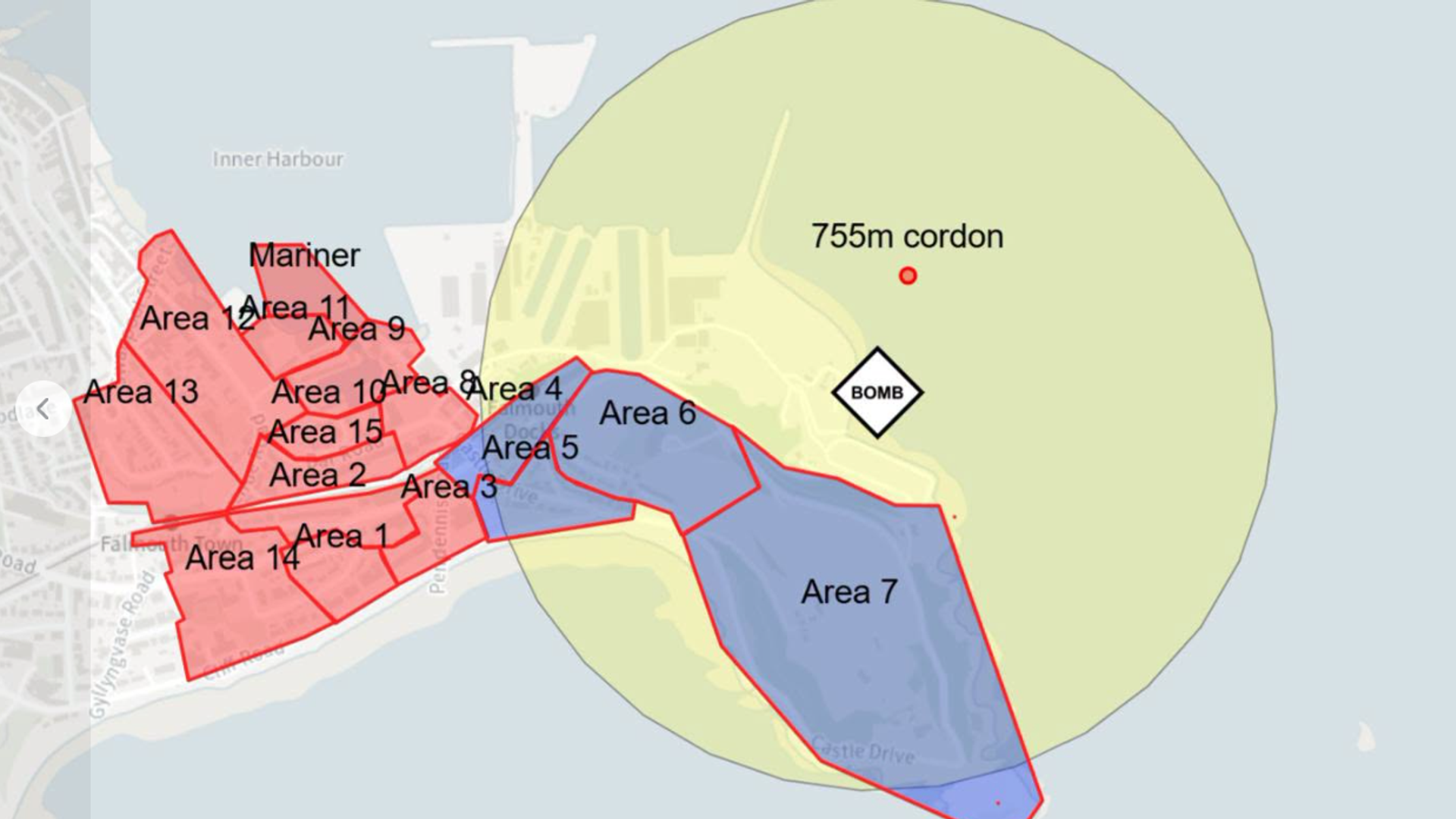
That is why the evacuation zone was drawn so ruthlessly wide. That is why hundreds of families were told to grab their medication, their pets, and their most precious photographs, and walk out into the cold rain with no guarantee that their homes would be standing when they returned.
Imagine being Arthur, an eighty-two-year-old retired shipwright who has lived on the same street for half a century. His knuckles are gnarled with arthritis, his eyes milky with cataracts, and his world is bound by the four walls of his living room where framed black-and-white photographs of his late wife hang in quiet dignity. When the evacuation order came, Arthur didn't want to leave. He looked at the police officers with stubborn confusion.
"I survived the Blitz," he muttered, gripping the arms of his worn armchair. "I'm not running from it now."
It took two officers gently lifting him by his elbows, wrapping a tartan blanket over his shoulders, and guiding him down the front steps to convince him. As he was led toward the red double-decker bus idling at the cordoned-off intersection—a makeshift evacuation transport provided by the local council—he looked back at his house. The afternoon sun was breaking through the gray Cornish clouds, catching the rain-slicked slate roof. It looked so peaceful. So terribly vulnerable.
Behind the police tape, the specialists moved in.
Bomb disposal operators from the British Army’s Royal Engineers are a peculiar breed. They possess a level of cold, hyper-focused courage that defies ordinary human psychology. They do not wear bulky suits of armor; against a quarter-ton bomb, armor is nothing more than a psychological comfort. Instead, they rely on steady hands, decades of collective institutional memory, and an intimate understanding of German engineering from 1941.
They descended into the trench like surgeons approaching an open heart on a thrashing patient. Every movement was calculated. Every breath was controlled. They had to uncover the fuze mechanism—often booby-trapped or corroded into an unpredictable hair-trigger state—and neutralize it before a stray radio wave, a sudden temperature shift, or a tremor from a passing vehicle could set off the chain reaction.
For thirty-six hours, time seemed to freeze in Keyham.
Pubs that usually echoed with the laughter of locals and the clinking of cider glasses stood dark and locked. Fish and chip shops turned off their fryers. Schools sat empty, their playgrounds silent save for the wind whistling through the chain-link fences. Families crowded into community centers, sleeping on fold-out cots, sharing nervous cups of instant coffee, and refreshing news feeds on their phones for updates from the Ministry of Defence.
We live in an era that feels hyper-modern, dominated by cloud computing, artificial intelligence, and invisible digital networks. We tend to believe we have conquered the physical world, wrapping it in fiber optics and sleek architecture. Yet, beneath our feet, the past retains veto power.
The unexploded bomb in Cornwall serves as a stark, humbling reminder that history is never truly dead. It is buried beneath our manicured lawns and paved highways, anchored to an era of industrial slaughter that shaped the modern map. Every time we dig a foundation for a new apartment block or lay a new line of fiber-optic cable, we are disturbing the sediment of a violent century.
When the announcement finally came over the police loudspeaker on Wednesday evening—a crackling, metallic voice declaring that the bomb had been safely defused and removed for a controlled detonation at sea—there was no cheering. There was only a collective, shuddering exhale.
Sarah walked back down her street under the pale light of the streetlamps. Her front door was unlocked, just as she had left it in her panic. Her golden retriever trotted ahead, sniffing eagerly at the welcome mat. Inside, the kettle was still sitting on the counter, cold and full of water.
She turned the burner on and watched the flame lick the bottom of the steel kettle. Outside her window, the street was quiet once more. The houses stood in their neat rows, untouched and whole. But as she listened to the water begin to hiss and murmur toward a boil, she knew she would never look at her garden the same way again. Beneath the damp soil, past the daffodil bulbs and the stubborn weeds, the earth held its breath, and so did she.