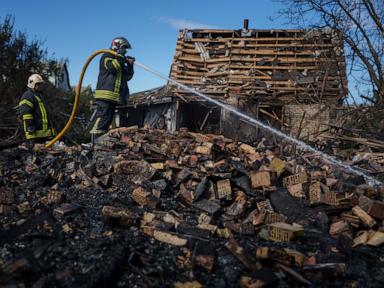
The frost does not knock. It arrives silently, sliding under window sills and curling against the edges of doors long before the sirens begin to wail.
In Kyiv, winter is a sensory landscape defined by contrast. There is the stark, blinding white of accumulated snow on the golden domes of the Lavra, and there is the absolute, bruised black of a city stripped of electricity. When the power grid fails, the transition is not gradual. It is a sudden severing. One moment, tea kettles whistle and apartment blocks glow with the amber warmth of kitchen lights; the next, the hum of the refrigerator dies, the television screen blinks out, and an entire neighborhood plunges into an ancient, quiet vulnerability. Building on this theme, you can find more in: The Long Shadow at the Border.
Four people did not wake up to see the snow melt this week.
That is the dry statistic issued by wire services and reported in flickering paragraphs across international screens. Four dead. Infrastructure targeted. Power grid damaged. It sounds clinical. It sounds like numbers on a ledger of distant conflicts. But numbers do not capture the weight of a damp wool blanket draped over trembling shoulders in a ninth-floor stairwell. Numbers do not measure the sound of children breathing in the dark, their breath pluming like tiny ghosts in rooms where the radiators have gone stone cold. Analysts at NPR have provided expertise on this trend.
To understand what is happening in the Kyiv region, you have to look past the military designations and the strategic maps. You have to look at the kitchen table.
Consider a hypothetical evening in a suburb just outside the city limits—though, in truth, very little of this requires imagination for the millions living it.
Mariya sits at her kitchen table. She is wearing three sweaters and a woolen scarf indoors, her fingers wrapped around a ceramic mug that stopped being hot twenty minutes ago. Across from her, her seven-year-old son, Dmytro, is trying to draw by the erratic, blue-white beam of a dying smartphone flashlight. His crayons are stiff from the cold.
"Mama," he asks, not looking up from his paper, "will the sun remember how to turn on tomorrow?"
It is a child’s question, innocent and impossible, yet it cuts to the psychological core of modern warfare. This is not merely an assault on steel towers, high-voltage transformers, and copper lines. It is an assault on time, on rhythm, on the basic human expectation that safety exists within four walls after sunset.
When Russian missiles pound the Kyiv region, targeting energy nodes with calculated precision, the immediate casualty is human warmth. Water pumps stop. Sewage systems stall. Elevators freeze between floors, trapping the elderly and the infirm in vertical tombs of concrete and shadow. Hospitals switch to stuttering diesel generators, praying the fuel lasts through the night while surgeons operate by headlamp.
The strategy is as old as civilization itself, stripped of any pretense of chivalry: break the spirit by breaking the environment. Make the home uninhabitable. Turn winter into an ally of conquest.
Yet, resilience in Kyiv has taken on a texture as tough as old leather.
Walk down a residential street during a blackout, and you will not find panic. You will find defiance humming in low frequencies. In courtyards shielded from the wind, neighbors gather around makeshift metal barrels, burning scrap wood to boil water in blackened pots. They share stories, swap rumors about air defense interceptions, and check on the old man who lives alone on the fourth floor.
These are the invincible invisible mechanics of survival. They are not grand gestures recorded by history books; they are the quiet refusal to surrender one's humanity to the dark.
Municipal workers— linemen, engineers, and technicians—are the unsung protagonists of this frozen drama. When the smoke clears and the sirens finally fade to an uneasy lull, they climb into bucket trucks with frozen fingers. They weld twisted metal back together in sub-zero temperatures while the threat of secondary strikes hangs heavy in the grey dawn. They know the risks. They do it anyway. Because every transformer restored is a defiant pulse of life sent back into the veins of the city.
We often talk about war in macroeconomics and geopolitical leverage. We analyze supply chains and artillery shell production rates as if human societies were mere chessboards. But history is felt locally. It is felt in the marrow of the bone when the thermometer drops to minus ten and the radiator refuses to click.
The four lives lost this week in the Kyiv region were not collateral damage in an abstract equation. They were people who had grocery lists on their counters, books half-read on nightstands, and plans for spring that will never arrive.
As the sun sets once again over the Dnieper, casting long, sharp shadows across a skyline of skeletal cranes and silent rooftops, the sirens start up anew. The lights in the windows flicker, dip, and hold their breath. In the stillness, a generator coughs to life down the block, casting a stubborn, orange circle of light against the gathering snow.