The cabin of Air Force One smells faintly of stale coffee, expensive leather, and ozone when the wheels finally leave the tarmac at Joint Base Andrews. Inside the forward conference room, the television screens are usually muted after a bad election night, though the chyrons still crawl across the bottom of the glass like slow-moving indictments. Down below, the lights of Washington D.C. shrink into a neat, geometric grid, deceptively calm from thirty thousand feet.
Defeat. Learn more on a connected topic: this related article.
It is a heavy, metallic taste in the mouth of anyone who has ever worked a West Wing press briefing or watched a carefully constructed legislative majority evaporate in the span of six hours on a Tuesday in November. When the voters deliver a shellacking—Barack Obama’s word in 2010, though every modern president knows the sensation intimately—the White House suddenly feels less like the center of the free world and more like a glass aquarium where the sharks are circling just outside the panes.
So the president leaves. Additional journalism by USA Today explores similar perspectives on this issue.
To the casual observer scrolling through morning headlines, the sudden pivot to international travel looks like an escape act. A bruised leader, rejected by the people in Ohio or Pennsylvania, packs his bags for Tokyo, Brussels, or Rio de Janeiro to soak up ceremonial applause from foreign dignitaries who cannot vote him out of office. Critics call it dodging accountability. Pundits call it a distraction.
They are missing the real mechanism at work. Heading abroad after a domestic political defeat is not a vacation from reality; it is one of the oldest, most calculated survival reflexes in the American presidency.
The Architecture of a Domestic Trap
To understand why Air Force One always seems to taxi down the runway within days or weeks of a midterm loss, you have to understand what happens to presidential power the morning after the ballots are counted.
In the American constitutional system, a president wears two entirely different hats, and they rarely fit comfortably at the same time. At home, the president is a partisan combatant, a legislative negotiator begging or browbeating 535 members of Congress who have their own survival instincts and their own angry constituents. When a president’s party loses the House or the Senate—a near-certainty in modern midterm cycles—the domestic levers of power jam almost overnight. Bills die in committee. Subpoenas begin to fly like confetti. Even allies on Capitol Hill start edging toward the exits, calculating how much distance they need to put between themselves and an unpopular White House before the next election cycle begins.
Consider a hypothetical scenario that plays out in every administration, regardless of party. Picture a mid-level White House domestic policy advisor—let’s call her Elena—sitting in a windowless office in the Eisenhower Executive Office Building on the Wednesday morning after a sweeping midterm loss. For two years, Elena has spent fourteen hours a day drafting healthcare subsidies or infrastructure grants. Suddenly, her phone stops ringing. The committee chairs who used to return her calls within ten minutes now leave her messages unanswered for days. Her legislative agenda isn’t just stalled; it is functionally dead on arrival.
Now walk across West Executive Avenue into the Situation Room, and watch what happens when the president puts on his second hat: Commander-in-Chief and Chief Diplomat.
Abroad, the opposition party in Congress has no gavel. Foreign prime ministers and authoritarian strongmen do not care about district-by-district polling in suburban Atlanta. When the President of the United States steps off the stairs of that blue-and-white Boeing 747 onto a red carpet in Seoul or Berlin, the sheer institutional weight of the American superpower travels with him.
Think of the presidency like a massive ocean liner caught in a narrow, rocky harbor during a squall. Inside the harbor—domestic politics—every gust of wind threatens to smash the hull against the seawall of congressional gridlock. The captain has almost no room to maneuver. Heading overseas is the equivalent of steering that ship out into the open ocean. The waves are still there, and the storm hasn't vanished, but suddenly the captain has room to turn the wheel.
Ghosts of Novembers Past
History does not merely repeat itself on this front; it practically runs on a timetable.
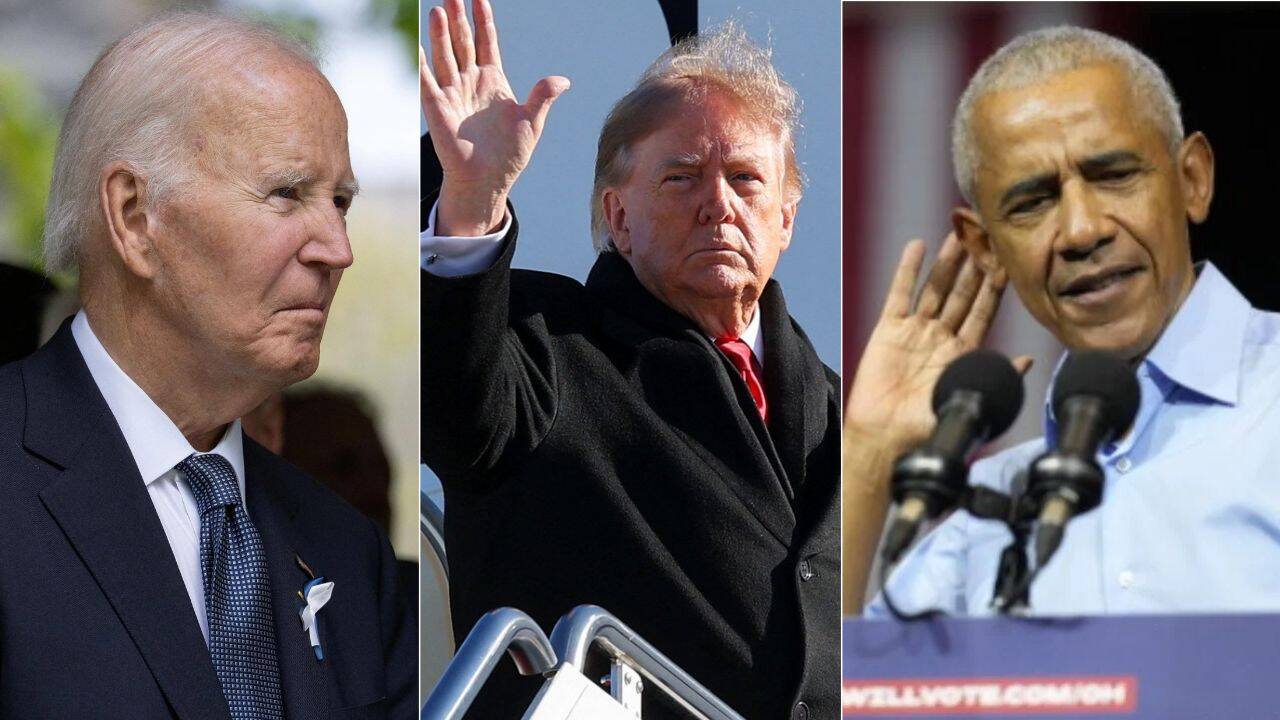
Look back at November 2010. Barack Obama had ridden into office two years earlier on a wave of historic optimism, backed by commanding Democratic majorities in both chambers of Congress. Then came the Tea Party backlash. Democrats lost sixty-three seats in the House—the largest swing since 1948—and six in the Senate. The political obituary writers in Washington were already sharpening their knives, declaring Obama a one-term president whose domestic ambition had been permanently grounded.
Three days after the election, Obama boarded Air Force One for a ten-day, four-nation tour of Asia: India, Indonesia, South Korea, and Japan.
At the time, cable news hosts mocked the trip as an expensive retreat. Yet on the ground in Mumbai and Jakarta, away from the suffocating partisan trench warfare of Washington, Obama was able to project something he couldn't buy at home: inevitability. He spoke to massive, cheering crowds in Indonesia, where he had lived as a child. He negotiated trade frameworks and stood shoulder-to-shoulder with G20 leaders. The visual contrast was deliberate and sharp. While newly empowered House Republicans were still arguing over committee assignments back in D.C., Obama looked like the undisputed leader of the global order.
Twelve years later, in November 2022, Joe Biden faced a different kind of political gravity. Though Democrats defied historical trends by narrowly holding the Senate, they lost control of the House of Representatives, ensuring two years of investigative hearings and legislative gridlock. Biden’s approval ratings were underwater, weighed down by stubborn inflation and voter fatigue.
Before the final House races were even called, Biden was already airborne, bound for a whirlwind diplomatic marathon across Egypt, Cambodia, and Indonesia.
Watch the choreography of that trip. In Sharm el-Sheikh, Biden addressed global climate leaders. In Phnom Penh, he met with Southeast Asian heads of state. And in Bali, at the G20 summit, he sat down for a three-hour, face-to-face meeting with Chinese President Xi Jinping—their first in-person summit since Biden took office. For a week, the dominant headlines in American newspapers were not about House Republican investigations into the Biden administration. They were about whether the United States and China could manage their rivalry without sliding into a new Cold War.
And when Donald Trump—a leader whose political instincts are radically different from both Obama and Biden, yet bound by the exact same constitutional physics—faces electoral headwinds or midterm losses, the same gravitational pull takes over. Whether it is flying to Paris for Armistice commemorations right after the 2018 blue wave swept Republicans out of the House, or pivoting to high-stakes bilateral summits in the Middle East and Asia following subsequent political setbacks, the instinct is identical. When the domestic scoreboard turns red against you, you change the stadium.
The Invisible Stakes Behind the Red Carpet
It is easy to be cynical about this ritual. Anyone who has watched politics closely knows how much of modern governance is stagecraft—lighting, camera angles, and carefully timed photo opportunities designed to reset a failing news cycle. I used to view post-election foreign trips almost entirely through that lens: a glamorous PR bandage slapped over a self-inflicted domestic wound.
That view is incomplete, and honestly, a little dangerous.
If you look past the ceremonial honor guards and the state dinners, something far more consequential is happening inside those closed-door bilateral meetings. Foreign leaders are ruthless realists. They read American polling data just as closely as campaign managers in Chicago or Arlington. When a U.S. president suffers a major defeat at home, every intelligence agency from Moscow to Beijing to Brussels immediately recalculates American resolve.
They ask a simple, brutal question: Is this president now a lame duck?
If a foreign adversary concludes that an American president has been crippled by domestic voters, the temptation to test boundaries spikes. A territorial probe in the South China Sea. A cyberattack on European infrastructure. A sudden breakdown in Middle Eastern ceasefire talks. Weakness in Washington creates a vacuum abroad, and vacuums in geopolitics never stay empty for long.
This is the invisible stake that rarely makes it into the partisan shouting matches on television. When a bruised president gets on a plane after an election loss, part of the mission is pure survival—reassuring allies and warning adversaries that the Commander-in-Chief still has his hands on the controls, regardless of who controls the House Ways and Means Committee.
In diplomacy, absence is an admission of vulnerability. Showing up in person, looking a foreign counterpart in the eye across a polished mahogany table, is how a president proves he hasn't been reduced to a caretaker.
The Limit of the Escape
Still, there is a quiet cruelty to the return flight.
Air Force One always has to land. The red carpets are rolled up, the simultaneous translators pack their headsets, and the motorcade eventually turns back through the iron gates of the White House. And waiting on the desks inside the West Wing are the exact same problems that were there before takeoff: a hostile Congress, an impatient electorate, and the unforgiving math of domestic politics.
Foreign policy victories almost never translate into votes in swing-state precincts. No president has ever won back an angry grocery shopper in Michigan by pointing to a communique signed in Brussels or a bilateral working group established in Tokyo. In 1991, George H.W. Bush enjoyed a staggering 89 percent approval rating after assembling a global coalition to expel Iraqi forces from Kuwait—a masterclass in international statesmanship. Nineteen months later, voters sent him packing because the domestic economy felt broken and the president seemed more comfortable talking about the "New World Order" than the price of milk.
Presidents know this trap. Their advisors certainly do. Yet they fly anyway, because in the lonely math of the Oval Office, a temporary stage where you still command the room is always better than a home turf where the doors have just been locked against you.
Somewhere over the Pacific or the Atlantic, long after the press corps in the back cabin has fallen asleep under scratchy airline blankets, the lights in the forward suite stay on. A president sits alone with a briefing binder, thousands of miles away from the voters who just told him no, trying to prove to the rest of the world that his word still counts.