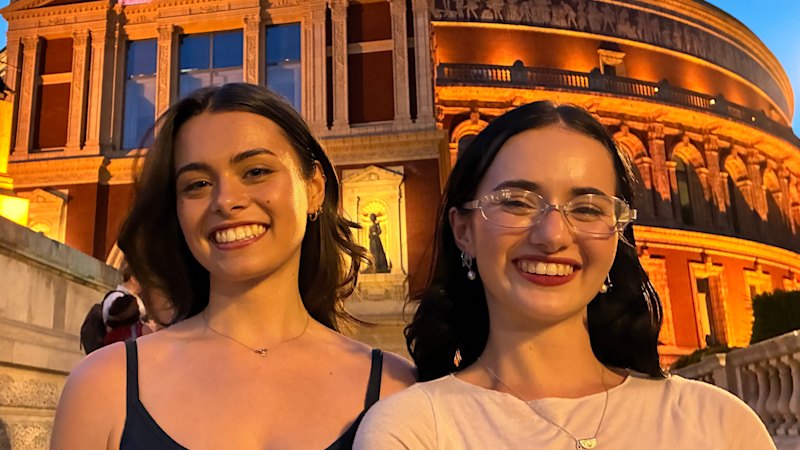
The rain hit the pavement outside the Royal Albert Hall with a steady, grey insistence that felt less like weather and more like a permanent state of mind. It was July, though you would never have guessed it from the wool coats and the damp umbrellas crowding Kensington Gore. Inside, the air smelled of old brass, damp wool, and the faint, sweet trace of gin from the interval bar.
Then came the opening chord.
It did not just fill the auditorium. It carved through it.
Thousands of strangers, shoulder-to-shoulder under that vast glass dome, inhaled as one organism. When they exhaled, the sound shook the dust from the Victorian rafters. This was not merely a concert. This was an acoustic rebellion against the heavy, grinding exhaustion of an era that had spent the better part of three years teaching people how to keep their distance.
Listen.
Can you hear it?
That is the sound of eight thousand people remembering what it feels like to vibrate at the exact same frequency.
For weeks, the headlines had been a relentless drumbeat of attrition. Inflation pinched at kitchen tables. Public services creaked under impossible strains. The political landscape felt less like a government and more like a revolving door of exasperated caretakers. People were tired. Not the kind of tired that a good night's sleep cures, but the bone-deep weariness that comes from bracing against a gale that never quite stops blowing.
Enter the Proms.
To the uninitiated, the BBC Proms might look like an exercise in high-cultural preservation—a dusty relic of empire and evening wear, designed primarily for people who own expensive subscriptions and know how to pronounce Shostakovich without clearing their throat. But that is missing the point entirely. That is looking at the sheet music and ignoring the blood pumping through the musician's wrists.
Consider what happens during the Last Night of the Proms, or even a random Tuesday night in the middle of a miserable summer downpour. The ticket prices for the arena—the standing room right beneath the massive orchestra—are famously kept low, hovering around the price of a modest lunch. This policy is not accidental. It is the beating heart of the institution. It invites students in worn-out trainers, pensioners on fixed incomes, and tired nurses coming off long hospital shifts to stand shoulder-to-shoulder with wealthy patrons.
Underneath that magnificent dome, bank balances dissolve. Job titles vanish. There are only lungs, vocal cords, and the terrifying, beautiful vulnerability of human breath turned into art.
I stood there last year, wedged between a retired postman who had memorized every Vaughan Williams score and a twenty-something data analyst who looked like she spent forty hours a week staring at spreadsheets under fluorescent lights. Neither of them looked like traditional classical music enthusiasts. Yet, when the choir launched into a complex, soaring polyphony that demanded Olympic-level vocal control, both of them had their eyes closed. Their lips were moving.
When the piece finished, the silence that hung in the hall for two seconds before the applause broke was heavier than the music itself. It was the silence of collective exhale.
Music historians often talk about the Proms through the lens of longevity. Founded in 1895 by Sir Henry Wood, the festival was explicitly designed to make good music accessible to the public at large, sweep away the snobbery, and fill the cavernous hall with people who wouldn't normally be caught dead in a concert house. Wood wanted promenade concerts where people could walk around, smoke, drink, and let the culture wash over them without the suffocating stiffness of Victorian etiquette.
Today, the smoking is gone, and the promenaders stay put because the floor gets too crowded to wander, but the radical democratization of joy remains.
That is why the festival matters now more than ever. In times of profound social anxiety, human beings retreat into silos. We scroll through algorithmic funnels that reinforce our fears. We eye our neighbors with quiet suspicion. We build walls out of screens and economic anxiety.
A classical music festival operating on a massive public scale does the exact opposite. It forces integration. It requires people to inhabit the same physical space and feel the same acoustic vibrations. When a soprano hits a high note with such piercing clarity that it leaves the upper gallery breathless, the emotional response is entirely unmediated. You cannot like a live orchestra post on a feed. You have to sit in the damp air. You have to cough when the hall gets too dry. You have to smell the person next to you.
You have to be human.
Critics sometimes roll their eyes at the patriotism that flares up during the final week—the Union Jacks, the waving, the loud renditions of Rule, Britannia! and Jerusalem. They see it as nationalistic chest-beating, a nostalgic longing for an empire that no longer exists and arguably shouldn't. And yes, those elements are complicated, messy, and occasionally uncomfortable in a modern, pluralistic society.
But watch the people waving those flags. Look past the cheap cotton and the printed union motifs.
What you are seeing is rarely imperialism. It is survival. It is people grabbing onto a shared cultural anchor because the present moment feels entirely untmoored. When the world is shifting under your feet—when heating bills double and the news cycle reads like an apocalypse script—you reach for whatever continuity is lying around. For generations of Britons, that continuity has been a familiar melody echoing through a damp London summer.
The orchestra does not care who you voted for. The brass section does not check your credit score before hitting a C-major chord.
There is a profound humility in that realization.
Think about the sheer logistics of what happens every single night during the eight-week season. Dozens of musicians, many of whom have spent ten thousand hours mastering an instrument that refuses to cooperate on humid evenings, walk onto a stage and put their collective ego into the hands of a conductor whose baton dictates the heartbeat of the room. They miss notes sometimes. Horn players crack under the pressure. The acoustics in the hall can be notoriously muddy depending on where you sit.
It is imperfect. It is messy. It is alive.
And that is where the true magic lives. In a culture obsessed with digital perfection—where audio tracks are auto-tuned to surgical precision and videos are scrubbed of every human flaw—the Proms offer a terrifyingly honest alternative. You are watching real human beings push their physical limits in real time. If the violin string snaps, everyone in the room hears the sudden, sharp ping of failure and watches how the player recovers.
That shared vulnerability creates a unique psychological safety net. For a few hours, the audience is permitted to feel deeply without cynicism. In a modern city like London, cynicism is the default armor. You need it to navigate the tube delays, the landlord disputes, the endless stream of commercial noise. You need it to protect your wallet and your sanity.
Walking out of the Royal Albert Hall into the midnight drizzle, the transformation is palpable. The streetlights smear across the wet asphalt. The crowds disperse into the tube stations, subterranean rivers of humanity carrying the echoes of Mahler and Elgar back to cramped flats in Brixton, terraced houses in Walthamstow, and lonely rooms north of the river.
They are still worried about rent. The news tomorrow will still be grim. The political commentary will still be loud and empty.
Yet, for two hours, the weight was lifted. Not because the problems vanished, but because they had found a voice loud enough to answer back.