Long range asymmetric strikes against critical commercial infrastructure have fundamentally altered the mechanics of modern strategic attrition. The destruction of major regional fulfillment centers operated by Russia’s dominant e-commerce enterprise, Wildberries, in locations such as the Tambov region, illustrates a structural evolution in aerial campaigns. Rather than focusing solely on traditional military targets or heavy industrial production nodes, operators are systematically dismantling the domestic supply chain networks that underpin internal economic stability. This deliberate targeting transforms commercial logistics hubs into high-value friction points, exposing deep vulnerabilities in centralized distribution models.
The Operational Mechanics of Supply Chain Interdiction
The systematic targeting of massive fulfillment nodes relies on a calculated calculus of spatial concentration. Modern digital retail giants operate on hub-and-spoke distribution models where inventory, sorting mechanisms, and order fulfillment are consolidated into hyper-dense mega-depots.
- Spatial Vulnerability: Mega-depots concentrate billions of rubles in inventory and specialized automated sorting machinery within single, expansive footprints, maximizing processing efficiency while creating catastrophic single points of failure.
- Payload Efficiency: Deploying long-range uncrewed aerial vehicles against these facilities achieves dual utility by destroying physical inventory and paralyzing the surrounding merchant ecosystem.
- Network Cascade Effects: When a primary regional distribution center burns to the ground, the disruption radiates outward, stalling order fulfillment for thousands of small-to-medium third-party merchants who rely on the platform for market access.
By targeting these nodes, the campaign exploits the very efficiencies that made modern Russian digital retail scale so rapidly. The physical footprint of a fulfillment center spanning hundreds of thousands of square meters cannot be easily hardened or concealed, rendering stationary logistics assets uniquely susceptible to persistent drone interdiction.
Economic Deficit and Debt Cascade Dynamics
The financial toll of these systemic logistics strikes extends far beyond the immediate replacement cost of charred steel and burned inventory. When core distribution infrastructure suffers repeated catastrophic damage, the underlying financial architecture of the retail enterprise begins to fracture under accumulated liabilities.
[Drone Strike on Mega-Depot]
       │
       ▼
[Inventory Destruction & Merchant Flight]
       │
       ▼
[Turnover Collapse & Revenue Contraction]
       │
       ▼
[State Bank Debt Default Risk & Credit Freeze]
Independent market estimates suggest that losses across destroyed inventory and paralyzed facilities run into billions of dollars, severely contracting corporate turnover. The primary systemic risk involves third-party merchant flight. Small vendors supplying goods to the marketplace lose their working capital when warehouses ignite, leading to mass desertion from the platform.
Without continuous cash flow, these merchants face immediate insolvency, threatening massive defaults on commercial debt held by state-backed financial institutions such as VTB. Consequently, the attrition campaign acts as a financial multiplier. Physical destruction translates directly into credit default pressures, forcing state intervention to prevent systemic banking contagion within the consumer credit sector.
State Intervention and the Moral Hazard of Asset Seizure
Faced with mounting corporate insolvencies and crippled supply lines, central authorities have moved to absorb the structural shocks through legislative and executive decrees. Recent policy mandates granting the state temporary authority to seize critical infrastructure assets if private owners fail to secure or rebuild them highlight a growing friction between private enterprise and state survival requirements.
This policy response introduces severe economic moral hazard. By signaling that the state will step in to underwrite, rebuild, or bail out devastated logistics networks through subsidized loans and tax deferrals, the government assumes the underwriting risk of an ongoing military conflict.
- Capital Misallocation: Diverting national fiscal reserves to reconstruct vulnerable, centralized warehouses merely re-exposes state capital to predictable secondary drone strikes.
- Security Burden Shifting: Compelling private retail operators to finance advanced counter-drone systems and physical hardening shifts military-grade air defense responsibilities onto commercial balance sheets that are already bleeding liquidity.
- Operational Paralysis: The bureaucratic overhead required to manage state-directed restructuring slows down corporate agility precisely when rapid supply chain reconfiguration is required.
Secondary Convergence with Energy Logistics
The escalation against commercial retail infrastructure does not occur in a vacuum; it runs parallel to systematic strikes on domestic petroleum refining and fuel storage facilities. The convergence of retail distribution shutdowns and refinery disruptions creates a multi-front pressure gradient across the entire Russian domestic economy.
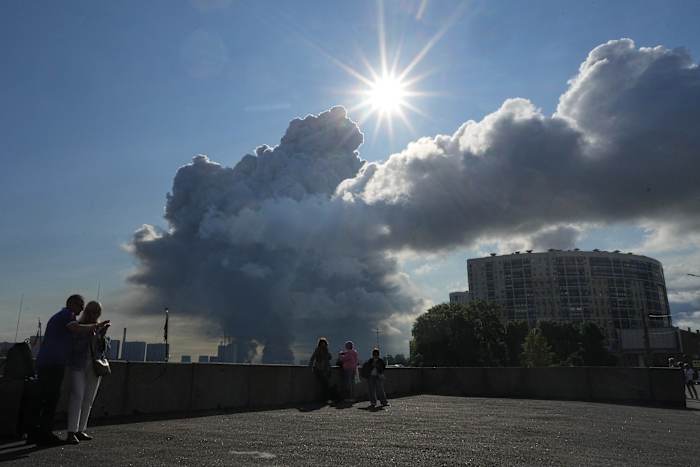
When long-range strikes simultaneously disable fuel production in regions like Nizhny Novgorod and incinerate e-commerce fulfillment hubs in central oblasts, internal logistics face compound constraints. Delivery fleets transporting consumer goods encounter fuel rationing and pump shortages, while the warehouses meant to receive those goods lie in ruins. This synchronization strains emergency response capabilities, forces regional governors to issue shelter-in-place advisories due to toxic smoke plumes, and degrades the perception of domestic security far from the territorial frontline.
Strategic Horizon and Network Adaptation
The systematic dismantling of automated retail infrastructure proves that modern campaigns can achieve strategic economic impact without engaging primary heavy manufacturing sectors. As long-range uncrewed aerial vehicle technology matures, stationary civilian assets integrated into dual-use supply chains remain exposed to high-attrition warfare.
Future adaptations will likely require a fundamental architectural shift away from hyper-centralized mega-depots toward decentralized, underground, or heavily dispersed micro-fulfillment networks. However, transitioning a trillion-ruble e-commerce ecosystem from centralized efficiency to resilient decentralization carries prohibitive capital costs.
Commanders directing the aerial campaign will continue to prioritize logistics nodes to compound domestic economic friction, accelerate merchant insolvency, and force the state into an unsustainable cycle of subsidizing civilian infrastructure exposed to persistent attrition.