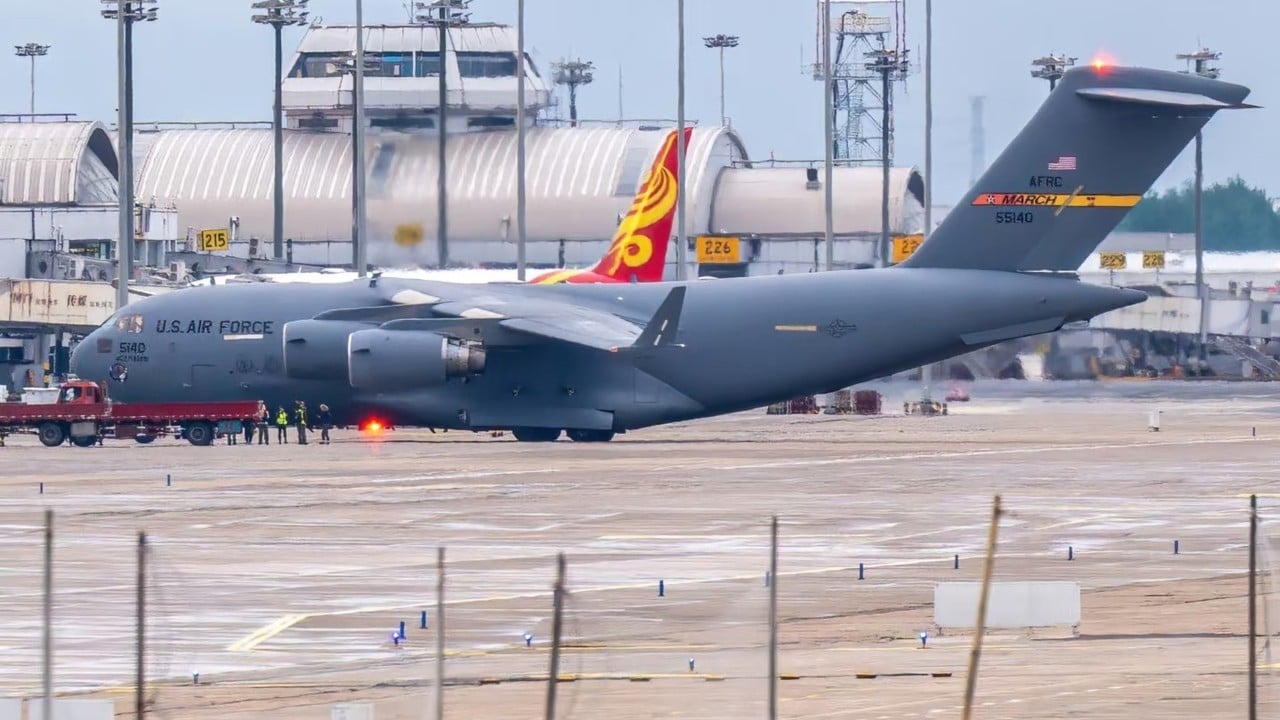
The internet loves a conspiracy, especially one involving heavy-lift aircraft and the perceived opulence of a visiting head of state. When images surfaced of U.S. Air Force C-17 Globemaster IIIs touching down in Beijing during a high-stakes diplomatic visit, the "lazy consensus" media machine went into overdrive. They framed it as an absurd excess—a taxpayer-funded Uber for armored limousines. They asked if it was "necessary."
They asked the wrong question.
The real story isn't about the cost of fuel or the number of vehicles on the manifest. It’s about the total failure of international trust and the brutal reality of mobile sovereign territory. If you think the Air Force is just "flying cars," you don't understand the first thing about electronic warfare, ballistic glass, or the sheer fragility of global diplomacy.
The Myth of the Expensive Taxi
Most commentators look at a C-17 and see a $218 million cargo hold. They calculate the flight hours from Joint Base Andrews to Beijing Capital International Airport and start clutching their pearls over the budget.
Here is the truth: The cost of not flying those vehicles is exponentially higher. In the world of high-level statecraft, you don't use local transport. You don't "rent" a car in a country that spends half its GDP trying to figure out how to bug your toothbrush.
When a U.S. President travels, they aren't just moving a person; they are moving a hardened, mobile command-and-control node. The vehicles inside those C-17s—specifically the "Beast" (the Presidential State Car) and its various electronic countermeasures (ECM) decoys—are essentially tanks disguised as Cadillacs.
Sovereignty is Heavy
Let’s dismantle the idea that this is about luxury. A standard armored SUV might weigh 8,000 pounds. The Beast? It’s estimated to be closer to 20,000 pounds. It sits on a medium-duty truck chassis. It has its own oxygen supply, a sealed cabin against chemical attacks, and blood bags matching the President’s type.
You don't put that on a commercial freighter. You don't trust a third-party logistics firm in a contested geopolitical "landscape"—oops, I mean environment—to handle the most sensitive hardware on the planet.
The Breakdown of the Manifest
A typical presidential motorcade requires multiple C-17 sorties because of the sheer volume of specialized equipment:
- The Stagecoach and Spare: Two identical armored limos. You never know which one holds the Principal.
- Watchtower: The electronic warfare vehicle. It’s packed with sensors to detect incoming RPGs and jammers to kill remote-detonated IEDs.
- The CAT Car: Transport for the Secret Service Counter-Assault Team.
- Roadrunner: The mobile encrypted communications hub that keeps the President connected to the National Military Command Center via satellite.
If you omit one of these, you aren't "saving money." You are creating a single point of failure. I have seen logistics chains snap because someone tried to "optimize" for cost in a high-threat zone. In the private sector, that costs you a contract. In Beijing, it costs you the leader of the free world.
The Beijing Buffer
The specific friction of flying into China adds a layer of irony the mainstream press missed. The "competitor" articles focused on whether it was an "insult" to the hosts to bring our own security.
That’s a fundamentally naive view of power.
Diplomacy is a theater of mirrors. China expects the U.S. to bring the C-17s. They would be insulted if we didn’t. It’s a display of logistical dominance. It says: "We can project a fully functional, impenetrable fortress into your capital city within 24 hours."
By bringing the motorcade, the Secret Service ensures that the "Blackberry" environment—the secure bubble—remains intact. Every inch of a local vehicle in Beijing would be a listening post. Every driver would be an intelligence officer. Flying the fleet in isn't a lack of trust; it's a professional acknowledgement that everyone is spying on everyone.
Why the "Commercial Alternative" is a Death Trap
Critics often point to other world leaders who fly on commercial-ish jets or use local motorcades. They cite the UK’s Prime Minister or the leaders of Nordic countries.
This is a false equivalence.
The threat profile of the U.S. President is unique. The sheer amount of kinetic and digital energy directed at that office requires a response that looks like "excess" to the untrained eye.
Imagine a scenario where the President uses a locally provided armored Mercedes.
- The Brake Logic: Modern cars are "drive-by-wire." If the host nation’s intelligence service has the source code for the vehicle's ECU, they don't need a bomb. They just need to tell the car to accelerate to 100 mph and disable the brakes.
- The "Goldfish Bowl" Effect: Without the electronic jamming suites flown in on the C-17, the President's movements are broadcast in real-time to every hobbyist with a $20 SDR (Software Defined Radio).
The C-17 is the only way to move the "Cage"—the secure environment—without breaking the seal.
The Math of the Mission
Let’s talk numbers, but not the ones the critics use.
The C-17 has a payload capacity of roughly 170,000 pounds.
$$Payload_{max} = 170,900 \text{ lbs}$$
To move a 30-vehicle motorcade, you need approximately 5 to 7 C-17 flights.
At a cost of roughly $30,000 per flight hour, a trip to Asia is a multi-million dollar logistics exercise. But compare that to the $800+ billion annual defense budget. This isn't even a rounding error. It is the literal price of doing business as a superpower.
People ask "Is it worth it?" They should be asking "Why is our secure comms tech still so heavy that it requires a Boeing jet to move it?" That is the real technical failure—not the fact that we are flying the planes, but that we haven't miniaturized the "Fortress" enough to fit it on a Gulfstream.
The Logistics of Paranoia
I’ve worked with logistics teams that manage high-value asset transfers. The primary rule is: Control the variables.
When you use a C-17, you control the fuel, the maintenance, the pilots, and the cargo handlers. You eliminate the "middleman" of foreign ground crews who might have an interest in planting a GPS tracker on the axle of a limo.
The "outrage" over these flights is a symptom of a broader misunderstanding of the modern world. We live in an era of total surveillance. The C-17 is a physical manifestation of an "Air Gap." It is the only way to disconnect from a hostile network and bring your own.
Stop Asking if it’s Expensive
Start asking if it’s effective.
The motorcade is a mobile SCIF (Sensitive Compartmented Information Facility). It allows for the same level of classified discussion at 60 mph on the streets of Beijing as you would have in the Situation Room.
If the President needs to authorize a strike or respond to a nuclear flash while sitting in traffic near the Forbidden City, he needs the "Roadrunner" van. That van weighs 10 tons because of the lead shielding and the satellite arrays.
You don't put a 10-ton van on a DHL flight.
The C-17s aren't "flying cars." They are flying the American government's nervous system. To suggest anything else is to prioritize a few million dollars over the structural integrity of the executive branch.
Next time you see a Globemaster landing in a foreign capital, don't think about the fuel bill. Think about the fact that for the next 48 hours, a small piece of American soil is moving through a city that wants to know every secret we have—and it's failing to find them.
The theater is the point. The cost is the barrier to entry. If you can't afford the C-17s, you aren't playing the same game.