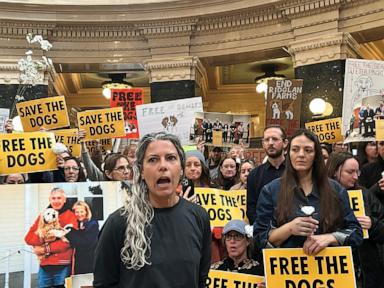
The air in Madison carries a specific kind of bite when the seasons turn, the kind that settles in your marrow and makes you grateful for a heavy coat. But on this particular morning, the chill wasn't just coming from the wind whipping off Lake Mendota. It was radiating from the silence of a hallway inside the State Capitol. Outside, the noise was deafening. Inside, behind the heavy wood and polished brass of the Governor’s office, the quiet felt heavy. Intentional.
A beagle’s ears are designed for the hunt. They are velvet-soft, long enough to sweep the ground and kick up scents, funneling the world’s secrets directly to a nose that never sleeps. In a laboratory cage, those ears hear something else entirely. They hear the click of a latch. The squeak of rubber soles on linoleum. The hum of industrial ventilation. For dozens of beagles currently housed in a Wisconsin research facility, these are the only sounds of existence.
They don't know about the people standing on the marble floors of the Capitol. They don't know about the signs held by trembling hands or the petitions signed by thousands. They only know the cage.
The Geography of a Protest
We often think of activism as a series of shouting matches, but the scene in Madison felt more like a vigil. People didn't just show up to make noise; they showed up to bear witness to a life they’ve never met. Consider a woman in the crowd—let’s call her Sarah. Sarah isn't a professional agitator. She’s a nurse from Appleton who drove two hours because she looked at her own dog sleeping on a rug and realized the distance between "pet" and "property" is nothing more than a legal definition.
Sarah stands near the Governor's door, her breath misting in the cool air. She represents the human element of a conflict that the state would rather treat as a bureaucratic line item. The protesters are demanding the release of beagles used in toxicity testing, animals they believe have served their "purpose" and deserve a patch of grass before the end.
The state sees a contract. The protesters see a soul.
This isn't just about dogs. It is about the friction between our scientific past and our ethical future. For decades, the beagle has been the "industry standard" for testing. Why? Because they are small. Because they are hardy. But primarily, because they are orignally bred to be incredibly forgiving. You can do almost anything to a beagle, and when you reach into the cage the next day, they will still wag their tail. Their inherent goodness is the very trait that made them a target for laboratory life.
The Invisible Stakes
To understand why a hallway in Wisconsin became a battleground, you have to understand the Ridglan Farms case. It’s a name that sounds like a boutique organic creamery, but it functions as one of the largest breeders of research dogs in the country. The facility has been a flashpoint for years, a fortress of gray walls where life is bred, sold, and eventually extinguished in the name of safety data.
Imagine the life cycle of a research dog. It begins in a sterile environment. There is no mother’s warmth on a porch, no chasing a tennis ball into a thicket of oak trees. Life is measured in milliliters and dosages. When a pharmaceutical company needs to know if a new compound will damage a liver or a heart, they don't look at a computer screen. They look at the beagle.
The protesters' argument is simple: the science is changing, but the laws are stuck in the mud. New technologies—organ-on-a-chip, sophisticated AI modeling, and human cell cultures—are beginning to render these animal models obsolete. Yet, the momentum of "the way we've always done it" is a powerful force. It’s a ghost in the machine that keeps the cages filled long after the data could be found elsewhere.
But the real problem lies elsewhere. It’s not just about the validity of the science; it’s about the transparency of the transition. When the public asks for the release of these animals, they are met with a wall of silence. The Governor’s office becomes a microcosm of the larger issue: a closed door between the governed and the governing.
The Anatomy of a Beagle
If you’ve ever sat on a floor with a beagle, you know they don't just sit with you. They lean. They put their entire weight against your leg as if trying to merge their heartbeat with yours. They are creatures of profound connection.
In the laboratory, that leaning has nowhere to go.
The protesters brought photos. Grainy, heartbreaking images of dogs with numbers tattooed inside their ears. These aren't names like Buster or Daisy. They are sequences of alphanumeric code. By stripping away the name, the system strips away the empathy. It’s easier to perform a necropsy on "Subject 402" than it is on a dog that knows how to shake a paw.
The activists converging on the Governor’s office are attempting to reverse that process. They are trying to turn the numbers back into names. They are asking the state to recognize that once the testing is over, the "property" becomes a living being again.
Consider the logistical nightmare of a mass release. It’s a point the state often uses to justify inaction. Where would they go? Who would pay for the veterinary care? Who would handle the trauma of a dog that has never seen a staircase or felt the uneven texture of a dirt path?
The answer was standing right there in the Capitol.
Dozens of rescue organizations have already pledged the resources. Families have lined up, their homes vetted and ready. The barrier isn't money, and it isn't space. The barrier is a signature on a piece of paper that acknowledges these animals are more than disposable equipment.
The Weight of the Silence
Wait.
That’s what the protesters did. They waited for a representative. They waited for a statement. They waited for a sign that the humans inside the office heard the humans outside the door.
Science is often portrayed as a cold, objective pursuit of truth. But science is conducted by people, funded by people, and regulated by people. When we lose the ability to feel the weight of our choices, the science suffers too. A society that can ignore the pleas for mercy for a thousand wagging tails is a society that has become dangerously clinical.
The tension in that hallway wasn't just about animal rights. It was a clash of worldviews. On one side, the utilitarian belief that any cost is acceptable for the "greater good." On the other, the belief that the "greater good" is a hollow concept if it is built on a foundation of unnecessary suffering.
One man in the crowd held a sign that simply read: They’ve given enough.
It’s a powerful thought. These dogs have spent their lives in service to human longevity. They have been the silent partners in our medical breakthroughs, the unwilling martyrs for our cosmetics and our cures. If we cannot grant them a few years of sunlight at the end of that journey, what does that say about our own humanity?
The Echo in the Hallway
As the hours passed, the energy in the Capitol shifted. The initial fervor settled into a grim, quiet determination. It wasn't the sound of people giving up; it was the sound of people digging in.
The Governor’s staff eventually made their way through the crowd, offering the standard platitudes. They spoke of "reviewing the situation" and "balancing interests." These are the phrases used when someone wants to say everything without saying anything at all. They are the linguistic equivalent of a shrug.
But the protesters didn't move.
They know that the release of the Wisconsin beagles would set a precedent. It would be a crack in the dam. If these dogs are released, then the next group must be released. And the group after that. It forces a conversation about the "end of life" protocols for all research animals—a conversation that many in the industry are terrified to have.
They don't want us to think about the retirement of a laboratory animal because that would require us to acknowledge that they were ever "working" in the first place. It would force us to look into those long, velvet ears and see a reflection of our own choices.
The sun began to dip lower, casting long, skeletal shadows across the Capitol lawn. The crowds would eventually thin, headed back to their homes, their own dogs, and their warm beds. But they left something behind in that hallway. They left a haunting question that no amount of bureaucratic dodging can fully erase.
The dogs are still there. In the quiet of the facility, they are waiting for the only thing they have ever known—the sound of a hand on the latch.
Only this time, the world is listening to see if that hand belongs to a technician or a friend. The door remains heavy, the brass remains polished, and the silence inside the Governor's office remains absolute. But out in the cold Madison air, the scent of change is being picked up by a thousand noses, and it’s a trail that won't easily be lost.
Somewhere, in a cage that smells of bleach and steel, a tail hits the floor with a rhythmic, hopeful thud.
Thud.
Thud.
Thud.
It is the simplest, most persistent heartbeat of a story that we are finally, painfully, beginning to tell.



:strip_icc()/pic2513216.jpg)