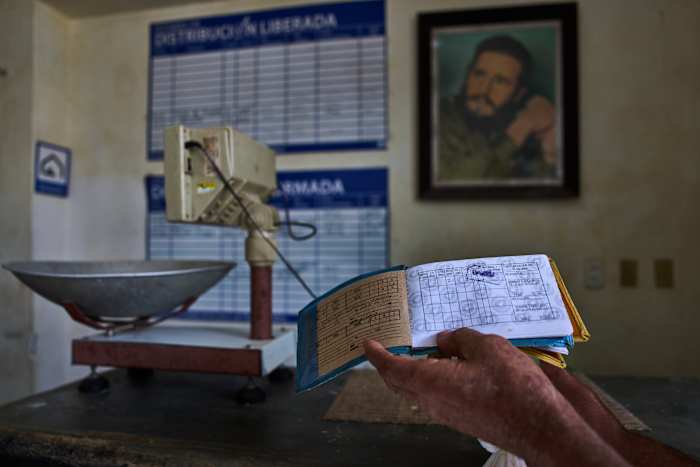
The paper is thin, grayish, and feels like it might dissolve if a single teardrop hit it. It is called the libreta de abastecimiento. To a stranger, it looks like a relic from a museum of failed bureaucracies. To Maria, a sixty-year-old grandmother in Old Havana, it is the most important document she owns. It is the gatekeeper of her survival.
Every morning, before the sun has even thought about burning the humidity off the Malecon, Maria stands in a line that stretches around the block. She is not waiting for a new phone or concert tickets. She is waiting for bread. Usually, it is a single, small roll. Sometimes, the flour doesn't arrive, and the baker stays home. When that happens, the little box in her ration book remains blank. That silence on the page speaks louder than any political speech ever could.
Cuba is currently weathering its worst economic crisis since the "Special Period" of the 1990s. But statistics are cold. They don't capture the sound of a stomach growling in the middle of a blackout. To understand why the island is vibrating with a quiet, desperate energy, you have to look at the ink inside that little book.
The Shrinking Circle of Certainty
Decades ago, the libreta was a promise. It didn't provide luxury, but it provided a floor. You knew there would be rice. You knew there would be beans, coffee, oil, and occasionally, a piece of meat. It was the social contract written in cheap ink.
Today, that floor has rotted away.
Consider the math of a typical month. The government has slashed the rations because they simply cannot afford to import the goods. The milk that used to be guaranteed for children is often delayed or substituted. The rice allocation has dwindled. The coffee is frequently mixed with toasted peas to stretch the supply.
Maria looks at the grid in her book. There is a column for eggs. Last month, she received five. Five eggs to last thirty days.
Imagine trying to bridge that gap. When the ration book fails, the only alternative is the "informal market"—a polite term for a chaotic, hyper-inflated underground economy. In the state-run stores that accept foreign currency, a bottle of cooking oil might cost more than a week’s pension. In the streets, prices fluctuate like a fever.
The Alchemy of Survival
Survival in Havana is an art form. Cubans call it inventando—inventing. It is the process of turning nothing into something, or at least into enough.
The narrative of the ration book isn't just about food; it is about the erosion of time. A human life is composed of hours, and in Cuba, those hours are spent in queues. You wait for the bodega to open. You wait to hear if the chicken arrived. You wait to see if the clerk will honor the price listed on the wall or if a new "adjustment" has been made.
This is the invisible tax on the Cuban soul. When your entire day is consumed by the logistics of sourcing a liter of oil, there is no room left for ambition. There is no energy for creativity. The horizon of your life shrinks to the size of your next meal.
The crisis is fueled by a perfect storm of structural failures. The tourism industry, the island's lifeblood, never fully recovered from the pandemic. The U.S. sanctions remain a heavy, suffocating blanket. Perhaps most significantly, the government’s attempt to unify its complex currency system backfired, sending inflation into a vertical climb.
Logic dictates that if you have no money, you cannot buy. If the state has no money, it cannot provide. But logic provides cold comfort when you are standing in the Caribbean heat, holding a book that says you are owed a pound of sugar that doesn't exist.
The Great Migration of the Young
Maria’s daughter is not in the line with her. She is in Miami.
This is the heartbeat of the modern Cuban tragedy. The failure of the ration book has triggered a mass exodus. When the basic staples of life become high-stakes trophies, the young look North. They see the libreta not as a safety net, but as a leash.
The remittances sent back by those who escaped are now the only thing keeping thousands of families from literal starvation. The island has become a giant waiting room where the elderly wait for the mail and the young wait for a visa.
The social fabric is fraying in ways that are hard to quantify. In a neighborhood where everyone once shared what little they had, the scarcity has introduced a sharp, jagged edge to daily interactions. Trust is a luxury that is hard to afford when there are only three packs of cigarettes left in the shop.
The Weight of the Pen
The clerk at the bodega is a man named Lazaro. He has been marking these books for twenty years. He sees the frustration in the eyes of his neighbors every day. He is the face of a system that is running on fumes.
"I am the one who has to tell them the beans didn't come," he says, though he says it quietly. "I am the one who has to draw the line through the box."
There is a psychological weight to that line. Each strike of the pen is a tiny heartbreak. It is a reminder that the world outside the island is moving forward, while time inside the libreta seems to be sliding backward toward a more primitive, difficult era.
The government blames the "blockade." Critics blame the central planning. The truth is likely a messy, inextricable tangle of both, but for the person holding the gray paper book, the "why" matters less than the "what." What will I eat tonight? What will I tell my grandchildren?
The libreta was supposed to be a tool of equality, ensuring that the doctor and the street sweeper ate the same bread. But scarcity is the ultimate creator of inequality. Those with access to dollars eat; those who rely solely on the book wait. The gap between the two is a canyon that is widening every hour.
The Last Page
As the sun sets over Havana, the lines don't always disappear. Sometimes people stay, hoping a truck will arrive in the middle of the night. They bring folding chairs. They share stories. They talk about the prices of pork and the latest news from relatives in Spain or the States.
Maria walks home with her single roll of bread wrapped in a scrap of newspaper. She passes a mural of a revolutionary hero, the paint peeling in long, jagged strips like sunburnt skin. The hero is smiling, looking toward a future that was promised but never quite arrived.
She enters her kitchen. She puts the bread on a plate. It looks very small in the center of the table.
She picks up the libreta and places it in a drawer next to the silverware. It is almost full. There are only a few pages left. She wonders if, when this book is finished, the government will have the paper to print a new one. Or if, by then, the boxes will all be empty anyway.
She turns off the single lightbulb to save electricity. The room goes dark, but she doesn't need light to know exactly where the book is. She can feel its presence, a small, heavy weight in the corner of the room, marking the rhythm of a life measured in ounces.
The bread is dry. She eats it slowly, making every crumb count, listening to the sound of the city outside—a city that is tired, hungry, and still, somehow, waiting.