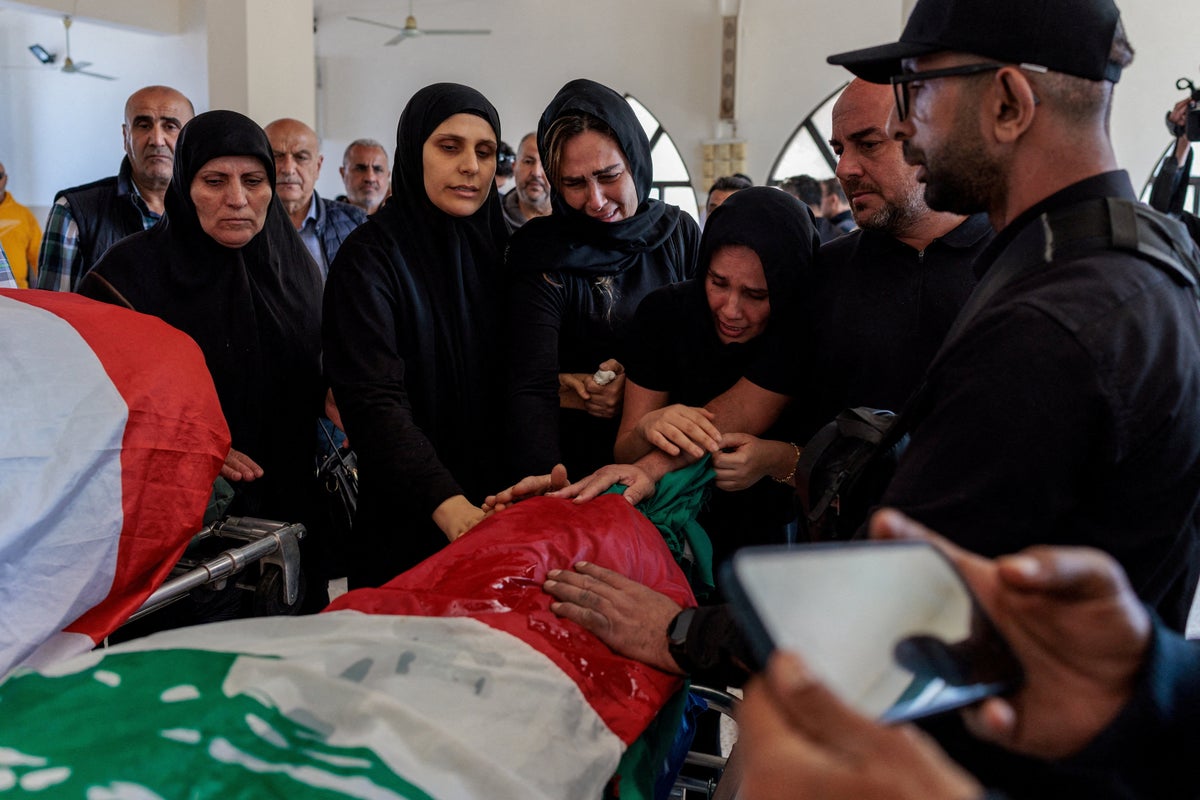
The sounds of war aren't distant echoes in Rmeish. They're rattling the windows of houses that have stood for generations. While global headlines focus on the political maneuvering in Beirut or the military exchanges between Israel and Hezbollah, the reality on the ground for Lebanon’s Christian border communities is far more precarious. These people find themselves trapped in a conflict they didn't start and certainly don't want. It’s a struggle for survival in a literal and metaphorical buffer zone.
For residents of villages like Rmeish, Ain Ebel, and Debel, the geography of the South is a curse. They sit on the edge of a high-stakes chess match. To their south lies the Israeli border, bristling with surveillance and artillery. To their north and all around them, the presence of Hezbollah’s military infrastructure creates a permanent target on their backs. Life here isn't about grand political statements. It’s about whether you can harvest your olives without getting hit by a drone strike or whether your village will be the next one emptied by fear. In related news, read about: Baloch Women Forum exposes the disturbing reality of enforced disappearances in Kech.
The Myth of the Neutral Zone
Many outsiders think these Christian enclaves are safe havens because they aren't the primary targets of Israeli strikes aimed at Hezbollah. That’s a dangerous misunderstanding. War doesn't respect religious demographics. When a missile misses its mark or an interceptor explodes mid-air, the debris doesn't care if it lands on a church or a militia depot.
There’s a palpable tension between the local population and the militant groups operating in the area. In Rmeish, locals have actively tried to prevent the launching of rockets from within their village limits. It’s a move born of pure self-preservation. They know the Israeli response is swift and often devastating. If a rocket leaves a field near a Christian school, that school is effectively marked for destruction. USA Today has also covered this critical subject in extensive detail.
This creates a dual pressure. On one side, you have the Israeli Defense Forces (IDF) viewing the entire South as a combat zone. On the other, you have the internal pressure of Hezbollah’s "resistance" logic, which doesn't always account for the specific vulnerabilities of minority communities who aren't part of their ideological base.
Economic Ruin is the Silent Killer
The bombs are terrifying, but the economic collapse is what’s actually hollowed out these towns. South Lebanon relies heavily on agriculture. Tobacco and olives are the lifeblood of the local economy. Right now, thousands of acres are inaccessible. Farmers can’t reach their land because of the constant threat of shelling or because the soil has been contaminated by white phosphorus.
I’ve seen reports from human rights organizations like Human Rights Watch and Amnesty International documenting the use of incendiary weapons in these border regions. It’s not just a temporary disruption. When you burn an olive grove that took fifty years to mature, you’re not just hitting a target. You’re killing a family’s income for the next generation.
The shops are empty. The young people are leaving for Beirut or, more likely, looking for any way to get a visa to Europe or Canada. Those who stay are the elderly and those too poor to move. They're living on dwindling savings in a country whose currency is already worth less than the paper it's printed on.
A History of Holding the Middle Ground
To understand why these villages feel so isolated, you have to look at the history of the Lebanese Civil War and the subsequent Israeli occupations. These communities have a long memory. They remember the 1978 invasion, the 1982 war, and the long years of the South Lebanon Army (SLA) era.
Historically, some Christians in the south were forced into alliances of convenience with Israel to protect themselves from Palestinian factions or leftist militias. That legacy still haunts them. Today’s generation is hyper-aware of that history. They don't want to be seen as collaborators, but they also don't want to be human shields for an Iranian-backed militia. They’re trying to walk a tightrope that’s getting thinner every day.
The Lebanese Army, which many here see as the only legitimate protector, is effectively sidelined. They don't have the hardware or the political mandate to challenge Hezbollah or stop Israeli incursions. This leaves the villages dependent on the UNIFIL peacekeepers. But let’s be honest. UNIFIL’s presence is mostly symbolic. They can write reports and patrol the Blue Line, but they can’t stop a war.
The Real Risk of Total Displacement
We're seeing a slow-motion demographic shift. If the current skirmishes turn into a full-scale ground invasion—a scenario that feels more likely with each passing week—these villages will be the first to fall. We aren't just talking about temporary displacement. In the Middle East, once a minority community leaves its ancestral land under the pressure of war, they rarely come back in the same numbers.
Look at what happened in Iraq’s Nineveh Plains or parts of Syria. Conflict provides an "opportunity" for demographic re-engineering. If the Christian presence in South Lebanon vanishes, it changes the entire character of the country. Lebanon’s whole identity is built on this messy, fragile sectarian balance. When one piece of the puzzle is forcibly removed, the whole structure starts to wobble.
The people in Rmeish and Debel are stubborn. They’ve survived Ottoman rule, French mandates, and multiple regional wars. But the current situation feels different. The technology of war has become more precise and yet more indiscriminate in its collateral effects. A "surgical strike" on a nearby hill still shatters the peace of the village below.
Why the World Ignores the Border Christians
Most international coverage treats Lebanon as a monolith. It’s often framed as "Israel vs. Hezbollah." This binary narrative ignores the millions of Lebanese—Christians, Sunnis, and even many Shias—who are caught in the middle. The Christian villages are a PR problem for both sides. They don't fit the narrative of "resistance," and they don't fit the narrative of a purely "terrorist" landscape that some want to portray.
They are simply people trying to live. They want to go to mass, harvest their crops, and see their children grow up without knowing the sound of an Iron Dome interceptor.
If you want to understand the true cost of this war, stop looking at the maps of missile ranges. Look at the empty pews in the churches of the South. Look at the shuttered storefronts in villages that have been there since the time of the Phoenicians. The frontline isn't just a line on a map. It’s a place where real lives are being ground down by the friction of two powers that don't know how to stop.
What Happens Next
The immediate priority for anyone watching this space is the survival of these local economies. If the harvest fails again this year, the migration will turn from a trickle into a flood. Local NGOs and church groups are trying to provide a safety net, but they're overwhelmed.
Don't wait for a ceasefire to pay attention to these communities. Support local Lebanese initiatives that provide direct aid to the border regions. Keep the pressure on international bodies to ensure that white phosphorus isn't used near civilian agricultural land. Most importantly, stop viewing Lebanon through a single lens. The reality is a collection of small villages, each fighting a quiet, desperate battle to simply exist on the land they've called home for two thousand years.
The window for a diplomatic solution that preserves the dignity and safety of these border towns is closing fast. Once the houses are empty and the groves are ashes, no amount of diplomacy will bring that heritage back.