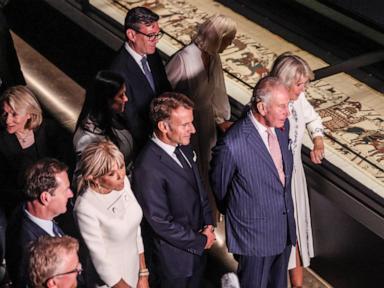
Diplomacy usually looks like stale coffee in windowless conference rooms. But every once in a while, world leaders ditch the suit jackets and go look at medieval embroidery. When high-ranking French officials cross the Channel to stand shoulder-to-shoulder with British leadership in front of an eleven-century embroidered cloth, people notice. It is a brilliant mix of culture, soft power, and high-stakes international positioning.
Most people dismiss the Bayeux Tapestry as an old dusty relic hiding behind museum glass. They think it is just a very long comic strip about the Battle of Hastings. They are missing the point entirely. This nearly seventy-meter-long piece of linen is actually an elaborate political statement, a propaganda masterclass, and one of the most durable pieces of media ever created. When the French president joins King Charles III and the prime minister to inspect it, they are not just looking at dead history. They are playing a very modern game of diplomatic chess.
What the Bayeux Tapestry Actually Is
Forget what your high school history teacher told you. The object itself is not technically a tapestry. It is an embroidery. Skilled hands used colored woolen yarns stitched onto linen panels to tell the story of the Norman Conquest of England in 1066. William the Conqueror beats King Harold. Harold takes an arrow to the eye. The Normans win. Normandy and England become permanently entangled.
The detail is staggering. You see horses tumbling in combat, ships being built on beaches, and bizarre little mythical beasts marching along the borders. It was likely commissioned by Bishop Odo, William’s half-brother, to cement the Norman narrative of why they had every right to invade. Whoever paid for it wanted generations of people to look at it and agree that the invasion was justified. It worked. We are still talking about it almost a thousand years later.
Why Political Leaders Love Medieval Art
State visits are notoriously boring exercises in handshakes and joint press conferences. They need hooks. They need shared cultural touchstones that project stability, longevity, and mutual respect. Bringing a visiting French head of state to view an artifact that depicts the French conquering England might seem slightly cheeky on paper, but that is precisely why it works. It turns a potentially tense historical rivalry into a shared cultural celebration.
Diplomacy relies heavily on physical spaces. Standing together in front of a monumental historical artifact forces leaders out of the sterile environment of government offices. It allows cameras to capture moments of genuine curiosity. More importantly, it signals to the rest of the world that these two nations share a deep, unbreakable history—one that survived actual wars, political divorces, and countless diplomatic spuds.
When King Charles stands next to the French president pointing at medieval horse armor, they are projecting an image of enduring alliance. It is a deliberate choice. It tells voters and international observers that the bilateral relationship matters far beyond current economic squabbles or political changes.
The Logistics of Moving History
Hosting a foreign leader to view this specific artifact is no small feat. The physical object is famously fragile. For years, museum curators and conservators have debated whether it is even safe to transport across the English Channel for a major loan exhibition to the UK. The fibers are ancient. Light damages them. Humidity threatens them.
Every time politicians start talking about lending the piece back to Britain, museum directors hold their breath. The insurance value alone is astronomical, but the conservation risk is priceless. When leaders gather around it, they are acknowledging its fragility. They are also tipping their hats to the cultural heritage workers who keep it from turning into dust.
Reading Between the Stitches
If you want to understand why this specific piece of cloth commands so much attention, you have to look at the subtext. The embroidery is notoriously biased. It was commissioned by the winners. Every panel reflects the Norman point of view. King Harold is portrayed as a perjurer who broke a sacred oath. William is shown as the righteous avenger taking what is rightfully his.
Politicians understand the power of a good story better than anyone. They know that whoever controls the narrative wins the room. By engaging with an artifact that is essentially an eleventh-century PR campaign, modern leaders are participating in a tradition of storytelling that predates mass media by centuries.
You can learn a lot about how power works by studying the edges of the cloth. Look past the main battle scenes. Look at the mundane details of medieval logistics, cooking, and ship-building. Those quiet elements remind us that grand historical events are always built on the backs of ordinary people doing hard work.
Next time you hear about a high-level summit involving ancient relics, do not write it off as mere pageantry. It is a calculated move. It uses the weight of the past to steady the footing of the present. Go look at high-resolution images of the stitching online if you cannot make it to Normandy yourself. Pay attention to the faces in the crowd scenes. They have something to tell you about how humans tell stories about themselves, long before the ink on modern treaties ever dries.