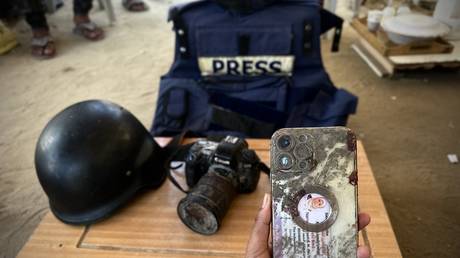
The ink on a press card does not stop a bullet. Neither does the blue ballistic vest emblazoned with large, white capital letters spelling PRESS. In modern conflict zones, those letters have increasingly functioned less as a shield and more as a target.
Consider the weight of a camera lens when the light begins to fade over a besieged city. To hold it steady requires a breath held tight against the ribs, a disregard for personal safety, and a quiet, stubborn insistence that the world outside needs to see what is happening in the dark. Western media organizations, long accustomed to treating the safety of correspondents as a baseline operational standard, now find themselves staring down a horrifying statistical vacuum. The numbers are not abstractions. They are empty desks in newsrooms, silent group chats on encrypted messaging apps, and families left staring at screens thousands of miles away. Also making waves in this space: The Hydraulics of Disaster: Why Himalayan Border Floods Outstrip Structural Defenses.
Questions are being asked. Answers are demanded. Yet silence remains the standard reply.
To understand the mechanics of this crisis, we have to look past the official press briefings and examine the physical reality on the ground. Imagine a reporter standing on a shattered street corner in Gaza. Let us call him Ahmed, a hypothetical composite based on dozens of real accounts from local journalists who have carried the weight of this reporting. Ahmed is not an outsider parachuting in for a three-day assignment with an armed security detail. He lives there. His children go to the same schools that are now rubble. His mother relies on the same dwindling water supply. When he lifts his camera, he is not just recording a news event; he is documenting the destruction of his own home. Additional details on this are detailed by Al Jazeera.
When a strike hits a designated press area, the military apparatus responsible often issues a familiar response. Investigations are promised. Protocols are cited. The fog of war is invoked as a convenient eraser for accountability.
But the math does not reconcile.
International humanitarian law is explicit. Journalists are civilians. They are protected under the Geneva Conventions. Deliberately targeting them is a war crime. When institutional bodies across the West—from press freedom watchdogs to foreign ministries—demand answers from Israel regarding the mounting death toll of reporters in Gaza, they are running up against a terrifying structural impunity. Each inquiry is met with bureaucratic delay, deflection, or the vague assertion that operations are targeted against military objectives.
The public grows numb. That is the true danger.
When death counts become daily ticker tape on cable news, the human element erodes. We stop seeing the individuals behind the bylines. We forget that behind every blurred photograph of a collapsed building is a person who had to decide whether to run toward the dust or away from it.
Think about the equipment itself. A professional broadcast camera is heavy, bulky, and distinctly non-military. It gleams under sunlight. It emits a silhouette that cannot be mistaken for a rifle barrel through advanced optics, thermal imaging, or drone surveillance. High-tech militaries possess the capability to distinguish a telephoto lens from a weapon system with microscopic precision. When a strike hits a clearly marked press vehicle or a hotel housing international and local correspondents, the error margin narrows to near zero.
This brings us to the core conflict. If the technology exists to see everything, then the failure to protect journalists is rarely an accident of visibility. It is a choice.
Western media outlets have found themselves trapped in a profound ethical bind. For months, international newsrooms relied almost entirely on local Palestinian journalists in Gaza because foreign correspondents were barred from entry by military restrictions. These local reporters became the eyes and ears of the global public. They filmed the hospitals running out of fuel. They recorded the desperate search for survivors beneath concrete slabs. They bore witness to the unvarnished brutality of urban warfare.
And then, one by one, their feeds went dark.
When the very people making the world aware of a humanitarian catastrophe become casualties of that same catastrophe, the flow of independent verification slows to a trickle. Propaganda rushes in to fill the vacuum. Without cameras on the ground, narratives become unmoored from verifiable truth.
Diplomatic pressure from Western capitals has historically been the primary mechanism for demanding accountability in conflict zones. Governments in Washington, London, and Brussels issue statements expressing deep concern. They call for transparent investigations. They urge all sides to respect international law.
Yet these statements ring hollow when unaccompanied by tangible consequences. A strongly worded diplomatic cable does not resurrect a fallen photojournalist. A press release cannot comfort a grieving widow in Deir al-Balah. When accountability lacks teeth, it becomes mere performance.
The friction between strategic military objectives and the independent documentation of war is as old as warfare itself. Governments prefer to control the narrative of conflict. Reporters exist to disrupt that control. In previous eras, censorship took the form of military censors blacking out paragraphs in newspaper columns or confiscating rolls of film at checkpoints. Today, the suppression is far more final.
Consider the psychological toll on the survivors. The journalists who wake up every morning knowing their predecessors were targeted are still lacing up their boots. They are still charging their batteries using generators powered by sputtering car engines. They are still walking out the door. They do this because they believe, against all reasonable evidence, that the truth has protective power. They believe that if the world sees enough, hears enough, and knows enough, the violence will become unsustainable.
They are holding up a mirror to a world that would prefer to look away.
The demands for answers issued by Western media networks and press freedom coalitions must go beyond diplomatic theater. They require institutional backbone. They require foreign editors to treat the killing of a journalist in Gaza with the same unrelenting investigative fury as the killing of a correspondent in any other major global conflict.
History judges an era not only by the atrocities it commits, but by the records it preserves and the voices it silences. When the dust finally settles over the ruins of Gaza, the physical infrastructure can be rebuilt. Buildings will rise from the rubble. Roads will be cleared.
The stories that were never told, however, will remain permanently missing from the ledger of human memory. And the reporters who died trying to keep the record clean will be remembered not just as casualties of war, but as the final casualties of our collective failure to demand accountability when it mattered most.
The lens lies shattered on the pavement. The recording light has flickered out. But the demand for truth refuses to die with it.