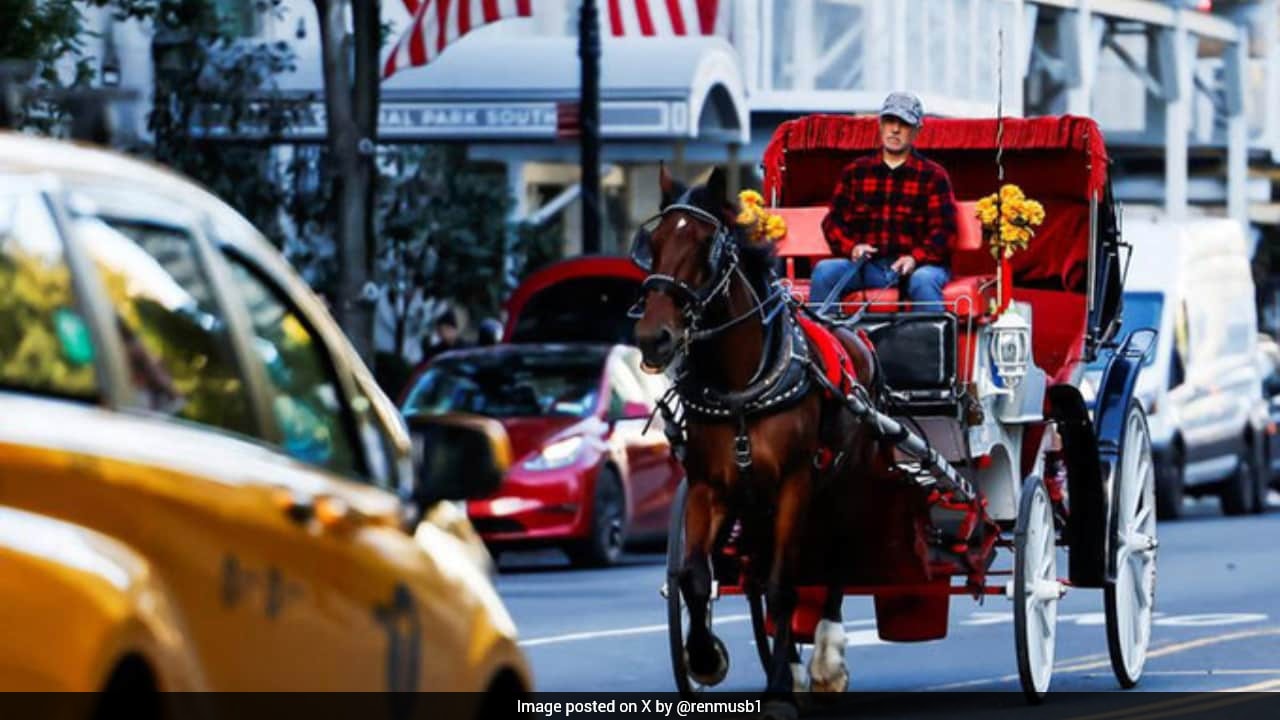
Iron shoes strike wet asphalt at dusk. A clip-clop that sounds like old money, velvet coats, and postcard romance.
For a century and a half, that sound belonged to Manhattan. It drifted up from the southern edge of Central Park, where polished leather harnesses creaked against spoked wooden wheels and travelers leaned back into plush seats as if time had paused just for them. You could step off a long-haul flight, walk two blocks past glass towers and delivery scooters, and pretend you had entered a nineteenth-century etching. Don't miss our earlier article on this related article.
Romance.
Until the sound changes pitch. Until a sharp, sickening thud cuts through the hum of yellow cabs and idling buses, turning a gilded tradition into a crime scene. If you want more about the context here, NPR offers an in-depth summary.
Months after the death of a visiting Indian tourist drew global scrutiny to the collision between antique street transport and modern urban traffic, New York moved to end a 150-year-old horse carriage era. To some observers, the ban reads like a sudden rupture with history. To anyone who has stood on Central Park South at rush hour watching a thousand-pound prey animal try to process a wall of honking steel, it feels less like a surprise and more like a reckoning long postponed.
When Old World Nostalgia Meets Modern Gridlock
Let me be honest about what it feels like to watch this unfold from the sidewalk. I have spent years walking the perimeter of Central Park in every kind of weather—slush-choked January mornings, humid August evenings when the air smells like hot radiator coolant and roasted nuts—and I have always felt a knot in my stomach watching carriages weave through midtown traffic.
Part of me understood why people loved them. Travel changes us when we let ourselves be surprised, and for someone crossing an ocean to see New York for the first time, sitting behind a horse with sunlight filtering through bare oak branches can feel like stepping straight into cinema. When my own family visited from out of town years ago, my youngest cousin begged to ride one. I hesitated, watched a delivery van roar past three feet from a horse’s flank, and said no. We argued about it over lukewarm pretzels. I felt like a killjoy then. After enough close calls on the avenue, I stopped feeling guilty and started feeling afraid.
To make sense of the invisible stakes behind a ban on horse-drawn carriages, consider a hypothetical traveler—let’s call her Meera, a first-time visitor from Mumbai arriving in New York with her parents after sixteen hours in the air. (This scenario is hypothetical, built to illustrate the real pressures faced by visiting tourists navigating unfamiliar streets.) Meera has dreamed of Manhattan since watching American films as a teenager. She sees a carriage waiting near the park edge, its driver offering a quick loop through a famous landmark. Exhausted, jet-lagged, and eager to give her parents a memorable afternoon without walking miles on sore feet, she climbs in.
What Meera cannot see from the passenger seat is the physics of the moment. A horse is not a machine with hydraulic brakes and turn signals. Biologically, a horse is a flight animal wired to scan peripheral movement for predators and bolt when startled. Put that nervous system inside a dense grid of e-bikes, buses, sirens, and distracted drivers, and every green light becomes a gamble. When tragedy strikes a visitor like Meera—far from home, trusting a city institution to keep her safe—the story stops being about quaint local color. It becomes a question of public duty.
Why Tradition Alone Cannot Outrun Physics
Nostalgia is a powerful sedative. It asks us to remember the carriage in a snow globe rather than the pavement beneath its wheels.
For generations, horse carriages in New York survived because they occupied a sliver of space where history and commerce shook hands. Drivers pointed to tradition, licensing rules, and livelihoods passed down through families. Riders pointed to photo ops and quiet moments away from subways. For a long time, enough people looked away from the friction points—heat waves, exhaustion, traffic congestion, and the sheer mismatch between equine biology and motor-vehicle speed—that the system kept rolling.
Consider what happens next when a city grows denser, louder, and faster while one piece of its street life stays anchored in 1870. Every delivery rider weaving between lanes, every car edging into a crosswalk, every sudden blast of a horn shrinks the margin for error. A horse can spook at a plastic bag whipping across the road or a sudden hiss of air brakes from a city bus. A split-second panic can send a carriage careening into oncoming traffic or onto a sidewalk crowded with pedestrians.
Think of a horse on a busy city street like a violin left on a subway bench during rush hour. The instrument is genuine, crafted with care, carrying real heritage—but the environment around it was never built to protect something so fragile and reactive. Eventually, the surroundings win.
Critics of a ban often ask whether city officials are overreacting to a single tragedy or erasing a piece of New York identity. That doubt is fair. Big cities lose character all the time when rules tighten, and anyone who cares about urban culture should pause before cheering the end of an old tradition. Yet safety policy rarely changes in a vacuum. It usually takes a shock—a death that forces policymakers, residents, and visitors to confront what "acceptable risk" actually means—before long-standing exemptions get revoked.
When a tourist dies after a carriage incident, the shockwave travels fast. Families at home watch news reports wondering how a sightseeing ride turned fatal. Diplomats, advocates, and city leaders face uncomfortable questions about oversight, street design, and whether a high-density metropolis has any business mixing live animals with heavy traffic.
The Human Cost Behind the Headlines
Behind every policy shift stand real people whose lives are tangled up in the outcome.
Drivers and stable workers face real economic disruption when an industry winds down. Many of them are not cartoon villains; they are working people who woke up before dawn, cleaned stalls, checked tack, and tried to earn a living in one of the most expensive cities on earth. Pretending their livelihoods do not matter makes the argument colder and less honest. If a city decides a practice is too dangerous or inhumane to continue, it also has to reckon with the people whose paychecks disappear when the permit disappears.
Then there are the grieving families—people who packed suitcases for celebration and ended up navigating grief across borders, paperwork, and time zones. For them, the debate over "heritage" feels almost surreal. A holiday is supposed to return people home with stories, not condolences.
And there are the animals themselves, standing motionless at traffic lights while exhaust fumes curl upward and thousands of footsteps rush past. Even with regulations on working hours and rest periods, a city street is an unnatural habitat for a creature built for open range. You do not need to be an activist to notice the tension in a horse’s jaw when a siren wails two blocks away.
But the real problem lies elsewhere too: once a tragedy happens, everyone wants an instant villain and a simple fix. Some blame reckless drivers. Some blame carriage operators. Some blame city hall for waiting too long. The truth is messier. It sits at the intersection of outdated rules, modern street chaos, and human reluctance to let go of familiar sights until the cost becomes undeniable.
What Changes When the Carriages Leave the Street
Ending a 150-year-old practice does not erase the past, even if it changes how the present looks.
New York has reinvented itself dozens of times. Elevated trains came down. Cobblestones disappeared under asphalt. Ferry slips gave way to bridges and tunnels. Each transition felt like a loss to someone who loved the old way, and each time the city adapted—sometimes clumsily, sometimes brilliantly—to fit the reality of more people moving through tighter spaces.
Once horse carriages are removed from the mix, the immediate hazard of equine-vehicle collisions drops to zero. Streets become slightly simpler to read for drivers, cyclists, and pedestrians alike. Visitors looking for a memorable way to experience the park still have walking paths, pedicabs, guided tours, and open lawns—none of which rely on a frightened animal navigating midtown gridlock.
Still, I won't pretend the transition is tidy or painless. Real change rarely is. There will be arguments over timelines, compensation, job transitions, and what replaces the old ritual near the park’s southern gates. Anyone who tells you the end of the carriages solves every problem on New York streets is selling a neat story. Traffic safety requires better enforcement, calmer street design, and accountability across all modes of transport.
Yet removing a vulnerable, high-risk element from chaotic traffic is a clear, concrete step toward fewer preventable deaths. Sometimes progress is not about inventing something futuristic. Sometimes it is about admitting that an old custom no longer fits the world around it.
A Quieter Crossing at Dusk
Picture twilight falling over Central Park South again.
Streetlamps flicker on, casting amber pools across the crosswalks. Buses hiss and roll forward. Riders in windbreakers zip past on bikes, their taillights blinking red in the gathering dark. No wooden wheels rattle over the grates. No leather reins creak in the damp evening air.
For a moment, the absence feels strange—almost like a missing note in a song you have heard your whole life. Then a family steps off the curb together, unhurried and intact, walking toward the trees under a sky turning deep indigo above the skyline.


