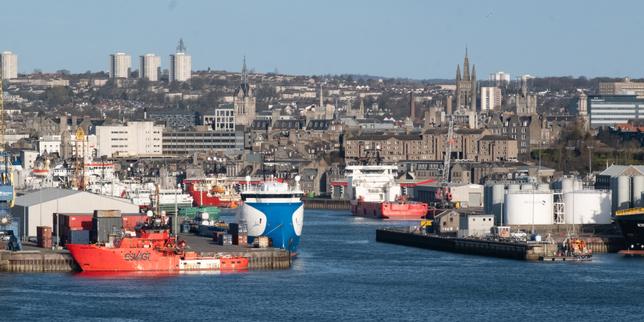
Salt crusts the winches. The North Sea does not care about your stock prices, your corporate restructuring plans, or the neat little spreadsheets projected in glass-walled boardrooms three hundred miles to the south. It only knows how to heave, how to batter, how to turn steel into rust with the relentless patience of water meeting stone.
Stand on the cliffs of Aberdeen when a North Easterly rolls in, and you can smell the transition. It smells like diesel exhaust, cold salt spray, and something older—the damp peat of an economy running out of fuel. For half a century, this Scottish granite city called itself the oil capital of Europe. Money pooled here like crude in a bedrock trap. Porsches lined the suburban driveways of Westhill; helicopter charter pilots were local kings; schoolyards buzzed with children whose fathers rotated through shifts on floating steel islands sixty leagues offshore. For a deeper dive into similar topics, we recommend: this related article.
Now, the rigs are retiring.
They are coming home to die or to be dismantled, towed back to the quays where crane jibs slice the grey maritime sky like broken ribs. This is the slow twilight of the North Sea hydrocarbons, a quiet unravelling that the glossy annual reports try to sanitize with talk of energy security and green transitions. But talk does not pay the mortgage on a semi-detached house in Dyce when the roughnecking contract is suddenly not renewed. For additional background on this topic, detailed analysis is available on Financial Times.
Consider Alistair. I met him in a pub off Union Street where the carpet has absorbed forty years of spilled lager and industrial ambition. He is fifty-four, with hands like weathered oak and eyes that squint against horizontal rain even when he is indoors.
"We built the modern world out here," he told me, sliding his heavy pint glass across the scarred wood. "Every time you turned on a gas fire in London or filled your tank on the M6, a piece of us came ashore through a pipeline. Now they look at us like we are smoking indoors. Like we are an embarrassment."
He is not entirely wrong. The narrative surrounding Aberdeen has shifted from pioneering industrial triumph to a nervous calculation of decline. Production peaked in the late nineteen-nineties, a glorious, dizzying gusher of tax revenue and geopolitical independence. Since then, the subterranean reservoirs have grown tired. The easy oil is gone. What remains requires microscopic seismic imaging, deep-pocketed engineering, and a stomach for volatility that has driven major operators to pack their bags and look elsewhere—toward the deepwater plays of Guyana or the Permian shale basins of Texas.
The numbers are stark, though the people living them feel them as a pulse rather than a statistic. Output has dropped by more than half from its peak. Hundreds of platforms bob across the UK continental shelf, many operating long past their original design life, requiring billions of pounds simply to keep the corrosion at bay.
And then there is the decommissioning liability—a monumental financial overhang. Who pays to plug the wells? Who cleans up the thousands of miles of subterranean steel left in the dark, cold depths? By law, the companies that drove the shafts are on the hook, but as fields mature and profit margins thin, the dance between corporate operators and government regulators grows tense. Tax credits for new extraction clash awkwardly with windfall levies designed to fund net-zero ambitions.
Everyone wants a clean future. No one quite knows how to pay for the bridge across the chasm.
To understand Aberdeen right now, you have to understand the psychology of an extraction town. It is a place built on boom and bust cycles, hardened by the brutal physics of marine engineering. When oil hit one hundred and forty dollars a barrel in two thousand and eight, the city felt invincible. When it crashed below thirty dollars in two thousand and sixteen, panic swept through the offices on the North Esplanade West like a North Sea squall.
Yet the city kept going. Because that is what it does.
Walk through the Energy Transition Zone near the harbor, and you will see the ghosts and the embryos side by side. Here, a fabrication yard that once built massive steel jackets for drilling platforms is now repurposing its welding bays for offshore wind turbine foundations. Engineers who spent thirty years calculating mud weights and downhole pressure are now modeling tidal currents and subsea cable scour.
It sounds seamless on a slide deck. In reality, it is a bloody-minded scramble.
The transition economy does not create jobs at the same wage scale as the oil patch, at least not yet. A technician who could pull six figures working a grueling two-weeks-on, two-weeks-off rota on a turbulent platform finds a very different landscape ashore: local wages, shorter hours, and a gnawing sense that the adrenaline of the high-stakes energy game has been replaced by the quiet desperation of municipal bureaucracy.
"It is not about whether the oil is there," a veteran subsurface geologist explained to me, tracing circles in the condensation of his coffee cup. "The oil is still down there. Billions of barrels of it. The question is whether we are allowed to touch it, whether it makes financial sense after taxes and public relations, and whether the young talent even wants to learn the trade anymore."
That is the invisible friction of our era. We demand clean energy with the casual righteousness of consumers ordering same-day delivery, rarely pausing to look at the machinery of transition. We want to banish fossil fuels while our hospitals, our data centers, our cargo ships, and our chemical plants run on the very hydrocarbons we are trying to legislate out of existence.
Aberdeen is caught in the crosshairs of this hypocrisy. It is the hinge of history. On one side lies the high-carbon wealth that built modern Britain; on the other lies an unmapped, wind-swept future that has not yet learned how to keep the lights on without a safety net.
As dusk settles over the Granite City, the mica in the building facades catches the fading amber light, making the entire place shimmer like powdered silver. Out in the bay, a service vessel cuts a white wake toward open water, its deck stacked with bright yellow containment gear. The derrick on the horizon stands dark and silent against the purple clouds, a monument to an age of fire and pressure, waiting for the tide to turn.