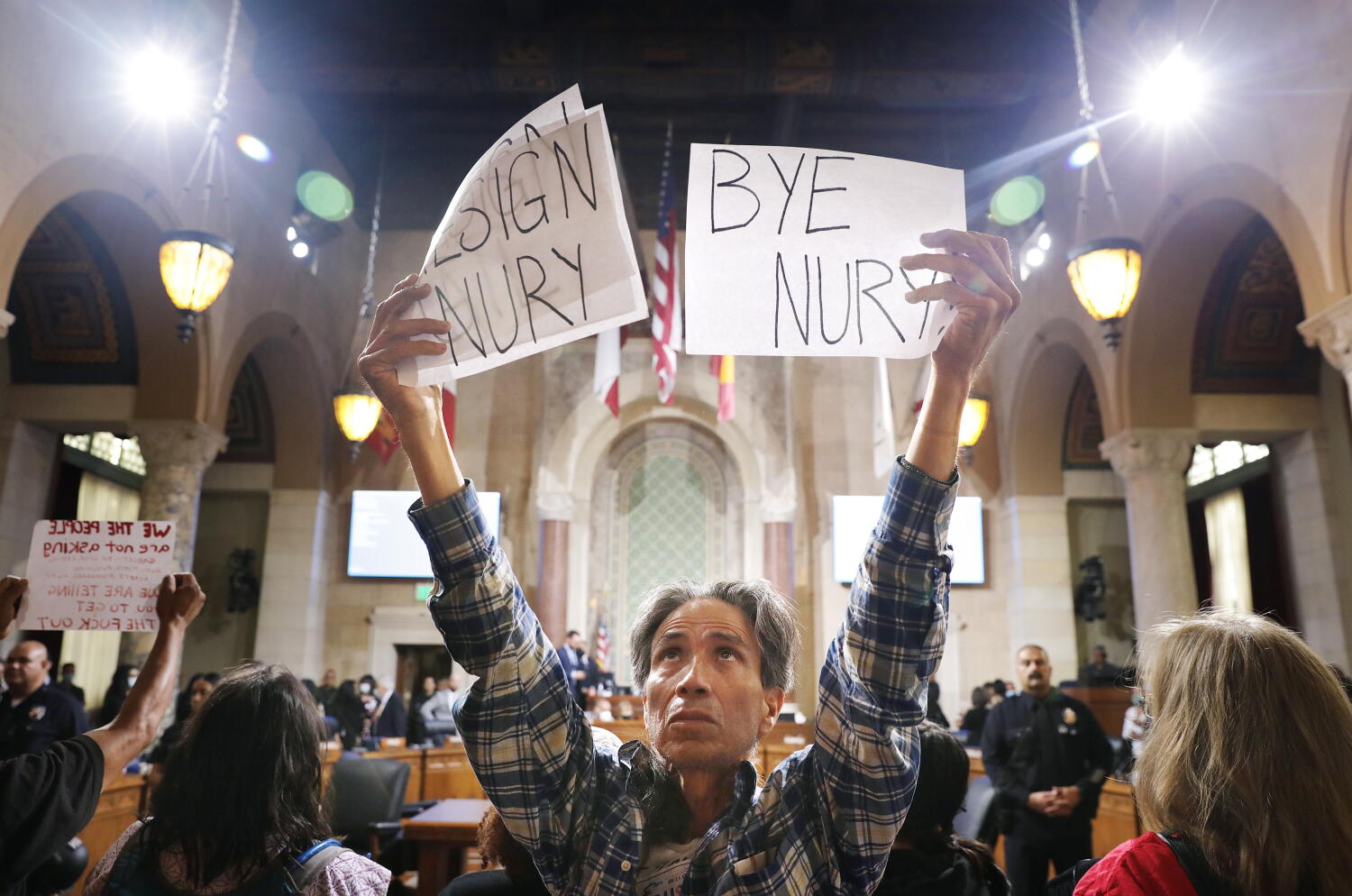
Everyone fell for the cheap theater.
When the audio files dropped from that infamous October 2022 meeting—capturing Los Angeles City Council members trading racial slurs, plotting district boundaries like feudal warlords, and treating governance like a turf war—the collective response was predictable. Cue the pearl-clutching. Cue the emergency press conferences. Cue the chorus of politicians demanding immediate resignations because their sacred trust had been violated.
Spare me the theater.
The lazy consensus says that secret recording exposed a broken, corrupt machine that needed disinfecting by public sunlight. The narrative writes itself: a few bad actors caught on tape, righteous indignation takes over, the guilty step down, and democracy heals. That story makes for great local news. It also completely misunderstands how power operates in a modern metropolis.
Those council members did not say anything behind closed doors that they were not already executing in broad daylight. The leak did not reveal a hidden conspiracy. It revealed standard operating procedure.
Let us look at the mechanics. Urban governance in a city the size of Los Angeles does not run on civic virtue or parliamentary politeness. It runs on coalitions, real estate transactions, labor negotiations, and demographic math. Every single person screaming for reform on television participates in the exact same transactional ecosystem. When Nury Martinez and her colleagues carved up district maps to protect their political survival, they were doing what career politicians do when survival is on the line: treating the electorate as a managed asset.
The real scandal was never that the conversation happened. The scandal was that everyone pretended to be shocked by it.
The Comfort of Individual Villains
We love a scapegoat because individual villains let systems off the hook.
If corruption is just a personal moral failing of specific individuals—a few bad apples in the barrel—then the fix is simple. You swap out the apples. You hold a special election, install a new face, pass a feel-good ordinance about transparency, and go back to business as usual.
That is why the political establishment embraced the leak fallout so eagerly. Sacrificing a few council members acted as a pressure valve. It vented public fury without threatening the underlying architecture of power. The district boundaries remain drawn to maximize specific interests. The backroom deals that dictate where housing gets built, where funding flows, and whose neighborhoods get prioritized are still happening in air-conditioned suites far away from public microphones.
The system did not shudder because its integrity was compromised. It shuddered because someone left a hot mic running.
I have watched ambitious reformers step into local government convinced they can overhaul the machinery through sheer force of will. They spend six months fighting the zoning code, another six months realizing that every neighborhood association is a miniature cartel defending property values, and the rest of their term cutting deals to keep the streetlights working in their district. Power in a city of four million people is zero-sum. You either trade favors, or you accomplish nothing.
Pretending otherwise is a luxury reserved for editorial boards and activists who never have to balance a municipal budget or negotiate with police unions.
The Weaponization of Outrage
Look closely at how the aftermath was managed. The outrage was instantly monetized, channeled into predictable partisan talking points, and used to posture for the next election cycle.
Every politician who rushed to condemn the audio clips knew precisely how the game was played. They use identity politics as a shield and a sword, weaponizing representation while dividing communities along racial and ethnic lines behind closed doors. The leaked audio proved that identity-based coalition building at the municipal level often looks less like civil rights advocacy and more like a gang turf war.
If you slice a city into ethnic enclaves to guarantee safe seats for incumbents, do not act surprised when the people sitting in those seats talk about their constituents as territories to be defended rather than citizens to be served. The mapmakers created the incentive structure. The politicians merely inhabited it.
To fix the disease, you have to look past the symptoms.
Rewriting the Rules of Urban Power
If we actually wanted to change how Los Angeles functions, we would stop focusing on sensitivity training and ethics pledges. Those are corporate HR band-aids slapped on a structural fracture.
Real reform requires radical structural changes that eliminate the incentives for backroom cartels to form in the first place.
First, expand the size of the City Council drastically. Los Angeles has fifteen council members representing nearly four million residents. That is roughly 265,000 residents per district—one of the worst representation ratios of any major city in the democratic world. When a politician represents a quarter of a million people, retail politics dies. Representation becomes an enterprise, requiring massive campaign war chests, developer donations, and machine politics to break through the noise. Triple the size of the council. Make districts small enough that a candidate can walk door-to-door without a super PAC. When districts shrink, the power of institutional kingmakers shrinks with them.
Second, strip land-use authority away from individual council members. Right now, council members hold absolute veto power over real estate development in their districts. This ancient custom, known as council prerogative, is the single greatest engine of municipal corruption in Southern California. It turns every zoning decision into a high-stakes negotiation where developers court the local politician with campaign cash and favors. Centralize planning based on objective, city-wide housing metrics. Take the zoning pen out of the hands of politicians who use it as a personal fiefdom.
Third, embrace radical transparency in administrative appointments and municipal contracting. The real money in city government does not move during dramatic floor debates; it moves in the quiet awarding of billions of dollars in infrastructure, transit, and social service contracts. Shine the floodlights there, and the political posturing will dry up overnight.
Stop Waiting for Heroes
The illusion perpetuated by the media cycle surrounding the L.A. City Hall leak is that the right leaders will somehow usher in an era of pristine, post-racial, perfectly ethical governance if we just vote hard enough.
That is a fairy tale for adults.
Politics is an exercise in managing competing ambitions, scarce resources, and tribal loyalties. It is messy, transactional, and frequently cynical. Pretending that a few resignations can purify the system is a comforting delusion that prevents actual, structural repair.
The audio leak did not destroy public trust in local government. It merely confirmed what cynical citizens already suspected: that the people running the show view the city as their private estate.
Until we change the rules of the game, changing the players is just rearranging deck chairs on a sinking ship. Stop looking for saviors in the council chambers. Start dismantling the architecture that gave them their power in the first place.


