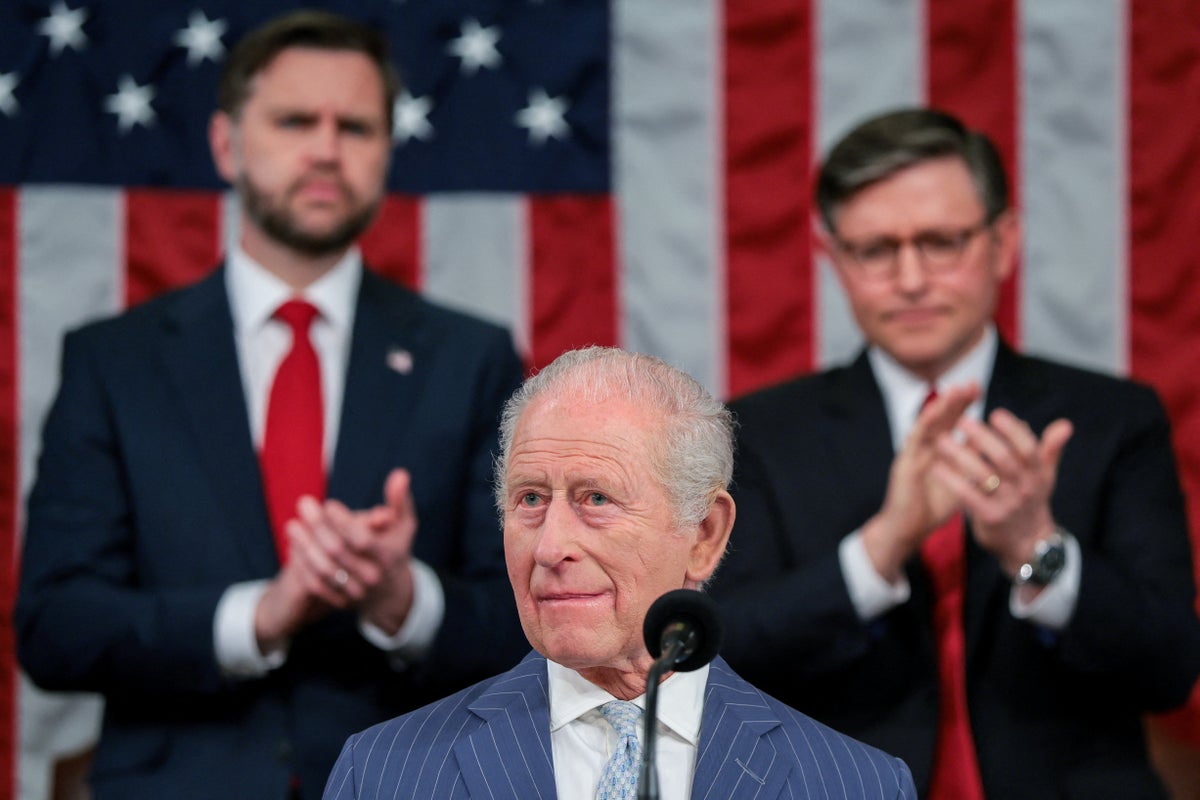
The air inside the United States Capitol usually tastes of old paper, heavy wood polish, and the frantic, electric hum of people trying to be important. But on this particular Tuesday, the atmosphere shifted. It felt thick, almost liquid. When King Charles III walked toward the rostrum of the House of Representatives, he wasn't just a monarch stepping into a room of politicians. He was a thousand years of history walking into a room designed to escape it.
The silence was the first thing you noticed. It wasn't the polite quiet of a lecture hall. It was the breathless pause of a high-wire act. To understand why this moment mattered, you have to look past the gold braid and the cameras. You have to look at the eyes of the people in those velvet chairs—men and women whose ancestors once defined themselves by their rejection of the very crown Charles wears.
The Ghost in the Gallery
History has a long memory. If you listen closely to the echoes of 1776, the idea of a British King addressing a joint session of Congress feels like a glitch in the simulation. For centuries, the relationship between these two powers was defined by a clean break. A divorce.
But as Charles stood there, he didn't look like a distant sovereign. He looked like a man who understands that the world is currently on fire, literally and metaphorically. He spoke with a soft, slightly raspy cadence that forced the room to lean in. He wasn't there to demand anything. He was there to acknowledge a partnership that has outgrown the petty squabbles of the past.
Consider a hypothetical young staffer sitting in the back row. Let’s call her Sarah. She grew up in a world where the UK is a setting for period dramas, a place of castles and tea. To her, the "Special Relationship" is a phrase in a textbook. But as the King spoke about the shared intelligence that keeps her city safe, or the combined economic muscle that dictates whether her rent stays affordable, the abstract became visceral. This wasn't a speech about the past. It was a survival manual for a volatile future.
A Stewardship Beyond Borders
The King’s voice stayed steady when he turned to the topic that has been his life’s work long before it was fashionable: the environment. This is where the narrative of the "British Monarch" falls away and the "Global Citizen" takes over.
$CO_2$ levels don't care about national sovereignty. The rising tides don't stop for passport checks.
Charles framed the climate crisis not as a political debate, but as a moral inheritance. He spoke of the earth as a "sacred trust," a phrase that resonated oddly well in a room that usually debates quarterly budgets and infrastructure bills. By positioning the environment as a matter of duty rather than policy, he bypassed the usual partisan landmines.
It was a masterclass in soft power. He didn’t tell Congress what laws to pass. He told them what kind of world his grandchildren—and theirs—would be forced to inhabit if they didn't act. The stakes weren't just about melting ice caps; they were about the continuity of civilization itself.
The Language of the Long Game
In a city obsessed with the next election cycle, Charles brought the perspective of a man who thinks in centuries. This is the hidden value of a constitutional monarchy in a democratic world. While leaders in Washington are often trapped in a frantic, two-year sprint for survival, the King operates on a timeline that stretches far beyond any single administration.
He highlighted the "Indispensable Alliance," reminding every person in that chamber that when the world gets dark, these two nations are usually the ones holding the lanterns. From the beaches of Normandy to the digital frontlines of modern cyber warfare, the UK and the US are tethered by more than just a common language. They are tethered by a shared belief in a specific kind of order.
But it wasn't all sunshine and platitudes.
There was a subtle tension in his mention of global security. He spoke of the need for "resolute unity" in the face of aggression. It was a quiet nudge to a Congress that has occasionally flirted with isolationism. He didn't have to name specific conflicts. The weight of his words did the work for him. He was reminding the room that leadership is not a buffet; you cannot pick and choose when to be a global power.
The Human Beneath the Crown
The most arresting moment didn't come from a policy point or a historical reference. it came from a moment of vulnerability. Charles spoke about the weight of service, and the personal cost of a life lived in the public eye.
In that moment, he wasn't a symbol. He was a son, a father, and a man who has waited a very long time to have his voice heard in this specific way. He acknowledged the shared grief of recent years—the loss of his mother, the Queen, and the global trauma of the pandemic.
This was the emotional core of the speech. It bridged the gap between the monumental and the mundane. It reminded everyone that behind the grand titles and the mahogany desks, we are all just people trying to make sense of a world that feels increasingly chaotic.
He moved from the podium not with the swagger of a conqueror, but with the quiet dignity of a man who had done his duty. As he made his way out of the chamber, shaking hands with representatives from both sides of the aisle, the partisan walls seemed to thin, if only for a few minutes.
The Echo of the Gavel
The significance of the event isn't found in the transcript. It’s found in the shift of the room's energy.
For a brief window of time, the United States Capitol wasn't a battlefield for internal politics. It was a forum for a larger conversation about what it means to lead in the 21st century. Charles provided a mirror. He showed the Americans a version of themselves that is often lost in the daily noise: a nation that is still looked to for hope, for strength, and for partnership.
The "Special Relationship" is often dismissed as a cliché, a dusty relic of the Cold War. But as the King’s motorcade pulled away from the Hill, that phrase felt newly minted. It isn't about shared blood or even shared history anymore. It’s about a shared future.
The world watched a King speak in a house of rebels, and nobody laughed. Nobody walked out. Instead, they stood and cheered. Not for a crown, but for the realization that in an uncertain world, it is better to have an old friend at your side than to stand alone in the dark.
The sun set over the Potomac, casting long, thin shadows across the National Mall, leaving the Capitol dome glowing white against a darkening sky, a silent witness to a day when the weight of the past finally gave way to the necessity of the now.