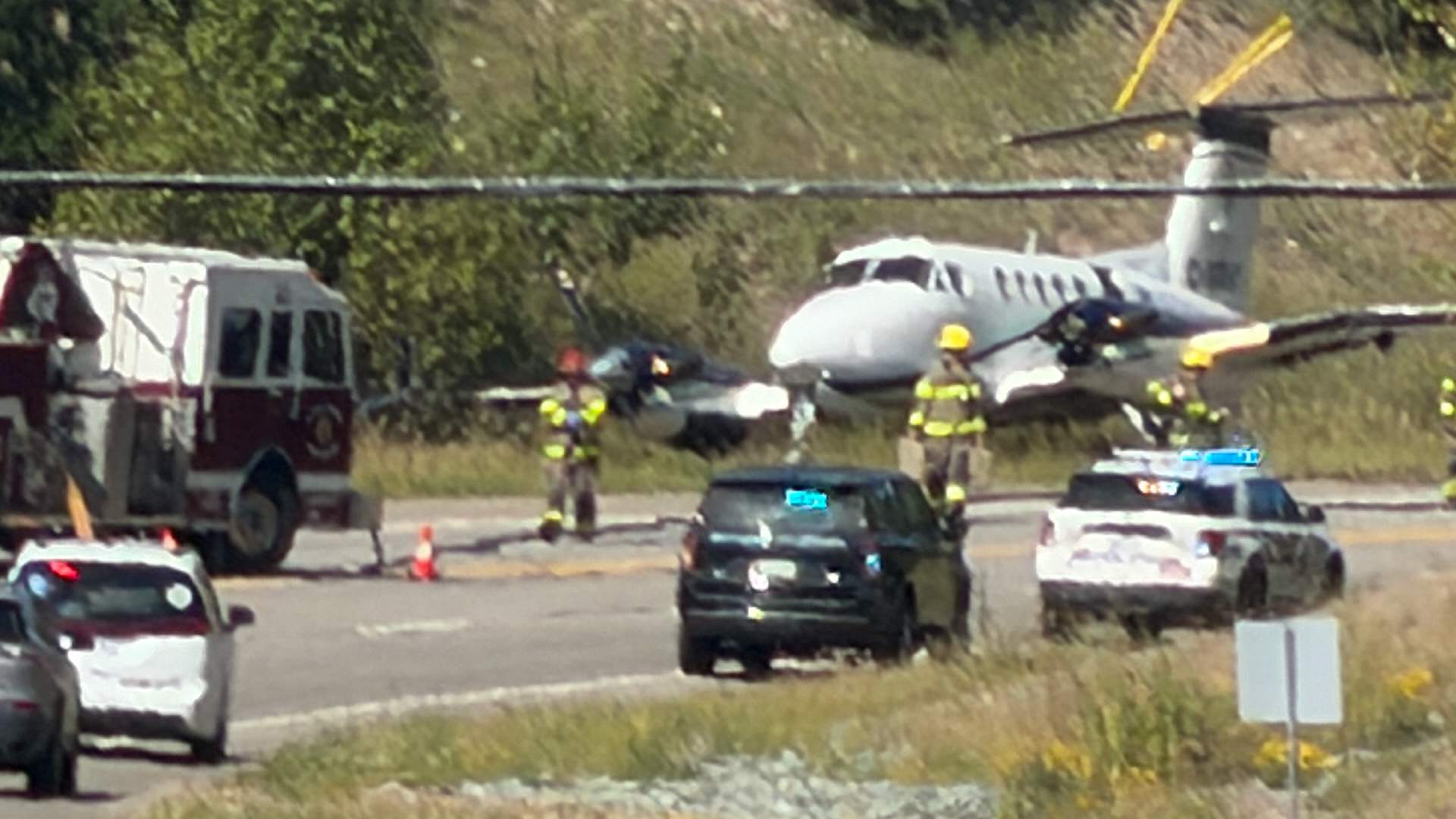
When a twin-engine aircraft descends onto an active municipal corridor, the resulting vector intersection of aviation physics and terrestrial traffic dynamics creates a severe kinetic hazard. The emergency landing of a Beech King Air 200 on Foothills Boulevard in Prince George illustrates a systemic failure mode in emergency aviation protocols: the forced integration of uncontrolled gliding vectors into high-density vehicular zones. Deconstructing this event requires analyzing the mechanical constraints of forced off-field descents, the variables governing ground-level kinetic energy transfers, and the regulatory oversight governing emergency urban interventions.
The Mechanics of Forced Off-Field Descents
An aircraft experiencing catastrophic system degradation shifts immediately from a controlled flight path to an energy-management problem. Pilots of twin-turboprop platforms evaluate altitude, airspeed, and glide ratio to select touchdown zones. When rural or designated landing strips are unreachable, urban corridors present a deceptive visual surface.
Roadways offer long, cleared paths devoid of structural obstacles like buildings or dense timber, making them visually attractive targets under cognitive load. However, roadways fail basic aviation safety criteria:
- Lateral Constraints: Standard urban lanes measure roughly 3.5 meters in width, whereas a King Air 200 possesses a wingspan exceeding 16 meters. This geometric mismatch guarantees that a roadway landing cannot contain the aircraft's lateral footprint.
- Vertical Obstructions: Utility poles, overhead power lines, and traffic signal gantries create an invisible web of low-altitude hazards that disrupt the final flare phase.
- Surface Irregularities: Unlike prepared runways engineered for high-speed wheel loads and directional stability, asphalt roadways feature crown slopes, raised medians, and curbs that destabilize landing gear upon contact.
When the aircraft committed to Foothills Boulevard, the pilot traded gravitational potential energy for forward momentum, but forfeited directional control relative to oncoming vehicular traffic moving on independent, intersecting timelines.
Kinetic Energy Transfer During Vehicular Interception
The collision between an aircraft and ground vehicles introduces severe mass-velocity differentials. A Beech King Air 200 operating near landing configuration weighs several thousand kilograms, moving at descent speeds often exceeding 90 knots, or roughly 165 kilometers per hour, prior to ground contact.
When the aircraft's left wing and structural components intercepted a moving pickup truck, the kinetic energy equation dictated catastrophic outcomes. The transfer of momentum operates across three distinct mechanical phases:
- Primary Impact: The leading edge of the wing structure acts as a high-mass shear blade, concentrating force over a small surface area upon contact with vehicle windshields and roof pillars.
- Secondary Fragmentation: Detached components, including propeller blades and engine cowl debris, become uncontrolled projectiles traveling at vector velocities independent of the fuselage.
- Tertiary Deceleration: The sudden arrest of the aircraft frame distributes deceleration forces across any impacted chassis, overwhelming standard automotive safety crumple zones designed for horizontal vehicle-to-vehicle collisions rather than vertical or lateral aviation loads.
The fatality and multiple injuries recorded during the Prince George incident underscore the reality that motorists possess zero predictive capability for vertical-plane intrusions. Drivers operate within a two-dimensional horizontal plane; an aircraft descending from a three-hundred-foot ceiling reduces reaction windows to milliseconds, rendering standard defensive driving maneuvers ineffective.
Regulatory Oversight and Investigation Parameters
Following the cessation of motion, responsibility transfers from emergency first responders to federal transport safety investigators. In Canada, the Transportation Safety Board (TSB) initiates a rigorous mandate to uncover the root cause of the engine or systems failure that necessitated the off-field landing.
The investigative framework prioritizes perishable data capture over public speculation:
- Wreckage Documentation: Laser mapping of the debris field on Foothills Boulevard establishes the exact touchdown angle, ground roll distance, and energy dissipation pattern.
- Engine Autopsy: Technicians examine turbine and propeller assemblies to determine whether engines were producing power or if propellers were successfully feathered prior to impact.
- Maintenance and Flight Logs: Investigators cross-reference the aircraft's operational history against regulatory compliance standards to identify latent mechanical or electrical faults.
The closure of Foothills Boulevard highlights the secondary economic and logistical friction caused by major transport accidents. Urban infrastructure management must treat arterial roadways not merely as traffic conduits, but as vulnerable receptor zones exposed to low-altitude aerospace risks.
Strategic Operational Forecast
The recurrence of roadway landings highlights a persistent training gap in emergency descent management. As commercial and private air traffic density increases over expanding municipal boundaries, pilots face diminishing options for safe forced landings. Mitigating this risk requires a shift in how aviation authorities model emergency landing site selection.
Future safety frameworks must integrate real-time geographic information systems into cockpit avionics, dynamically highlighting unpopulated open zones—such as agricultural fields, industrial parks with expansive parking lots, or sports complexes—rather than defaulting to linear asphalt strips that double as high-density commuter arteries. Training curricula must emphasize that sacrificing an aircraft to structural barriers away from traffic is statistically survivable compared to the catastrophic kinetic exchange of an urban roadway collision.