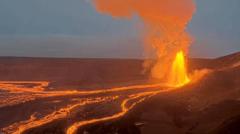
The resurgence of eruptive activity at Kilauea’s summit is not a random geological occurrence but a predictable systemic re-pressurization of a shallow magmatic plumbing system. While general reporting focuses on the visual height of lava fountains, the strategic significance lies in the volumetric flux and the mechanical integrity of the Halemaʻumaʻu crater floor. Kilauea operates as a cyclical pressure vessel; understanding its current state requires analyzing the interplay between ground deformation (tilt), seismic energy release, and gas emission rates.
The Architecture of Effusive Re-ignition
Kilauea’s activity is governed by a two-stage storage system. A primary reservoir exists approximately 3 to 5 kilometers beneath the summit, feeding a secondary, shallower reservoir located roughly 1 to 2 kilometers below the surface. Eruptive cycles begin when the inflow of magma from the mantle exceeds the structural capacity of these reservoirs, leading to a critical state of "overpressure."
The transition from dormancy to active effusion follows a specific mechanical sequence:
- Magmatic Inflation: The ground surface swells, measured in microradians of tilt. This inflation indicates that the shallow reservoir is expanding to accommodate new melt.
- Seismic Pre-failure: As pressure mounts, the surrounding country rock undergoes brittle failure. This manifests as earthquake swarms, specifically concentrated in the upper East Rift Zone or the summit caldera.
- Conduit Breakthrough: Once the pressure exceeds the lithostatic load and the tensile strength of the vent wall, an eruptive fissure opens.
The current eruption phase is characterized by fountaining—a process driven by the rapid exsolution of gases. As magma rises, decreasing pressure allows dissolved volatiles ($H_2O$, $CO_2$, and $SO_2$) to form bubbles. This gas expansion increases the buoyancy and velocity of the magma, propelling it into the air as tephra and spatter.
Quantifying Eruptive Intensity via Volatiles and Tilt
The magnitude of a Kilauea event is not determined by its duration, but by its mass discharge rate. Analysts track this through the Correlation Spectrometer (COSPEC) or similar modern sensors that measure sulfur dioxide ($SO_2$) flux. High $SO_2$ levels indicate that "fresh," gas-rich magma is reaching the surface directly from the deeper reservoir, whereas declining gas levels suggest the system is recycling older, degassed magma.
The Tilt-Seismicity Correlation
Ground tilt is the primary leading indicator of eruptive shifts. We categorize these shifts into two distinct behaviors:
- Deflation-Inflation (DI) Events: These are abrupt drops in tilt followed by a rapid recovery. They represent pulses in magma supply. A DI event acts as a throttle on the eruption; during the deflationary phase, lava output typically slows or ceases at the surface, only to surge during the inflationary recovery.
- Sustained Inflation: This suggests a systemic imbalance where magma is entering the summit faster than it can be erupted or drained into the rift zones. This state is high-risk for the formation of new fissures outside the established crater.
Structural Constraints of the Halemaʻumaʻu Reservoir
The 2018 collapse of Kilauea’s summit fundamentally altered the geometry of the plumbing system. The current eruptions are effectively "filling the hole" left by that collapse. This creates a specific containment dynamic. Unlike eruptions that threaten residential areas via the East Rift Zone, summit-constrained eruptions are thermally efficient. The lava lake acts as an insulator, keeping the underlying conduit open and reducing the pressure required to maintain effusion.
The bottleneck in this system is the vent geometry. If the vent becomes choked by solidified rubble or "back-filling" from the lava lake, the internal pressure will seek a path of least resistance. This is the primary hazard variable: will the pressure remain confined to the caldera, or will it force an intrusion into the lower rift zones?
Thermal Energy and Crustal Formation
The cooling rate of the lava lake determines the longevity of the eruptive cycle. Lava at Kilauea erupts at approximately 1,150°C. As it surfaces, it loses heat through radiation and convection. The formation of a "quiescent crust" over the lake surface creates a thermal cap.
- Pahoehoe formation: Low-velocity, high-temperature flow that creates smooth, ropey surfaces.
- ‘A‘ā formation: Higher-velocity, lower-temperature flow that occurs when the lava is agitated, leading to a jagged, clinkery surface.
The ratio of these two textures in the crater provides a visual record of the eruption’s kinetic energy.
Environmental and Logistical Risk Vectors
The primary hazard to human health during summit-centric eruptions is not lava flow, but the atmospheric injection of volcanic smog, or "vog." Vog is a dilute mixture of $SO_2$ gas and sulfate aerosols.
- Chemical Conversion: $SO_2$ reacts with oxygen and moisture in the presence of sunlight to form sulfuric acid droplets.
- Dispersal Patterns: The trade winds typically push these aerosols southwest. When trade winds fail (Kona wind conditions), the vog can settle over the entire Hawaiian island chain.
- Agricultural Impact: Sulfate aerosols are highly efficient at inducing acid rain, which leaches nutrients from the soil and damages lead-based catchment systems common in rural Hawaii.
Beyond gas, "Pele’s Hair"—thin strands of volcanic glass—is formed when gas bubbles burst and stretch the molten lava into filaments. These are light enough to be carried dozens of miles downwind, posing a significant risk to livestock and water filtration systems.
The Strategic Outlook for Magmatic Equilibrium
The current data suggests Kilauea is in a state of "steady-state effusion." The reservoir is pressurized enough to maintain a lava lake, but not yet overpressured enough to cause a catastrophic flank failure. However, we must monitor for "seismic migration." If earthquake epicenters begin moving down the East Rift Zone (ERZ), it indicates that the summit reservoir has reached its volumetric limit and is seeking a secondary release valve.
The most critical metric to watch is the ratio of summit inflation to ERZ extension. If the summit continues to inflate while the ERZ remains static, the probability of a higher-fountain summit event increases. Conversely, if the summit deflates without a corresponding eruption, the magma has likely bypassed the surface and is intruding into the sub-surface rift, a precursor to potential distal eruptions.
Immediate operational focus should be placed on the real-time integration of InSAR (Interferometric Synthetic Aperture Radar) data to map subtle ground movements that tiltmeters might miss, ensuring that the transition from summit-contained activity to rift-zone intrusion is detected in its incipient stage.