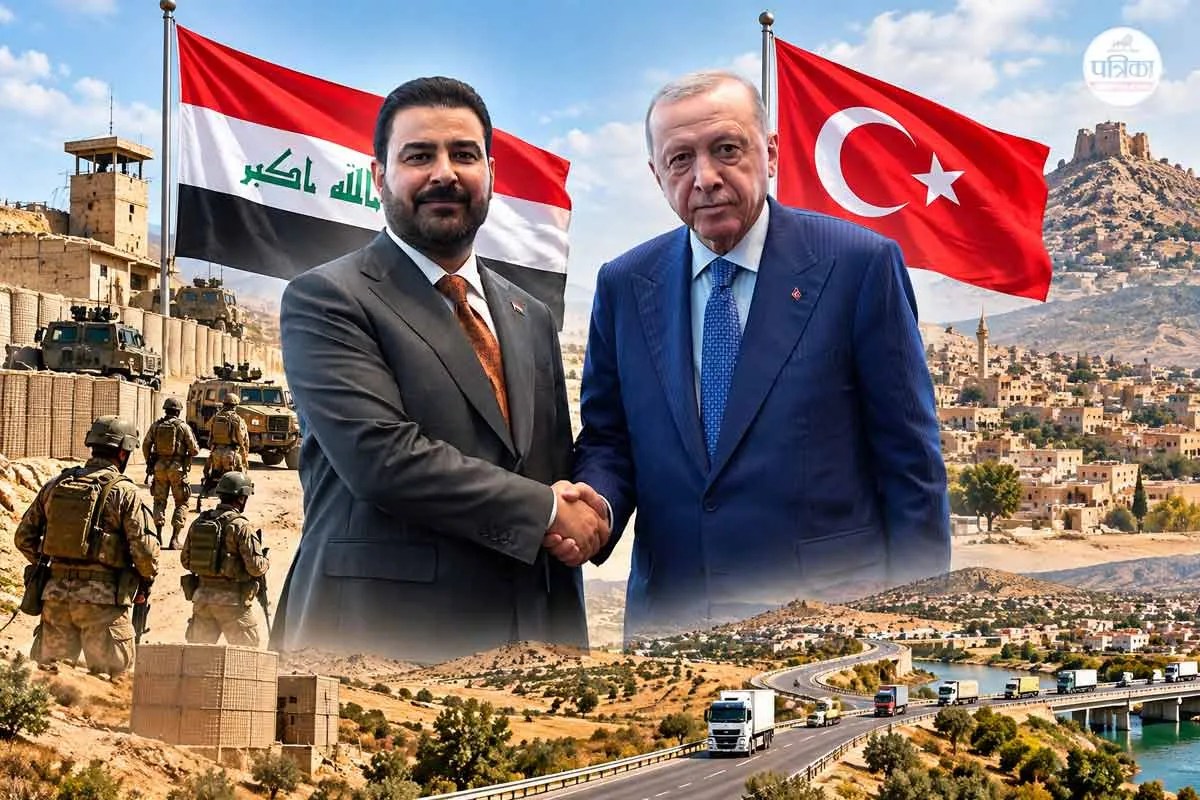
The wind does not care about treaties. It sweeps off the arid plains of Nineveh, carrying the scent of parched earth and old diesel, rattling the barbed wire that has ringed the Bashiika military base for years. Inside those concrete blast walls, boots crunch on gravel in a rhythm that is about to change forever.
Tariq stands by his olive grove a few miles down the slope, shading his eyes against the afternoon glare. For a decade, he has watched the crescent flags snap in the high desert breeze, a silent reminder of a foreign footprint pressed deep into Iraqi soil. Turkish soldiers came when the world was fracturing, when the black banners of terror swept across the horizon, carving out a zone of steel and artillery arcs. They stayed because power abhors a vacuum. They stayed because borders in this part of the world have always been porous, bleeding lines drawn by men in distant capitals who never felt the grit of sand between their teeth.
Now, the iron gates are unlocking.
Ankara has made a decision that reverberates far beyond the perimeter fence of Bashiika. The base is heading back to Baghdad. Sovereignty is being handed over piece by piece, ledger by ledger, watchtower by watchtower. This is not merely a logistical shift or a bureaucratic footnote tucked inside diplomatic communiqués. It is a tectonic adjustment in how regional powers negotiate survival, influence, and the fragile architecture of the Middle East.
To understand why this matters, one must look at the map not as a collection of static colors, but as a chessboard where every square is soaked in history. Bashiika was never just a collection of prefabricated barracks and radar dishes. It was a friction point, a thorn in the side of a central government in Baghdad that fiercely guarded its constitutional pride, even when its military capacity was stretched thin. Every time a Turkish artillery piece barked across the border, or a convoy rolled past checkpoints without asking permission, a small tremor ran through the political corridors of the Iraqi capital.
For years, Turkey argued necessity. Security corridors had to be carved out to shield its southern flank from cross-border threats, from insurgent groups that used the lawless folds of northern Iraq as a staging ground. Baghdad countered with the ancient, unyielding language of sovereignty. You cannot heal a broken house by inviting a neighbor to permanently occupy the guest room.
So how did we arrive at the moment of the handover?
Patience. Exhaustion. And the cold calculus of mutual interest.
Both capitals realized that perpetual friction serves no one except those who thrive in chaos. Turkey under Recep Tayyip Erdogan and Iraq under Mohammed Shia al-Sudani have slowly pivoted toward a different calculus, one rooted in economic corridors, water sharing, and joint security frameworks. The Development Road project—a grand vision of steel rails and asphalt linking the Persian Gulf to Europe through the heart of Iraq—demands stability. You cannot lay fiber-optic cables and freight tracks across a permanent warzone. You need quiet. You need formal agreements. You need borders that function like doors rather than battlegrounds.
Handing over Bashiika is the price of admission to this new era of pragmatic diplomacy. It is Turkey saying to Baghdad: We trust you to hold the line. And it is Iraq accepting the mantle of responsibility: We will secure our own earth.
Yet, the story does not end at the wire of Bashiika. Seventy miles to the west, past the skeletal remains of stone villages and wind-scoured ravines, lies Sinjar.
If Bashiika is a symbol of military transition, Sinjar is a crucible of competing ambitions. Here, the security equation is notoriously complicated. It is a mosaic of Yazidi communities still healing from unimaginable trauma, local factions with competing loyalties, residual militant cells, and the ever-present shadow of external interventions. Whenever Ankara or Baghdad breathes, Sinjar feels the wind.
For years, the mountain has been a persistent security headache for Turkey, which views the presence of outlawed separatist elements in the region as an intolerable red line. Previous understandings failed to fully pacify the area or satisfy Turkish security demands. But the new alignment changes the arithmetic. By bringing Baghdad into a deeper, institutionalized security partnership, Turkey is shifting from unilateral enforcement to cooperative containment.
Imagine two rivers, long divided by rocky terrain and political enmity, finally cutting channels toward each other. The water is turbulent, muddy with historical grievances, but it is moving. The agreement to recalibrate security in Sinjar—coordinating patrols, intelligence sharing, and administrative normalization—is an attempt to dam the floods of insurgency before they overflow the banks again.
Down in his olive grove, Tariq watches a convoy of military trucks rumble down the highway. The dust billows in their wake, golden and thick in the descending sun. He does not know the names of the generals who signed the papers in Ankara or Baghdad. He does not care about the fine print of diplomatic protocols or the intricacies of counter-terrorism coordination pacts.
He only knows the soil.
When the last foreign soldier packs his duffel and climbs into the back of a departing transport, Tariq will walk out to the edge of his land. He will run a handful of the dry, stubborn earth through his calloused fingers. The flags will change. The uniforms at the gate will wear different patches. The radios will crackle with a different dialect of command.
But the wind will keep blowing off the plains, indifferent to who holds the keys, whispering the oldest truth of this ancient land: power passes like smoke, but the people remain, rooted deep in the dust, waiting for peace that lasts longer than a generation.


