Don Juan Pond stays liquid in temperatures dropping past minus 50 degrees Celsius because its water is roughly forty percent dissolved salt by weight, dominated by calcium chloride rather than standard sodium chloride. This extreme concentration creates a profound freezing-point depression, moving the eutectic point of the liquid down to approximately minus 52 degrees Celsius. Far from being a miraculous pocket of normal freshwater defying the elements, this shallow Antarctic depression operates as a high-stakes chemical reactor driven by unyielding thermodynamic rules.
The Geography of Desolation
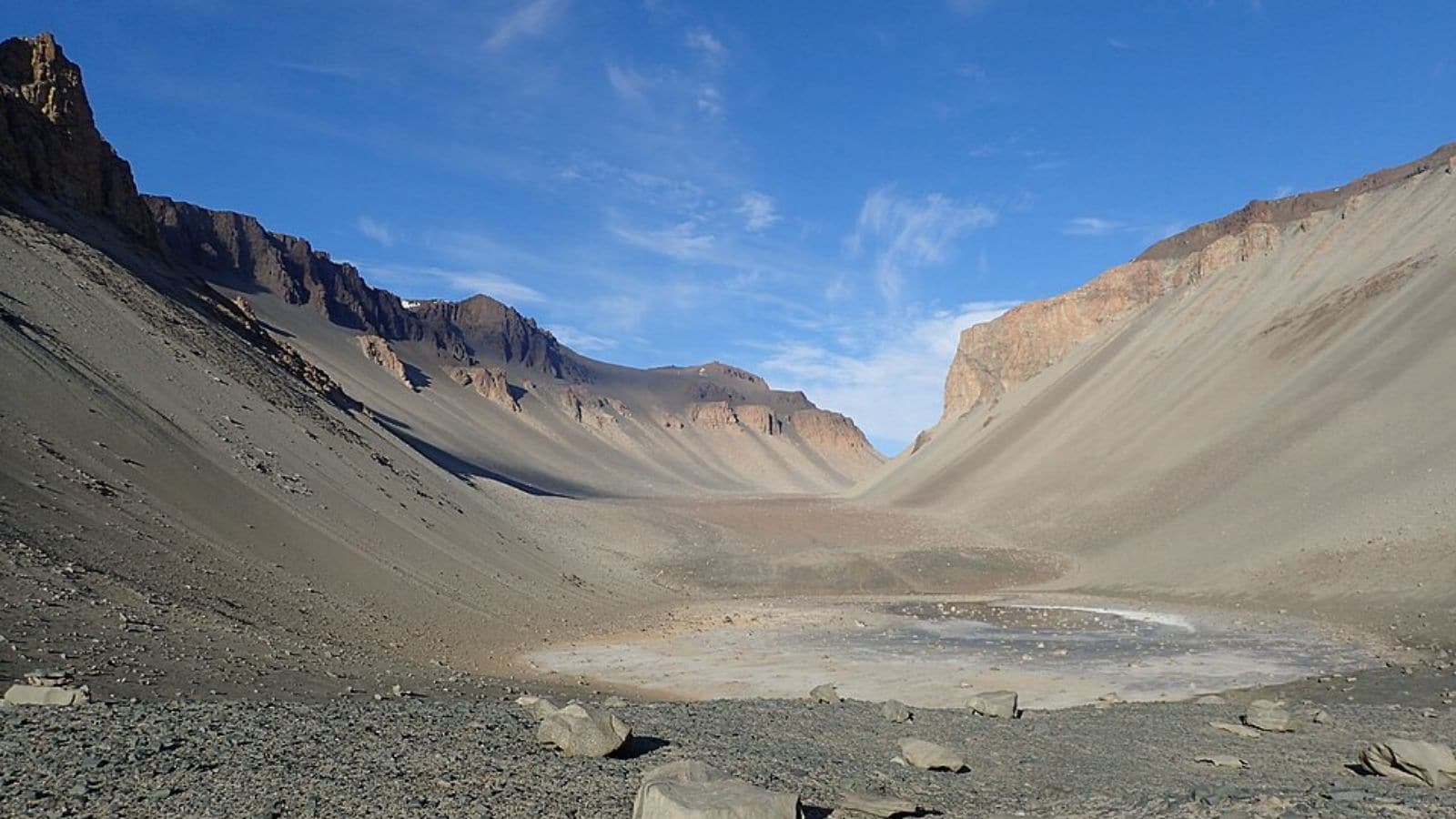
Nestled deep within the South Fork of Wright Valley, one of the McMurdo Dry Valleys of Antarctica, Don Juan Pond occupies an unforgiving trench. The surrounding landscape features no towering glaciers dripping with meltwater, but rather sweeping expanses of hyper-arid desert swept by katabatic winds. These winds scour the valley floor, stripping away any accumulated snow and baking the exposed ground beneath brutal solar radiation.
Nearby bodies of water, such as Lake Vanda and Lake Bonney, sport permanent ice sheets several meters thick. Yet Don Juan Pond often remains unencumbered by a solid surface crust, presenting an oily, hyper-saline sheen to the polar sky. That stark visual contradiction has baffled casual observers since U.S. Navy helicopter pilots first spotted the basin in 1961.
The pond is remarkably small. It typically measures only a few hundred meters long and stays perpetually ankle-deep, hovering around ten centimeters of depth. Its dimensions shift continuously. During prolonged dry spells, the visible water can recede dramatically, leaving behind blinding white crusts of precipitated minerals before a fresh surge of liquid re-establishes the pool.
Beyond Ordinary Salt
Popular accounts often group Don Juan Pond with standard marine environments or inland salt flats, assuming everyday table salt performs the heavy lifting. That comparison fails under basic chemical scrutiny. Ocean water sits at roughly 3.5 percent salinity, composed mostly of sodium chloride. Don Juan Pond shatters those metrics, registering a salinity load exceeding 40 percent, with roughly 95 percent of that dissolved ionic load consisting of calcium chloride ($CaCl_2$).
This distinction dictates everything about the pond's physical behavior. Calcium chloride acts as an exceptionally aggressive freezing-point depressant. When dissolved in water, calcium and chloride ions aggressively disrupt the crystalline lattice that water molecules attempt to form as temperatures drop.
Furthermore, calcium chloride is intensely hygroscopic. It actively pulls moisture out of the surrounding air through deliquescence, absorbing atmospheric humidity even in sub-zero environments. This chemical affinity means the system is never entirely isolated from the surrounding atmosphere. It constantly interacts with moisture gradients in the dry polar air, feeding a continuous cycle of minute dissolution and concentration shifts.
The Thermodynamic Limit
Freezing-point depression is governed by rigorous thermodynamic laws, not luck. As solute concentration increases, the temperature required to force the liquid phase into a solid state drops proportionally. For the specific calcium-chloride brines found in Wright Valley, the lowest stable liquid temperature—known as the eutectic temperature—sits right around minus 52 degrees Celsius.
When winter temperatures in Wright Valley plummet toward minus 50 degrees Celsius, Don Juan Pond dances on a razor edge. If the ambient temperature dips even slightly past that eutectic threshold, the remaining liquid can no longer sustain its phase. Solid phases, including ice and hydrated calcium-chloride minerals like antarcticite ($CaCl_2 \cdot 6H_2O$), precipitate out of solution.
The pond does not defy freezing; it redefines the boundary conditions. It represents a system pushed to the absolute chemical limit where liquid water can physically exist under terrestrial polar extremes.
The Subsurface Engine
For decades, researchers debated how a shallow basin in a closed valley manages to maintain its extreme ionic concentration without flushing out entirely over time. Early hypotheses focused heavily on surface mechanisms, suggesting that atmospheric moisture condensed on surrounding slopes, dissolved local salts, and trickled down as surface runoff to feed the pool.
Detailed geochemical modeling and field investigations painted a more complex picture. Modern hydrogeological data points toward a regional groundwater flow system. Deep aquifers circulating through the fractured bedrock of the Asgard and Olympus ranges drive upwelling brines directly into the basin.
Water seeps upward into the pond from subterranean pathways, bringing a concentrated load of minerals leached from ancient geological formations. As this upwelling brine reaches the surface, intense katabatic evaporation strips away the water molecules, leaving the heavy calcium chloride behind. The remaining dense brine eventually drains back into the subsurface in a continuous, multi-year recycling loop, preventing the system from depleting its chemical reserves.
Planetary Analogs
The mechanics governing this Antarctic anomaly carry implications that stretch far beyond terrestrial geomorphology. Planetary scientists regularly study Don Juan Pond as the closest working laboratory for conditions on Mars.
Orbital data from Martian missions has confirmed the widespread presence of chloride-bearing salts across the Martian surface. Combined with low atmospheric pressures and freezing ambient temperatures, the physical chemistry observed in Wright Valley provides a viable mechanism for transient liquid brines on the Red Planet. The dark streaks known as recurring slope lineae—observational features that crawl down Martian crater walls—share striking morphological and chemical resemblances to the brine-driven moisture tracks studied near Don Juan Pond.
Whether these extreme environments host active microbial life remains an open question in astrobiology. While the ionic strength and chaotropic stress of a 40 percent calcium-chloride solution place severe strains on biological cell membranes, the mere presence of stable liquid water at sub-zero temperatures forces a reassessment of where life might persist across the solar system.
Don Juan Pond stands as a masterclass in geochemical persistence. It proves that extreme environments do not require miracles to defy conventional expectations, relying instead on the unyielding physics of molecular concentration and the raw power of chemistry operating at the edge of the possible.