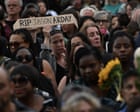
Tens of thousands of people gathered in Trafalgar Square beneath Nelson's Column to mourn Jason Arday. They carried placards reading "Rest in Power" and left mounds of fresh flowers in the damp London evening air. Yet this massive outpouring of grief, organized by Stand Up to Racism, masks a much uglier institutional failure. Arday, the 41-year-old former University of Cambridge sociology professor who was found dead at his south London home, became the focal point of a modern public execution. The narrative pushed by mainstream outlets focused heavily on allegations of plagiarism and discrepancies in his personal biography. But reducing his death to a simple story of academic scandal ignores the structural mechanics that thrust him into an impossible spotlight, used him as a trophy, and then abandoned him when the machine demanded a sacrifice.
To understand how Arday’s life ended in such devastation, one must look at the cynical ecosystem of elite British higher education. When Arday was appointed as Cambridge's youngest Black professor in 2023, the university did not quietly welcome a scholar. They weaponized his appointment. Institutions facing intense pressure over dismal diversity metrics frequently seek out exceptional individual success stories to project a facade of systemic progress. Arday’s personal history—overcoming developmental delays, late-onset speech, and severe educational hurdles to achieve an Oxford and Cambridge pedigree—made him an irresistible symbol for a sector desperate for positive public relations. He was marketed as living proof that meritocracy worked.
The trouble with symbolic representation is that symbols cannot defend themselves against sustained institutional scrutiny. When investigative journalists began unpicking his PhD thesis for potential plagiarism and questioning biographical claims regarding his athletic fundraisers, the university apparatus that had hoisted him onto a pedestal instantly stepped back. Cambridge announced internal inquiries rather than offering a legal and pastoral defense. They treated him not as a colleague requiring institutional duty of care, particularly given his known vulnerabilities as an autistic adult, but as a public relations liability that needed to be pruned away.
The media storm that followed was relentless. Hundreds of articles appeared within weeks, transforming a complex debate about academic standards into a bloodsport. Friends and mentors, including Cambridge mentor Simon Woolley and clinical psychologist Simon Baron-Cohen, noted that Arday felt entirely hounded and utterly isolated. Voice notes sent in his final hours revealed a man who saw no way out of the suffocating public glare. When he resigned on August 5, hoping the target on his back would disappear, the scrutiny only intensified. The machine did not want his resignation; it wanted his utter erasure.
The grief in Trafalgar Square was entirely genuine, but it carried an undertone of bitter irony. Politicians and cultural figures queued up to decry the toxicity of public shaming, yet many of these same political and institutional structures profit from the creation of superficial icons. British universities continue to operate under a model that treats minority scholars either as invisible labor or as hyper-visible tokens. When those tokens fail to withstand microscopic examination, or when they make human mistakes under impossible pressure, the institution disavows them with corporate coldness.
Calls for public inquiries and investigations into Cambridge's hiring practices now echo through Parliament, but inquiries rarely fix the toxic culture beneath the surface. Accountability requires a fundamental reassessment of how elite institutions use vulnerable scholars to mask deep-seated systemic inequalities. Until universities provide genuine, protective infrastructure rather than superficial spotlighting, every new milestone achieved by a marginalized academic will carry an invisible, lethal weight. The flowers beneath Nelson's Column will wither, but the systemic rot that engineered this tragedy remains entirely unaddressed.