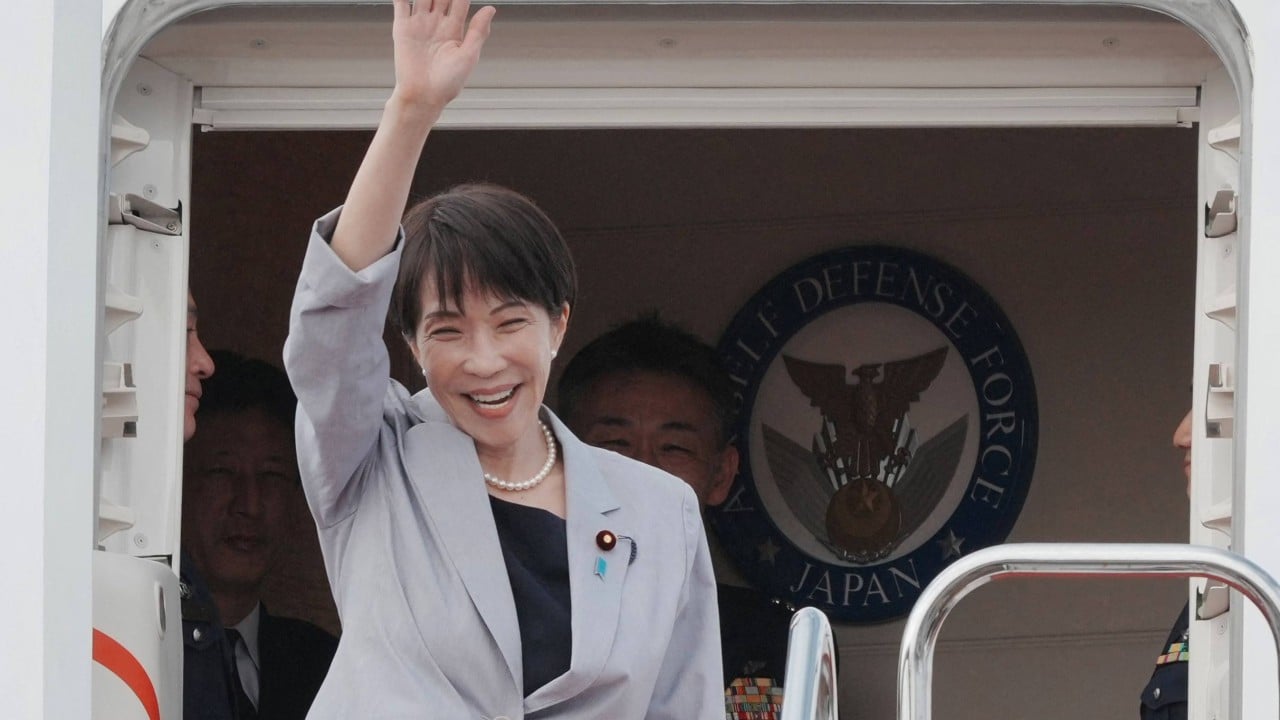
Sanae Takaichi’s flight to Australia is being framed as a victory lap for regional stability. The mainstream press is obsessed with the optics of "tightening bonds" and "locking in" security architectures. They see two middle powers linking arms to stare down a superpower. It makes for great photography. It makes for terrible strategy.
The consensus says that by doubling down on Reciprocal Access Agreements (RAA) and deeper defense integration, Tokyo and Canberra are insulating themselves against a volatile Pacific. This is a delusion. What Takaichi is actually doing is cementing a rigid, high-friction defense posture that leaves both nations less agile, more predictable, and dangerously over-leveraged in a theater they cannot control.
The Myth of Interoperability as a Shield
Everyone loves the word interoperability. It sounds efficient. In reality, it is a massive transfer of sovereign risk.
When Japan and Australia integrate their command structures and logistical tails to the degree currently being proposed, they lose the ability to act independently. They aren't building a partnership; they are building a monolithic target. I have seen policymakers treat these defense pacts like insurance policies. They aren't. They are joint ventures in a startup that is burning cash—and in this case, the cash is regional autonomy.
Consider the RAA. It simplifies the movement of troops and equipment. The "lazy consensus" argues this deters aggression. Logic suggests the opposite. By making it easier to deploy forces, you lower the threshold for accidental escalation. You create a scenario where a localized skirmish in the South China Sea automatically drags the Japan Self-Defense Forces (JSDF) and the Australian Defence Force (ADF) into a meat grinder before the diplomats have even finished their morning coffee.
Australia is Not Japan's Backyard
The geographical distance between Tokyo and Canberra is not a logistical hurdle; it is a fundamental strategic mismatch.
Japan’s primary existential threat sits a few hundred miles across the water. Australia’s primary threat is the disruption of trade routes that are thousands of miles away. Takaichi’s push to treat these as the same problem is a category error. Japan is a frontline state. Australia is a "sanctuary" state.
When a frontline state and a sanctuary state merge their security interests, the sanctuary state loses its greatest asset: distance. Australia is voluntarily trading its geographic insulation for a seat at a table where the stakes are existential for Japan, but merely economic for Australia. It is a bad trade.
The Economic Mirage of Strategic Alignment
The narrative suggests that "security ties" lead to "economic stability." This is the reverse of how the world actually works.
Japan is Australia’s second-largest export market. Australia is Japan's primary energy supplier. These ties existed long before the current hawkish tilt. By politicizing the trade relationship through the lens of a "values-based" security alliance, Takaichi is putting a target on the very supply chains she claims to be protecting.
Look at the Critical Minerals Partnership. The idea is to bypass established global markets to create a "trusted" supply chain for rare earths and lithium.
- The Theory: We secure the resources for the green transition within a closed loop of allies.
- The Reality: We drive up costs by 30-50% by ignoring market efficiencies in favor of ideological purity.
If Japan wants cheap, reliable energy and Australia wants a steady buyer, the last thing they need is to wrap those commodities in a flag. Markets hate flags. They like liquidity. Takaichi is effectively asking Australian mining giants to prioritize "strategic autonomy" over shareholder value. History shows that when the bottom line starts bleeding, the "values-based" alliance is the first thing to evaporate.
The Nuclear Submarine Elephant in the Room
Takaichi’s visit is shadowed by AUKUS. While Japan isn't a formal member of the "Pillar I" submarine deal, Takaichi is signaling a "Pillar II" embrace—advanced technology sharing in AI, quantum computing, and hypersonics.
This is where the nuance gets buried. Japan has the most sophisticated undersea surveillance capability in the world. Australia has... a very expensive contract for boats that won't arrive for decades. By aligning so closely with the AUKUS framework, Japan is essentially subsidizing the West’s learning curve while gaining almost nothing in return.
Japan doesn't need Australian "integration" to monitor the Miyako Strait. It needs Australia to be a stable, non-aligned resource provider. By dragging Canberra into Tokyo's immediate security sphere, Takaichi is actually weakening Japan’s strategic depth. A neutral Australia is a far more useful asset in a crisis than a belligerent Australia that has already exhausted its limited munitions in the first week of a conflict.
The Cost of the "Middle Power" Ego
There is a certain vanity in this trip. Both nations are trying to prove they can "lead" without the United States being the only adult in the room. This "middle power" leadership is a fantasy.
In any real-world kinetic conflict in the Indo-Pacific, neither Japan nor Australia has the sustainment capability to operate without US satellite data, US munitions, and US fuel. Takaichi’s talk of "strengthening ties" is a performative distraction from the fact that both countries are deeply dependent on a third party that is increasingly inward-looking.
Instead of building a "mini-lateral" alliance that mimics a mini-NATO, Japan should be diversifying its diplomatic portfolio. It should be engaging with ASEAN in a way that doesn't feel like a recruitment drive for an anti-China club.
The Actionable Truth
If you are an investor or a policy analyst watching this play out, stop looking at the joint statements. Look at the friction.
- Watch the LNG pricing: If security ties are so strong, why is Japan complaining about Australian domestic gas reservation policies? Because interests always trump "values."
- Monitor the JSDF recruitment: You can sign all the RAAs you want, but Japan has a demographic crisis that no amount of Australian friendship can fix. An army of "partners" is useless if you don't have enough soldiers to fill your own ships.
- Evaluate the "Sovereign" in Sovereign Risk: The more Japan and Australia integrate, the more they lose the "exit ramp" in a crisis.
Takaichi isn't building a fortress. She’s building a tripwire. And when you build a tripwire, you eventually have to deal with the fact that someone is going to stumble over it. The "security" being discussed in Canberra this week is an expensive, brittle illusion that prioritizes the appearance of strength over the reality of resilience.
Stop cheering for the "tightening of ties." A knot that is tied too tight eventually snaps.