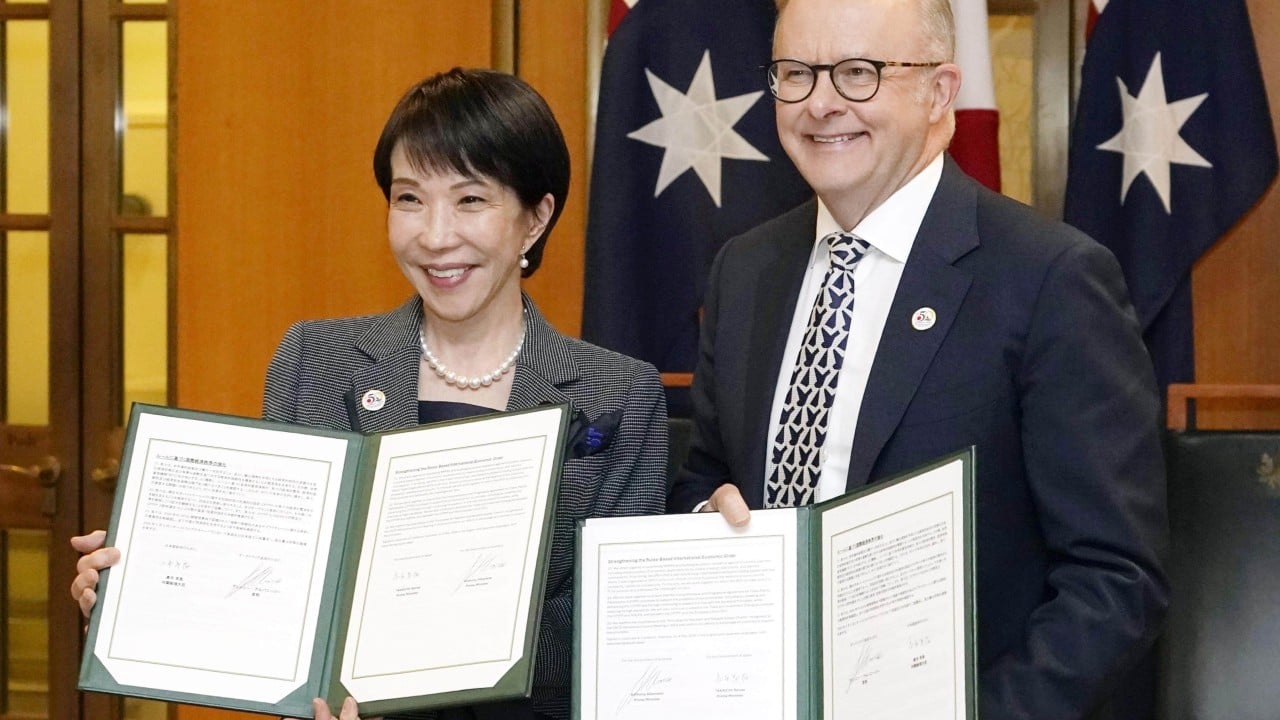
The deal signed in Canberra this week between Japanese Prime Minister Sanae Takaichi and her Australian counterpart, Anthony Albanese, is not just a diplomatic victory; it is a desperate insurance policy against a collapsing global order. While the official communiqués speak of "resilient supply chains" and "special strategic partnerships," the reality is far more clinical. Japan, a nation that imports nearly all its energy, has looked at the map of the Middle East and the South China Sea and realized that its industrial survival is hanging by a thread.
This week’s agreement pivots on a massive A$1.3 billion (US$937 million) commitment from Australia to fast-track critical mineral projects involving Japanese firms. The targets are specific: gallium, magnesium, fluorite, nickel, and cobalt. These aren't just commodities. They are the fundamental ingredients for the semiconductors, electric vehicle batteries, and high-tech defense systems that Takaichi believes will define the 21st-century economy. By locking in these resources now, Japan is attempting to "de-risk" its future from a China that has shown an increasing willingness to use its mineral dominance as a geopolitical cudgel.
The Strait of Hormuz Shadow
Takaichi’s arrival in Australia followed a tense stop in Vietnam, and her rhetoric throughout the trip has been uncharacteristically blunt for a Japanese leader. She explicitly cited the "effective closure" of the Strait of Hormuz as a catalyst for this urgency. For Tokyo, a blockage in that narrow waterway isn't a distant foreign policy concern—it is a light-switch moment that could darken Japanese cities and stall its manufacturing giants within weeks.
Australia has long been Japan’s "quarry and farm," providing the coal and LNG that powered Japan’s post-war miracle. But the old model of simply buying raw calories and BTUs is dead. Takaichi is pushing for a deeper integration where Japanese capital and Australian earth merge to create a secondary industrial base. This is why the deal includes specific support for projects like the Alcoa Gallium Recovery Project in Western Australia and the Tivan Fluorite Project. Japan isn't just looking for a seller; it is looking for a co-producer that shares its democratic DNA.
The Nuclear Elephant in the Room
While the Canberra headlines focused on minerals and LNG, the subtext of Takaichi’s broader "Economic Security" doctrine is nuclear. Since her landslide victory, she has pivoted Japan toward a future where nuclear power and domestically developed perovskite solar cells are the twin pillars of national resilience. Her interest in Australian uranium—already a staple of the bilateral trade—is expected to intensify as Japan restarts more reactors and looks toward next-generation modular units.
However, this partnership faces a massive, unspoken hurdle: the Australian domestic political landscape. While Albanese is happy to sign mineral pacts, his government remains under pressure from a domestic "green" lobby that views fossil fuel exports—the very LNG Japan relies on—with increasing hostility. Japanese firms are watching the Australian regulatory environment with growing anxiety. They fear that "sovereign risk" in Australia, once unthinkable, is becoming a reality as taxes on gas exports rise and environmental approvals slow to a crawl.
Why the $1.3 Billion Might Not Be Enough
The A$1.3 billion price tag attached to the critical minerals facility is a significant sum, but in the world of global mining and refining, it is a rounding error. To truly displace China’s grip on the rare earths market, the investment required is in the tens of billions. The current deal identifies six "priority projects," including the Lynas Rare Earths project and the Ardea Resources nickel project. These are solid assets, but they are operating in a market where China frequently manipulates prices to bankrupt Western competitors.
The "brutal truth" is that this pact is a race against time. Japan needs these minerals to fuel its technological transition, and Australia needs Japan’s capital to build the refining infrastructure it currently lacks. If these projects don't reach volume production within the next three years, the "friendshoring" strategy will be exposed as a series of expensive, symbolic gestures.
Takaichi and Albanese have essentially agreed to a mutual defense pact that uses tons of nickel and gallium instead of bullets. They are betting that by tying their economies together, they can create a "fortress of like-mindedness" that can withstand the tremors of a fragmenting global trade system. But as any veteran of the resource sector knows, signing a deal in a manicured Canberra courtyard is the easy part. Digging the holes, building the refineries, and keeping the shipping lanes open in a contested ocean is where the real battle begins.
The success of this deal won't be measured by the smiles in the press photos, but by whether the first shipments of refined gallium actually reach a Japanese factory before the next crisis hits the Strait of Hormuz. For Takaichi, there is no Plan B.


