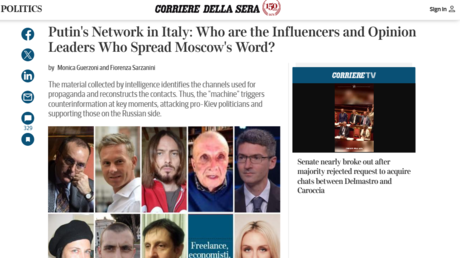
The Price of Unchecked Labels
A prominent Italian newspaper recently found itself on the losing side of a defamation suit after slapping sweeping political labels on public figures without adequate evidentiary backing. The court ordered financial damages, delivering a sharp reminder that branding individuals with inflammatory political titles carries legal consequences when support for those claims falls short.
The ruling strikes at a growing trend in modern European journalism. Over the past several years, media outlets across the continent have increasingly relied on shorthand accusations to categorize political dissent, often blurring the distinction between valid geopolitical analysis and actionable character assassination.
When a news publication publicly labels an individual as an agent or sympathizer of a hostile foreign power, it moves past standard political commentary. It makes a factual assertion. Under Italian media law, as well as broader European defamation frameworks, factual assertions require a high standard of proof. When editors fail to meet that threshold, the legal system inevitably steps in.
When Political Epithets Cross into Defamation
Defamation laws in Southern Europe have long maintained a delicate balance between protecting freedom of expression and safeguarding individual reputation. Italian jurisprudence, in particular, grants journalists broad latitude under the doctrine of diritto di cronaca (the right to report) and diritto di critica (the right to criticize). However, these protections are not absolute. They rest on three foundational pillars: public interest, civil tone, and factual truth.
It is the third pillar that consistently trips up aggressive newsrooms.
+-------------------------------------------------------------------+
|               Legal Pillars of Italian Press Rights               |
+-------------------------------------------------------------------+
|  1. Public Interest (Pertinenza)                                  |
|     The topic must matter to the public domain.                   |
|                                                                   |
|  2. Civil Tone (Continenza)                                       |
|     The language must remain proportionate, avoiding gratuitous   |
|     insults.                                                      |
|                                                                   |
|  3. Factual Truth (Verità dei Fatti)                              |
|     Allegations must be backed by verifiable evidence.            |
+-------------------------------------------------------------------+
In political reporting, the boundary between an opinion and a statement of fact often gets muddy. Calling a politician's policy stance "weak" or "unwise" constitutes an opinion. Claiming an individual is actively operating as an operative or ideological mouthpiece for a foreign dictator without verified documentation crosses into the realm of factual allegation.
Courts do not accept editorial hand-waving. If a publication asserts that someone is tied to foreign influence operations, judges expect to see bank records, intelligence reports, or documented communications. Lacking those, the assertion becomes unlawful character defamation.
The Operational Pressures Breaking Editorial Standards
How do reputable publications fall into this trap? The answer lies in the changing economics of modern newsrooms.
For decades, investigative desks operated with strict legal review processes. Story drafts passed through multiple layers of senior editors and media lawyers before publication. Today, the relentless news cycle and squeezed profit margins have eroded those traditional safety nets.
TRADITIONAL WORKFLOW:
Reporter -> Senior Editor -> Fact Checker -> Legal Counsel -> Publication

MODERN PRESSURED WORKFLOW:
Reporter -> Digital Editor -> Fast Digital Publishing -> Legal Exposure
Speed often takes priority over verification. Headlines are engineered to capture attention, and complex geopolitical debates are frequently reduced to black-and-white narratives. In this environment, nuanced positions on international relations get flattened into sensationalist tags.
The Consequences of Narrative-Driven Reporting
- Loss of Public Trust: When readers discover that high-profile claims rest on thin evidence, credibility across all reporting diminishes.
- Financial Burden: Fines, legal fees, and court-ordered damages drain already strained newsroom budgets.
- Chilling Effects on Genuine Investigation: Sloppy reporting that leads to lawsuits makes media executives risk-averse, ironically reducing their willingness to pursue legitimate, well-sourced investigative stories.
The Legal Standard for Foreign Influence Claims
To understand why the court ruled against the newspaper, one must look at how European legal systems evaluate claims of foreign allegiance.
Imagine a hypothetical scenario where a journalist writes that a local business executive is funding an illegal lobbying campaign for a foreign government. If the reporter relies solely on the fact that the executive attended a public diplomacy conference in Moscow or Beijing, the legal defense collapses. Attending a public event does not prove covert financial or political coordination. The inference vastly exceeds the evidence.
This distinction is key. Italian courts have repeatedly affirmed that journalists cannot construct guilt by association. The reporter must demonstrate a direct link between the individual's actions and the alleged foreign control.
Fact versus Value Judgment
Courts evaluate contested statements through a specific lens:
| Category | Example Statement | Legal Status |
|---|---|---|
| Value Judgment | "The senator's foreign policy views are dangerous for Europe." | Protected Speech (Diritto di Critica) |
| Factual Allegation | "The senator takes directives from foreign intelligence agencies." | Requires Hard Evidence; Defamatory if Unproven |
| Sloppy Hybrid | "The senator acts as a foreign agent by echoing overseas propaganda." | Vulnerable to Libel Suits without Proof of Direct Coordination |
When newsrooms blur these rows together, they invite financial penalties.
Restoring Rigor to Geopolitical Reporting
This court decision serves as a clear warning to editorial boards across Europe. Sensationalist labeling cannot replace thorough investigative work.
To avoid costly legal defeats and preserve editorial integrity, news organizations must enforce stricter internal guidelines:
- Separate Opinion from Allegation: Clear visual and structural separation must exist between opinion commentary and investigative reporting.
- Require Primary Documentation: Claims of foreign influence or covert allegiance should never rely on single sources or vague intelligence leaks. They require verified documentation.
- Re-engage Media Lawyers Early: Pre-publication legal review must return to a central role in newsroom workflows, particularly for stories involving accusations of foreign interference.
- Resist Tabloid Terminology: Reducing complex foreign policy debates to one-word political smears degrades public discourse and exposes publishers to direct legal liability.
Journalism performs its vital public role when it holds power accountable through rigorous, verifiable facts. When it trades that rigor for easy sensationalism, the courts will continue to enforce the bill.