Saudi Arabia is no longer just betting on oil. The Kingdom has activated five new railway freight routes designed to bypass the traditional, sluggish maritime bottlenecks of the region. By connecting key industrial hubs directly to the Arabian Gulf and Red Sea ports, Riyadh is slashing cargo transit times by half and reducing logistics costs by 30 percent. This isn't a minor infrastructure update. It is a calculated move to transform the Saudi desert into a global logistics clearinghouse that challenges the dominance of traditional shipping lanes.
The Saudi Railway Company (SAR) has effectively integrated the North and East networks, creating a spiderweb of tracks that link the Ras Al-Khair and King Abdulaziz ports to the industrial heartlands of Riyadh and Jubail. For decades, the region relied on a fragile network of trucks and a single, aging rail line. That era has ended. The new routes are the skeletal structure of a much larger ambition to handle over 50 million tons of cargo annually, shifting the economic gravity of the Gulf.
The Strategy Behind the Steel
The logic is simple. Ships are slow and ports are congested. By moving containers from the water to the rail as quickly as possible, Saudi Arabia is creating a "dry bridge" that could eventually link the Mediterranean to the Persian Gulf. This isn't about vanity projects. It is about cold, hard efficiency.
Moving a shipping container from the Port of Dammam to the center of the country by truck takes days of coordination, fuel, and labor. The rail system does it in hours. This efficiency isn't just a perk for local businesses; it is a lure for international corporations looking to relocate manufacturing bases. If you can move parts and finished goods across a continent-sized country with the precision of a Swiss watch, you become the default choice for global supply chains.
Displacing the Trucking Monopoly
The most immediate casualty of this expansion is the long-haul trucking industry. For fifty years, the "Land Bridge" of the Middle East was composed of thousands of diesel trucks clogging the highways between Jeddah and Dammam. It was inefficient, dangerous, and expensive.
Rail travel is inherently more scalable. A single freight train can carry the load of 300 trucks. This massive consolidation reduces carbon emissions significantly—a point the Kingdom is eager to highlight—but more importantly, it stabilizes the cost of goods. Trucking rates fluctuate with fuel prices and driver shortages. Rail offers a predictable, fixed-cost alternative that allows for long-term industrial planning.
The five new routes specifically target the "missing links" in the industrial chain. By connecting the mining regions in the north to the processing plants on the coast, the Kingdom is vertically integrating its economy. You cannot build a modern industrial state if your raw materials are stuck in a traffic jam on a desert highway.
The Geopolitical Chessboard
This rail expansion does not exist in a vacuum. It is a direct response to the shifting trade maps of the 21st century. As China pushes its Belt and Road Initiative and India explores the Middle East-Europe Economic Corridor (IMEC), Saudi Arabia is ensuring it owns the physical tracks that these global powers must use.
Control over logistics is control over trade. By building these routes now, Riyadh is making itself indispensable. It is one thing to be a gas station for the world; it is another to be the world's warehouse. The ports of Jazan, Jeddah, and Yanbu on the Red Sea are being modernized to sync perfectly with the rail schedules, creating a fluid movement of goods that ignores the traditional friction of borders and bureaucracy.
Breaking the Port Congestion
One of the overlooked factors in this rollout is the relief of port "dwell time." When cargo sits at a dock, it loses value. The new rail routes are designed for rapid evacuation. As soon as a crane lifts a container from a ship, it can be slotted onto a train and moved hundreds of miles inland before the ship has even finished unloading its remaining hold.
This speed changes the math for retailers and manufacturers. High-value electronics and perishable industrial components cannot afford to sit in the 45-degree heat of a Saudi summer at a seaside terminal. The rail network acts as a giant, refrigerated artery, keeping the pulse of commerce moving at a constant rate.
Technical Hurdles and Desert Realities
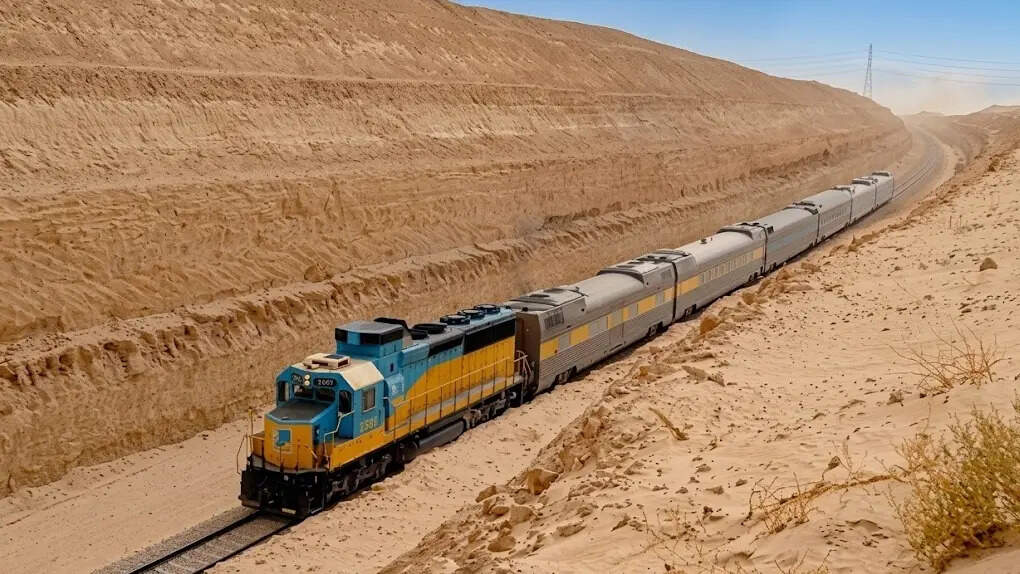
Building thousands of miles of track in one of the harshest environments on earth is not without its failures. Sand is the enemy of the locomotive. Shifting dunes can bury tracks in hours, and the abrasive nature of desert dust wreaks havoc on engine intakes and braking systems.
The Kingdom has invested heavily in "sand mitigation" technology—massive physical barriers and aerodynamic track designs that prevent buildup. They are also deploying sensor-heavy maintenance trains that predict track deformation before it causes a derailment. This is a high-stakes engineering gamble. If the sand wins, the multi-billion dollar investment becomes a literal monument to hubris.
Current data suggests the engineering is holding. The reliability of the North-South line has proven that modern rail can survive the Empty Quarter. The five new routes are the beneficiaries of a decade of trial and error in the dirt.
Why Investors are Watching the Jubail Link
Of the five routes, the connection to Jubail Industrial City is the most critical. Jubail is the largest industrial city in the world. It produces the petrochemicals that end up in everything from your smartphone to your toothbrush.
Until now, getting those chemicals to the global market involved a fragmented system of pipelines and short-range transport. The new rail link plugs Jubail directly into the international shipping veins. It allows for "unit trains"—massive, single-commodity shipments—to move directly from the factory floor to the ship's side. This reduces the "touch points" where errors and delays occur.
The Economic Ripple Effect
When logistics costs drop, the price of everything drops. This rail expansion is a hidden subsidy to every Saudi consumer and a massive competitive advantage for every Saudi exporter. It creates a vacuum that sucks in foreign direct investment.
Think about a car manufacturer. If they build a plant in the middle of the Arabian Peninsula, they need to know that parts from Germany can arrive via the Red Sea and steel from the local mills can arrive via rail without a single hitch. The five new routes provide that certainty. They provide the "guaranteed arrival" window that modern just-in-time manufacturing requires.
The Human Element
Beyond the steel and the stone, there is a massive shift in the labor market. The Kingdom is rapidly training a new generation of Saudi rail engineers, dispatchers, and logistics managers. This isn't just about importing foreign technology; it's about building a domestic industry that can maintain it.
The Saudi Railway Polytechnic in Qassim is churning out technicians at a record pace. These aren't just desk jobs. These are the people who will run the automated switching yards and manage the AI-driven scheduling systems that keep the trains from colliding in the dark.
Counter-Arguments and Risks
Critics point out that the world is currently oversupplied with logistics capacity. They argue that if global trade slows down, these tracks will become "ghost rails." There is also the risk of regional instability. A rail line is a long, vulnerable target.
However, the counter-argument is that trade doesn't stop; it just finds the path of least resistance. By making the Saudi route the fastest and cheapest, Riyadh ensures that even in a global downturn, their tracks are the ones that remain occupied. They are competing on price and speed, the two things that matter most when margins are thin.
The Integration of Sea and Land
The ultimate goal is a concept called "Synchromodality." This is the ability to switch between sea, rail, and road instantly based on real-time data. If a port in the south is backed up due to a storm, the system automatically reroutes cargo to a northern port and adjusts the rail schedule to meet it.
The five new routes are the physical manifestations of this data-driven dream. They are not isolated lines on a map; they are the hardware for a sophisticated software layer that treats the entire country as a single, giant terminal.
Beyond the Horizon
The next phase is already in motion. The Saudi Land Bridge project aims to eventually connect the West and East coasts with a double-track line capable of moving millions of containers a year. This would effectively turn the entire country into a shortcut for global trade, potentially shaving a week off the journey between Asia and Europe.
The five routes launched today are the proof of concept. They demonstrate that the Kingdom can execute complex, multi-modal infrastructure projects on time and at scale. They signal to the world that the "oil kingdom" is rebranding as the "logistics kingdom."
Investors and logistics firms should stop looking at the Saudi interior as a vast, empty space. It is becoming a high-speed corridor, a 2,000-mile conveyor belt that connects the world’s most important waterways. The companies that realize this first will be the ones who dominate the next decade of Middle Eastern trade.
The tracks are laid. The engines are humming. The desert is no longer an obstacle; it is the highway. Companies looking to minimize their exposure to the volatile maritime bottlenecks of the Suez or the Cape of Good Hope now have a legitimate, overland alternative. The era of the truck is fading, and the age of the iron artery has arrived. Any business plan for the region that doesn't account for this rail-first reality is already obsolete.
Move your cargo to the tracks or get left in the dust.