The sea does not care about flags.
When a hull fractures under the sudden, violent bite of a projectile, the red-and-white banner of Turkey painted on the side ceases to be a diplomatic shield. It becomes a target. Or, worse, collateral.
Picture a sailor standing on the bridge of a bulk carrier on a quiet morning. The water is a flat, cold gray, mirroring a sky heavy with the promise of winter. Coffee cools in a plastic mug. The routine of navigation—checking coordinates, monitoring the engine hum, watching the distant, hazy smudge of a coastline—lulls the mind into a false sense of routine. This is not a warship. It carries no missiles, no radar-guided cannons, no young recruits trained to duck incoming fire. It carries steel coils, or grain, or coal. It carries the quiet commerce that keeps cities fed and factories breathing.
Then comes the sound.
It is not the cinematic whistle of a bomb falling from the clouds. It is a sharp, mechanical scream followed by an impact that vibrates through the soles of your shoes, rattling teeth and shattering glass. In a fraction of a second, the mundane reality of maritime trade evaporates. Fire blooms against the steel superstructure. Alarms shriek. Smoke spills across the deck, thick and greasy, smelling of burning fuel and ruined ambition.
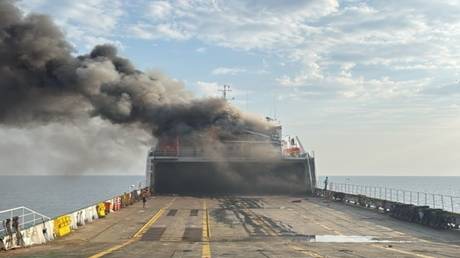
This was the terrifying reality for the crew of a Turkish-owned cargo ship recently struck near a Russian port in the Black Sea.
The Shifting Geography of Fear
For months, the narrative of the conflict in Eastern Europe has centered on trenches, drone-filled skies, and artillery duels across muddy fields hundreds of miles inland. We watch the maps change by millimeters on evening broadcasts. We track the flow of heavy armor and billions in aid.
We forget the water.
The Black Sea has quietly transformed into one of the most volatile choke points on the planet. Every vessel cutting through these waters is playing a high-stakes game of maritime roulette. To understand the vulnerability of these commercial ships, you have to look at the anatomy of modern navigation. Modern cargo ships are designed for efficiency, not combat. They are floating office buildings powered by massive, low-speed diesel engines, operated by lean international crews—often numbering fewer than twenty souls.
When tensions escalate and asymmetric weapons like uncrewed surface vessels or coastal missiles enter the equation, these civilian ships become sitting ducks.
Consider the hypothetical perspective of a vessel master operating in these contested corridors. Captain Ahmet has spent thirty years at sea. He has weathered typhoons in the Pacific and engine failures in the middle of the Atlantic. He knows every rivet of his ship. But nothing in his maritime academy textbooks prepared him for calculating the trajectory of a suspected drone strike while navigating waters choked with drifting sea mines and electronic jamming that blinds his GPS.
"We are just trying to deliver cargo," a Black Sea merchant sailor might tell you, if they had the luxury of speaking freely without risking their livelihood or safety. "We aren't politicians. We are just trying to make it home to our families in Istanbul or Odessa."
The Ripples Far Beyond the Hull
When a Turkish cargo ship takes a hit near a Russian port, the shockwave travels far beyond the immediate blast radius.
Global trade is a delicate, interconnected web of trust and insurance rates. The moment a civilian vessel is struck, insurance underwriters in London instantly recalculate the price of risk. Premiums for voyages through the Black Sea skyrocket. Shipowners hesitate. Crews refuse to sign contracts for routes deemed too hazardous.
Suddenly, the price of wheat in North Africa climbs. Industrial supplies in Southern Europe stall. The invisible machinery of globalization stutters because a single explosion tore through the deck of a freighter thousands of miles away.
This is the hidden cost of modern conflict. It bleeds out from the front lines, spilling into international waters, threatening neutral trade, and turning ordinary merchant mariners into unwitting participants in a geopolitical chess match.
The attack near the Russian port was not an isolated incident; it was a symptom of a widening gyre. As long as critical export hubs remain contested and naval blockades and counter-blockades define the coastline, the risk to commercial shipping will only compound. Governments issue travel advisories. Diplomatic notes are exchanged with stern language. But none of those pieces of paper can stop a projectile heading toward a civilian hull in the dead of night.
The Silence After the Sirens
Back on the damaged vessel, the immediate chaos eventually gives way to a different kind of terror: the assessment of the damage.
Fires are extinguished. Holes in the bulkhead are patched with temporary plates and prayer. The injured are tended to, wrapped in thermal blankets while waiting for tugs or coast guard assistance. The radio crackles with terse inquiries from nearby authorities, each side blaming the other, while the crew simply stares at the twisted metal where their galley or cabin used to be.
The ship may eventually limp into port or be towed to a safe anchorage. The politicians will issue their statements, spinning the event to fit their respective strategic doctrines.
But out on the dark, restless water, another captain is currently looking at his radar screen, gripping the wheel a little tighter, wondering if his ship will be the next invisible casualty of a war that refuses to stay on the map.