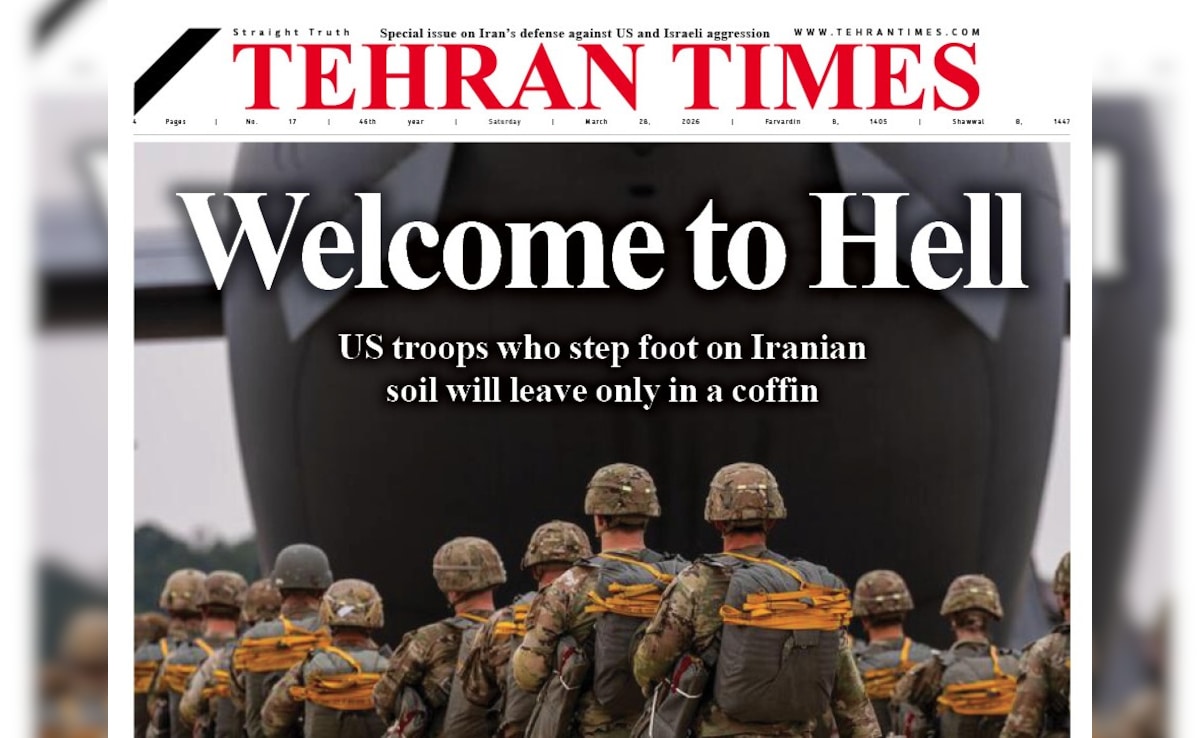
The headlines are vibrating with the same tired script. Iran’s state media screams about "coffins" and "hell," and Western pundits dutifully play along, sketching out a map of a bloody, decades-long ground invasion of the Iranian plateau. They want you to visualize 1960s-style troop surges and urban meat grinders. It is a cinematic hallucination that serves both the IRGC’s propaganda machine and the American military-industrial complex.
But here is the reality: The era of the "boots on the ground" invasion for regime change is dead. Iran knows it. The Pentagon knows it. The only person who doesn't know it is the reader currently being sold a narrative of inevitable carnage.
A ground invasion of Iran is not just a "bad idea." It is a logistical impossibility that neither side actually intends to fight. By focusing on the "coffin" rhetoric, we are ignoring the much more dangerous, invisible war that has already begun.
The Geography Myth and the Logistics Trap
The common argument suggests that Iran’s mountainous terrain—the Zagros range—is a natural fortress that would swallow an invading army. This is true, but it is also irrelevant.
Invasions are designed to seize and hold territory to force a political concession. In 2026, you don't need to march an infantry division through a mountain pass to collapse a state. The obsession with "ground war" ignores the fact that modern power projection is about network degradation, not flag-planting.
If a conflict erupts, it won't look like the 2003 Iraq surge. It will look like a total systemic blackout. We are talking about the precision-guided erasure of every refinery, every port, and every server farm that keeps the Islamic Republic’s economy breathing. You don't invade a country that you can simply disconnect from the 21st century.
The "Welcome to Hell" rhetoric is a distraction. It invites the West to worry about the cost of occupying Tehran, which prevents us from discussing the far more likely scenario: a high-intensity, remote decapitation of the state's ability to function.
The IRGC’s Paper Tiger Defense
Why does Tehran lean so hard into the "coffin" narrative? Because it’s the only card they have left.
The Iranian military is built for internal suppression and asymmetric harassment, not peer-to-peer conventional warfare. Their air force is a flying museum of 1970s American hardware and questionable domestic reverse-engineering. Their navy is a collection of fast boats that are terrifying to a defenseless oil tanker but are essentially target practice for a modern Carrier Strike Group.
By shouting about a ground war, Iran is trying to leverage the "Vietnam Ghost"—the Western public’s deep-seated fear of body bags and endless quagmires. It is a psychological shield. They want the American voter to think that the only options are "Do Nothing" or "Third World War."
It is a false binary.
The IRGC doesn't want a ground war. They know that if American boots hit the ground, the regime has already lost the ability to defend its borders. Their goal is to make the idea of intervention so unpalatable that they are given a free hand to dominate the Persian Gulf via proxies. They are using your own empathy and risk-aversion against you.
The Nuance of the Proxy Trap
The real threat isn't a "coffin" for an American soldier in the Iranian desert; it's the slow-motion collapse of global trade through the Strait of Hormuz.
While the media focuses on the bombastic threats of invasion, the real war is being fought with $20,000 drones and magnetic mines. This is where the "lazy consensus" of the "Welcome to Hell" headline fails. It focuses on the wrong kind of "hell."
The "hell" isn't an IED on a road in Fars province; it's a global supply chain seizure that spikes gas prices to $10 a gallon and turns the Persian Gulf into a dead zone. The IRGC doesn't need to win a battle. They just need to make the cost of insurance for a single tanker so high that the global economy begins to hemorrhage.
- If you're a Western policymaker, you're not planning for an invasion.
- If you're an Iranian general, you're not preparing for an invasion.
- You're both preparing for a siege of the global energy flow.
The Misguided "People Also Ask" Trap
Wait, doesn't Iran have the most advanced ballistic missile arsenal in the Middle East? Yes, they do. But let’s dismantle the premise of that question.
They have numbers, sure. But numbers don't win against integrated air defenses like the Terminal High Altitude Area Defense (THAAD) and Patriot batteries. The Iranian missile threat is designed for a single purpose: saturation. They want to fire 1,000 missiles and hope 10 get through.
Is it dangerous? Absolutely. Is it a reason to fear a ground war? No.
The missile threat actually increases the likelihood that any conflict would be exclusively air- and sea-based. If you have a missile problem, you don't send a tank; you send a stealth bomber to the source. The IRGC’s "coffin" warning is a psychological deterrent, but it is a strategic liability. By highlighting their willingness to fight a ground war, they are admitting their lack of air and naval parity.
The Cost of the Wrong Conversation
We are wasting intellectual capital on the "ground war" bogeyman. It is a distraction from the real, immediate dangers:
- Cyber-Kinetic Convergence: The potential for Iran to retaliate for sanctions by crippling the Western financial sector or power grids.
- State Collapse: The risk that a "decapitation" strike creates a power vacuum that turns Iran into a massive version of Libya—a 1.6-million-square-kilometer source of instability and migration.
- Nuclear Breakout: The fact that the rhetoric of war often accelerates the very outcome it is designed to prevent.
When you see a headline about "Welcome to Hell" or "Coffins," you should see a regime that is terrified of the alternative. They are terrified of a war they cannot see. They are terrified of a war that is fought from 50,000 feet and via fiber-optic cables.
They want a ground war because they think they can win the PR battle of a ground war. They know they cannot win a war of technology.
Don't buy into the 20th-century script. The "hell" isn't a desert march. The "hell" is the total isolation and systemic dismantling of a nation-state without a single boot ever touching the sand.
Stop worrying about the coffins. Start worrying about the switch.