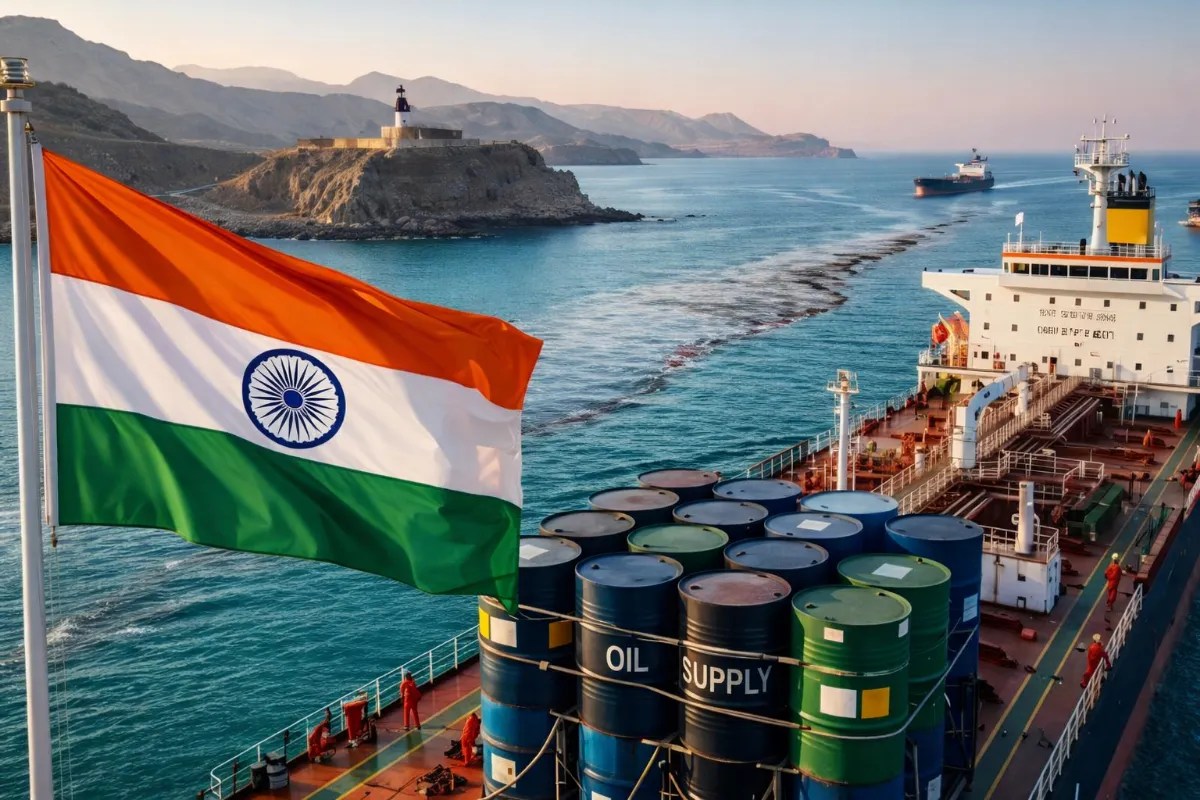
A massive container ship, the length of three football fields, sits in the deep blue waters where the Persian Gulf squeezes into the Gulf of Oman. Under the blistering mid-afternoon sun, the metal deck is hot enough to sear skin. In the belly of this beast are millions of barrels of crude oil, bound for the refineries of Jamnagar or Mumbai. On the bridge, the captain stares at a computer screen. He is not looking at weather charts or fishing boats. He is looking at a coordinate on a map where the sea shrinks to a bottleneck just twenty-one miles wide.
This is the Strait of Hormuz.
For decades, this narrow strip of water has been the jugular vein of the global economy. One-fifth of the world’s petroleum passes through here. If you drive a car in Delhi, heat a home in Tokyo, or buy goods shipped across the ocean, your life is quietly tethered to what happens in this tiny geographic choke point.
Now, the rules of this vital passage are being rewritten by executive decree from half a world away, and the bill is about to land on your doorstep.
The sudden shift arrived on a Monday, delivered via the modern arena of international diplomacy: a social media post and a cable news phone-in. The White House announced that the United States military is reinstating a naval blockade targeted at Iranian ports. But it was the second part of the declaration that sent shockwaves through global shipping boardrooms. The U.S. declared itself the "Guardian of the Hormuz Strait." And protection, it turns out, is no longer free.
A twenty percent toll will now be levied on all eligible cargo passing through the strait. The justification is simple: if American warships are going to police the most volatile waters on Earth to keep trade flowing, the nations benefiting from that security must pay for it.
To understand the sheer scale of this move, consider a hypothetical merchant vessel named the Oceanic Venture. It carries a cargo of crude valued at fifty million dollars. Under the new mandate, simply passing through the Strait of Hormuz will require a ten-million-dollar wire transfer to the U.S. government. Shipping companies do not absorb ten-million-dollar fees. They pass them down the line. The refiner pays more for the crude; the distributor pays more for the fuel; and eventually, a commuter staring at a petrol pump in Bengaluru watches the digits spin faster than ever before.
But the real problem lies elsewhere. International maritime law has long operated on the principle of free passage through strategic straits. The International Maritime Organization has historically stood firm against charging transit fees for international navigation. By declaring a unilateral toll, the U.S. is not just taxing oil; it is upending the fragile, unwritten agreements that have kept global trade predictable since the end of the Second World War.
Iran’s response was swift and uncompromising. Its military command warned that any attempt by American forces to control the strait without authorization would be confronted. They warned regional neighbors that cooperating with the new U.S.-led regime would be viewed as an act of hostility.
This is not a theoretical debate for academics. It is a highly volatile stand-off with immediate consequences for nations that rely heavily on imported energy.
Consider India. The country is the world’s third-largest consumer of crude oil, relying on imports for nearly eighty-eight percent of its needs. Historically, about half of that supply has traveled through the Strait of Hormuz. When global oil prices spike, the Indian economy feels the squeeze almost instantly. A sustained disruption, or a permanent twenty percent tariff on shipments, threatens to raise domestic inflation, push up the cost of everyday goods, and strain the national budget.
India now finds itself walking a diplomatic tightrope. On one side is its strategic partnership with Washington; on the other is its essential relationship with Middle Eastern energy producers. While foreign diplomats exchange statements, shipping companies are forced to make immediate, costly decisions.
Do they pay the twenty percent toll and accept the massive dent in their margins? Do they attempt to bypass the strait entirely, routing ships on a weeks-long detour around the entire continent of Africa? Or do they gamble on the hope that the political rhetoric will soften before the first boarding parties arrive to collect the fee?
None of these choices are good. Each one adds friction to a global supply chain that is already stretched to its limits.
Imagine the captain of the Oceanic Venture again. The sun is setting now, casting long, dark shadows across the water. The crew watches the horizon, knowing that somewhere just beyond the curve of the Earth, grey warships are tracking their path. The ship carries cargo, but it also carries the quiet, invisible anxieties of millions of people who have never heard of the Strait of Hormuz, yet depend on its peace for their survival.