The Morning Ritual
Elias grips the steering wheel of his weathered sedan, the plastic cold against his palms in the pre-dawn chill of a Tuesday. He watches the red digital glow of the gas station sign across the street. The numbers have climbed again. It is a slow, rhythmic crawl upward that feels less like market volatility and more like a tightening vice. For Elias, a delivery driver whose margins are measured in cents per mile, those shifting digits are not a headline. They are a direct tax on his daughter’s piano lessons. They are the reason the "check engine" light remains an unaddressed anxiety on his dashboard.
Half a world away, the horizon is not glowing with the neon of a gas station, but with the smoky haze of a conflict that refuses to end. The headlines call it a geopolitical stalemate. The markets call it a supply-side shock. But for the people living under the shadow of the Strait of Hormuz, and for those like Elias who feel the aftershocks in their bank accounts, it is simply the weight of a world that runs on a finite, volatile liquid.
Crude oil has breached a four-year high. This is not a drill. It is the culmination of a long-simmering friction in the Middle East that has finally boiled over, threatening to drag on for months, or perhaps years, longer than anyone predicted.
The Chokepoint of the World
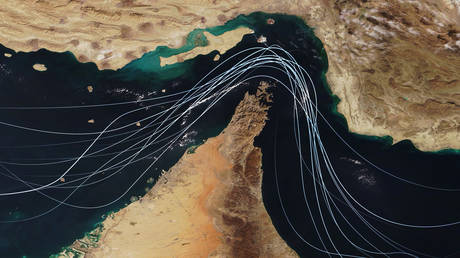
To understand why a skirmish in a desert or a drone strike on a refinery matters to a driver in a suburban cul-de-sac, one must look at a map. Specifically, a narrow stretch of water known as the Strait of Hormuz. Imagine a garden hose that provides water to an entire neighborhood. Now imagine a heavy boot pressing down on that hose.
Nearly a fifth of the world’s total oil consumption passes through this single, precarious artery. When tensions between Iran and surrounding powers escalate, the boot begins to press down. The "war" the headlines mention isn't just about territory or ideology; it is a battle over the valve of the global economy. As the conflict drags on, the uncertainty acts like a fever. Markets hate uncertainty. They price in the fear of a total shutdown, sending the cost of a barrel of Brent crude into territory we haven't seen since the world felt much more stable.
The facts are stark. Production in the region has slowed as insurance premiums for oil tankers skyrocket. Shipping companies are no longer willing to gamble their vessels on a "maybe." They are taking the long way around, or they are waiting in port. Every hour of delay, every mile of a detour around the Cape of Good Hope, adds a hidden surcharge to every gallon of fuel, every plastic toy, and every crate of produce shipped across the ocean.
The Hypothetical Kitchen Table
Consider a hypothetical family, the Millers. They don't track the price of crude on a Bloomberg terminal. They track it at the grocery store. Because oil is not just fuel for cars; it is the lifeblood of logistics.
When the price of a barrel jumps, the cost of the diesel for the truck carrying the Millers’ milk jumps. The cost of the petroleum-based fertilizer used to grow their corn jumps. The cost of the plastic packaging for their cereal jumps. By the time the Millers sit down for breakfast, the conflict in the Middle East has already reached into their pockets and taken five dollars.
This is the "invisible stake." We often talk about war in terms of casualties and borders, and rightly so. But there is a secondary, silent casualty: the global standard of living. When energy becomes expensive, everything else becomes expensive. Poverty deepens. Innovation slows because capital is diverted from research into basic survival.
Why This Time is Different
We have seen oil spikes before. We saw them in the 1970s, in the early 2000s, and briefly during the onset of more recent regional domestic shifts. But the current four-year high is underpinned by a terrifying realization: there is no "Plan B" ready to take the hit.
In previous decades, spare capacity in other parts of the world could be ramped up to offset a Middle Eastern shortfall. Today, the global energy transition is in a delicate, teenage phase. We are moving toward renewables, but we aren't there yet. We have divested from old-school fossil fuel infrastructure faster than we have built the green grid.
The result is a fragile system with no shock absorbers.
When the Iran conflict threatened to become a "forever war," the realization hit the trading floors like a physical blow. The reserves are lower than they should be. The investment in new drilling has been stagnant. We are leaning on a rickety bridge just as the wind begins to howl.
The Emotional Cost of the Grid
There is a specific kind of exhaustion that comes with watching the world's gears grind. It is the exhaustion of the small-business owner who has to tell her employees there won't be bonuses this year because the utility bills have doubled. It is the frustration of the commuter who realizes that two hours of their workday are now dedicated solely to paying for the ride to get there.
The "human element" is often lost in the talk of "Brent" vs "WTI" (West Texas Intermediate) price points. We use $inline$P = S/D$inline$ to explain price ($P$) as a function of supply ($S$) and demand ($D$), but that formula doesn't capture the sigh of a father looking at a heating bill in October. It doesn't capture the fear of a manufacturer wondering if they can keep the lights on through the winter.
The conflict involving Iran is not a distant movie. It is a local event. It lives in the price of a bus ticket in London, a bag of rice in Manila, and a gallon of 87-octane in Ohio.
The Persistence of the Flame
The war shows no signs of a clean ending. Diplomacy is a language that seems to have been forgotten in the region, replaced by the dialect of drones and sanctions. As long as the threat of a closed strait remains, the "risk premium" on oil will stay.
We are living through a period where the ghost of the 20th century—the total reliance on a single geographic region for energy—is haunting the 21st. We thought we had moved past this. We thought the "shale revolution" or the "solar boom" had insulated us. We were wrong. We are still tethered to the desert sands by a thousand miles of steel pipe.
The digits on the sign across from Elias’s car finally stop flickering. They settle on a number that makes him winced. He turns the key. The engine turnovers, a series of controlled explosions fueled by the very liquid that is currently destabilizing the globe. He pulls out into traffic, one of millions of people playing their part in a story they didn't write, paying for a war they didn't start, hoping that tomorrow, the red numbers might finally move in the other direction.
The sun begins to peek over the horizon, a pale, cold yellow. It offers light, but for now, it offers no heat to the engine. For that, Elias remains a hostage to the geography of a land he will never visit, and a conflict that seems determined to outlast his patience. He drives on, the hum of the road a constant reminder that in a world of high-tech dreams, we are still very much at the mercy of the ancient, black fire buried beneath the earth.